ZIP Screens vs Cable-Guided Outdoor Blinds: Which Fits Your Project?
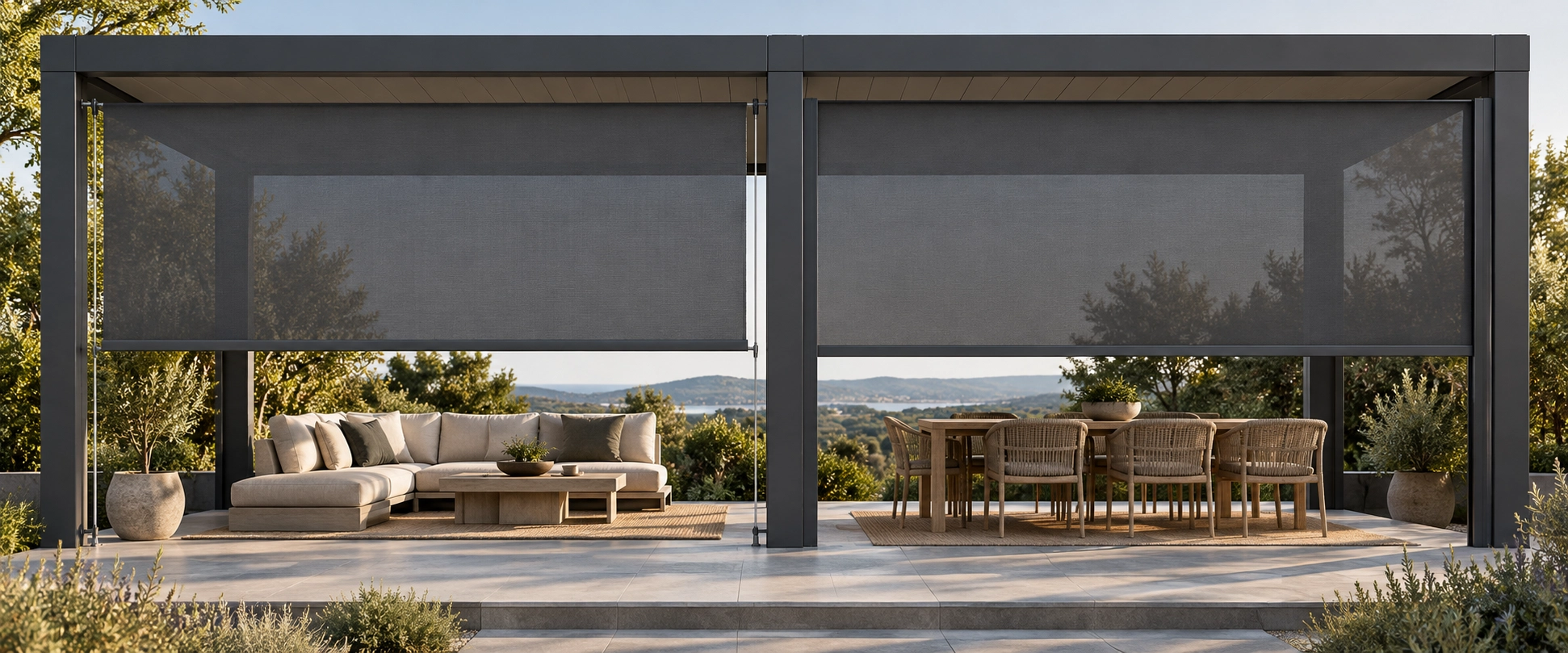
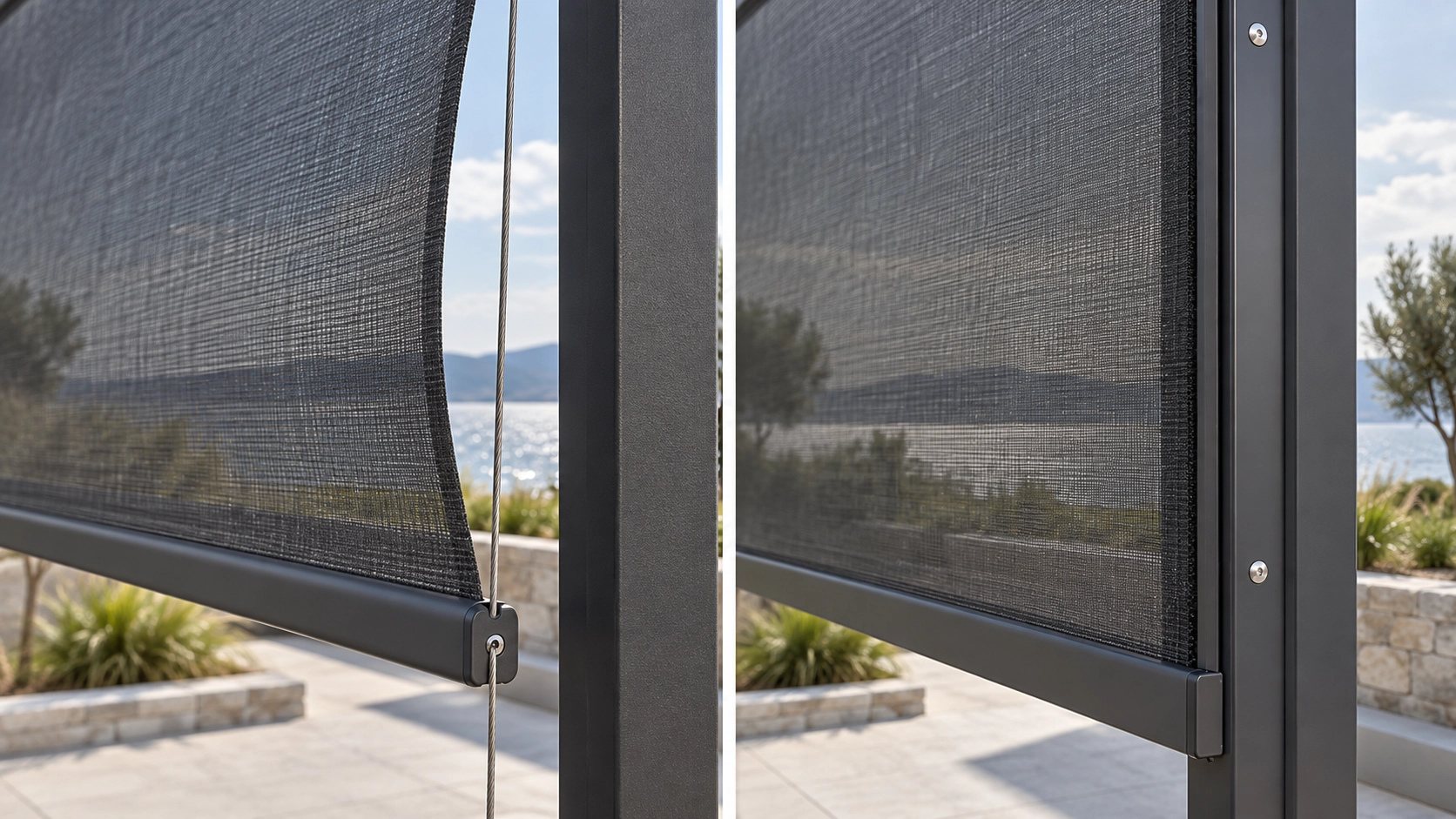
A cable-guided blind and a ZIP screen can both shade a patio. Their difference becomes obvious when wind reaches the fabric: a cable system guides the bottom bar while leaving the fabric sides open; a ZIP screen retains the fabric edges inside vertical tracks.
For a sheltered patio used mainly for sun control, the cable-guided option may be enough. For an exposed pergola, a restaurant terrace troubled by flapping, or an opening where side gaps defeat the purpose of the blind, start with a ZIP screen. Then check whether the opening and its supporting structure can accommodate the required system.
The Quick Decision
| Your main problem | Better starting point | What would change the decision? |
|---|---|---|
| Afternoon sun on a sheltered patio | Cable-guided blind | Move to ZIP if edge movement or side gaps become unacceptable. |
| Fabric slaps against posts in ordinary site winds | ZIP screen | Check the tracks, fixings and fabric configuration before ordering. |
| Drafts or insects enter around an outdoor dining area | ZIP screen | Inspect the gaps at the top and bottom as well as the sides. |
| No suitable posts or walls for continuous side tracks | Cable guidance, or ZIP with a designed sub-frame | The additional frame may change the budget and appearance. |
| High balcony, exposed corner or unusually large opening | Project-specific assessment | Require a complete configuration and relevant test evidence. |
Why ZIP and Cable-Guided Blinds Behave Differently in Wind
Cable guidance controls the bottom bar, not the entire fabric edge
On a typical cable-guided blind, a cable runs down each side and guides the bottom bar. The fabric's vertical edges remain free. Wind pushes against the fabric, which can bow away from the opening. Its edges may flutter, the gaps beside the posts can widen, and movement can reach the bottom bar and cables.
The load does not act on only two anchors. It passes through the fabric, roller tube, bottom bar, cable hardware and their fixings. But the absence of continuous restraint along the fabric sides explains why a cable-guided blind can provide adequate shade while offering limited control over side gaps and flapping.
For a cafe or bedroom balcony, noise can be the deciding issue. Repeated fabric movement, a bottom bar tapping a post, or a vibrating cable may be more disruptive than the visible deflection itself.
A ZIP screen restrains the edges along the opening
A ZIP screen holds each fabric edge within a side track. Under wind pressure, the fabric still bows; the retained edges help stop it from moving freely away from the sides. This gives the screen a more consistent side boundary and reduces uncontrolled fabric movement. For a fuller explanation of the mechanism, see what a ZIP screen is and how it works.
| System | Wind-load path |
|---|---|
| Cable-guided | Fabric → roller tube and bottom bar → cable hardware, brackets and fixings |
| ZIP | Fabric → retained fabric edges and tracks → track fasteners → supporting posts or walls |
This is the useful meaning behind the shorthand "point loads versus continuous edge restraint." A cable arrangement can create substantial reactions at its fixing points. A ZIP edge engages the track along its height, but the track still transfers load to the structure through individual fasteners. Weak posts or inadequate fixings remain a failure risk.
The load on the zipper cannot be calculated from blind area alone
Take a 3 m × 3 m (9.8 ft × 9.8 ft) screen. Its projected area is 9 m² (96.9 sq ft). At an assumed uniform pressure of 800 Pa (16.7 psf), the resultant pressure force is 7.2 kN (about 1,620 lbf).
For a ZIP screen, that figure is only the beginning of the analysis. As the fabric bows, pressure is resisted through tension in the fabric and reactions at its boundaries. The forces pulling on the retained edges depend on the fabric's curvature, initial tension, stiffness, dimensions and how the top and bottom are held. A flatter, more tightly restrained fabric can develop higher in-plane tension for the same transverse pressure. That is why the zipper-to-fabric joint, track insert, rail and fixings all matter.
Edge pull-out force is not a fixed multiple of the 7.2 kN resultant. They describe different forces, and a multiplier requires the screen geometry and test or engineering data. A useful assessment examines both fabric deformation and edge retention.
What Opening Size Calls for a Stronger Configuration?
Width is a useful screening number, but a supplier must check width and height together. A wider roller tube spans farther between its supports; a taller blind increases deployed fabric area and changes the amount of fabric wound inside the cassette.
- Under 4 m (13.1 ft) wide: NewHoo's WR100 commonly uses a 63 mm (2.48 in) roller tube.
- Over 4 m and up to 5.4 m (13.1–17.7 ft) wide: NewHoo's WR110 uses a 78 mm (3.07 in) double-layer tube in its published wider motorized configuration. That configuration is listed for heights up to 2.8 m (9.2 ft).
- A wider or taller combination beyond that configuration: Move to a larger or engineered system assessment. Do not simply retain the WR110 tube and increase the fabric drop.
- Long commercial openings: A connected system may solve transport and coverage problems, but the drawing must identify its sections, supports and assembly method. NewHoo's oversized-system guide explains why maximum width and maximum height cannot automatically be combined.
The extra height changes the area as well: 5.2 × 3.6 m = 18.72 m², compared with 5.2 × 2.8 m = 14.56 m². That is about 29% more deployed area at the same width. More fabric must also fit inside the cassette when the blind is raised.
For a separate market reference, Australian supplier DIY Blinds describes 4.2–4.5 m (13.8–14.8 ft) as a practical width range for a single manually operated Ziptrak blind, depending on fabric weight and drop. It points to operating weight and spring-balance calibration. That manual-operation reference should not be applied to every motorized track-guided system.
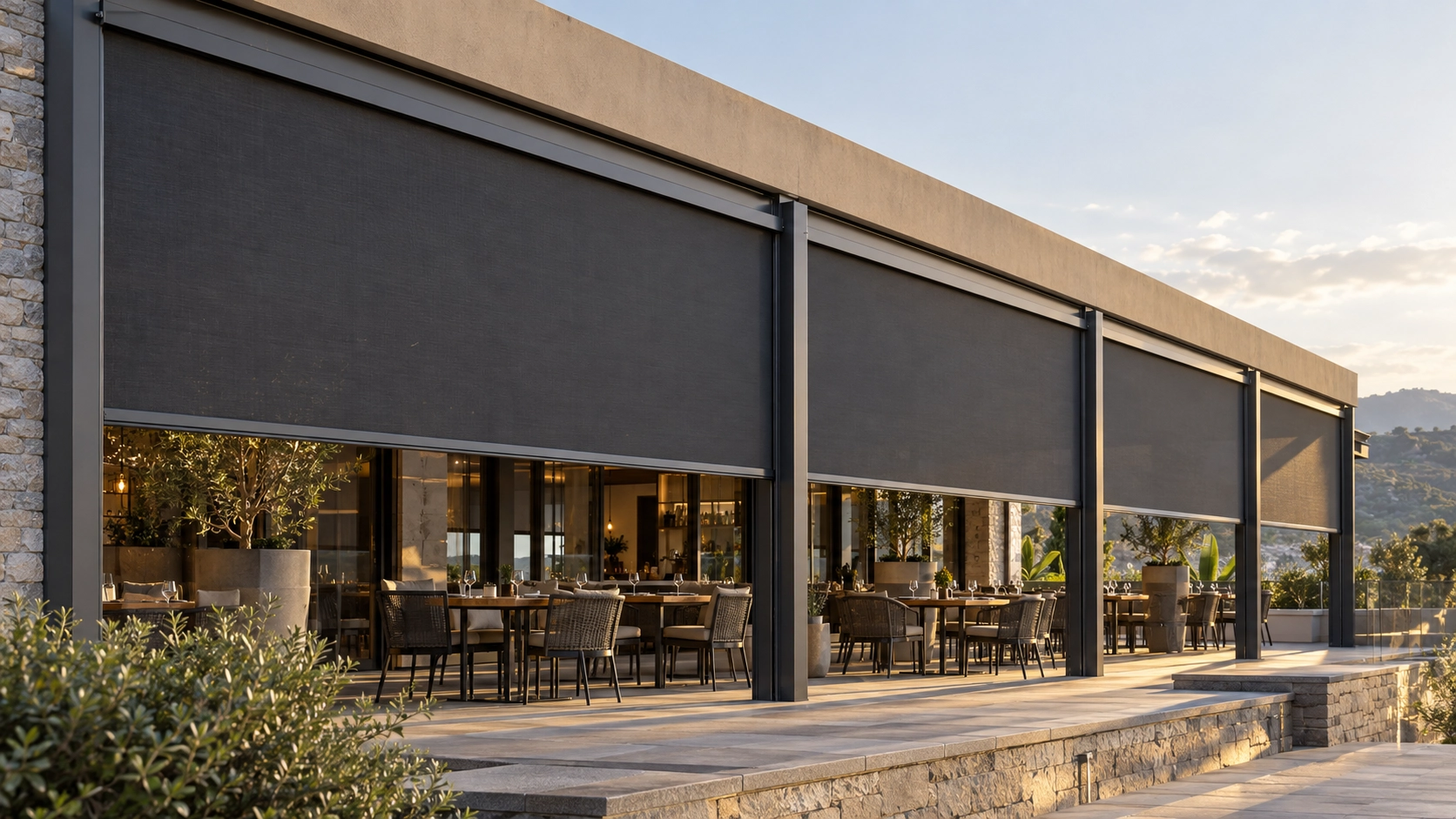
Large openings should be assessed as a system of spans, supports, tracks and fixings.
The Installation Benchmark: Can the Tracks Be Aligned and Supported?
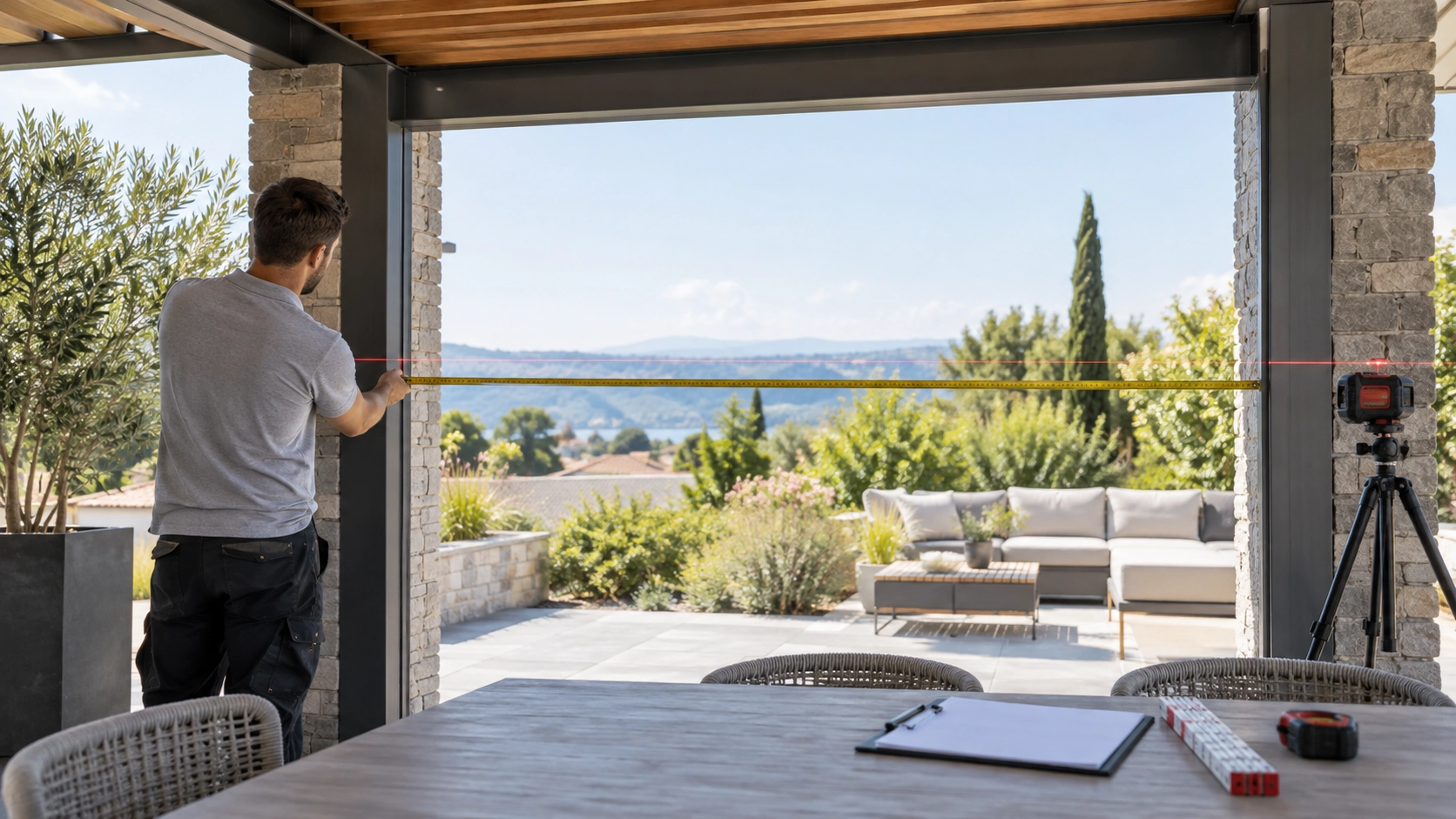
A ZIP screen needs a level cassette, aligned side tracks and suitable material behind the fixings. The buyer does not need to calculate a universal millimeter tolerance to identify a weak installation proposal.
A workable proposal contains:
- Measurements at three widths, three heights and both diagonals.
- A drawing showing final cassette and track positions.
- A named correction, such as an adjustable rail arrangement or sub-frame, where surfaces are uneven.
- The selected system's written alignment tolerance and fixing specification, followed by smooth operation across the full travel after installation.
An incomplete proposal gives only one width and height, says "the installer will adjust it on site," and leaves the fixing substrate or corrective frame unspecified.
NewHoo includes adjustable side-rail and installation-focused options in its range. Their purpose is to resolve real site conditions on the installation drawing, not to replace an accurate survey.
The final acceptance point is clear: the measured opening must meet the written requirements for the exact supplied model, and the assembled blind must travel its full height without binding, edge escape or repeated rubbing.
How Much More Does a ZIP Screen Cost?
The price difference is substantial enough to budget for early. Two published retail guides give starting ranges, with different markets and pricing units:
| Market and quoted scope | Cable-guided | ZIP or zipper-track |
|---|---|---|
| Brisbane, Australia: Awning Scape indicative motorized, installed pricing | A$300–450 per linear meter of width | A$500–700+ per linear meter of width |
| United States: BlindsMagic guide to motorized outdoor shades with materials and installation | US$10–20 per sq ft | US$25–35 per sq ft |
For a 3 m (9.8 ft) wide opening, the Brisbane ranges imply roughly A$900–1,350 for the cable-guided category and A$1,500–2,100+ for the zipper-track category. These are retail budgeting figures, not NewHoo factory quotations. The US guide comes from one seller, and its area-based prices should not be blended with Australia's width-based prices.
The decision is whether the difference buys a result the project needs. If the opening is sheltered and the blind only blocks low afternoon sun, full side tracks may bring little practical benefit. If edge movement regularly makes an outdoor seating area uncomfortable, the cheaper blind may fail the reason for purchasing it.
For an actual comparison, put the fabric, opening dimensions, motor, cassette, sub-frame, installation and warranty on the same line. A cable-guided price excluding installation should not be compared with a complete motorized ZIP installation.
What Evidence Supports Wind Performance?
A meaningful test identifies the specimen, mounting method, loading and outcome.
NewHoo's WR120-140 test summary describes a 2,500 mm × 2,500 mm (8.2 ft × 8.2 ft) sample exposed to stages from 25 to 40 m/s (about 56–89 mph), with each stage held for five minutes. The summary reports no damage at the highest stage. Those results describe the tested sample and conditions. For project use, the underlying test record should identify the fabric, fixing arrangement, method and observations.
As an example of detailed reporting, Ziptrak's published research identifies its 2.5 m × 2.5 m specimen, recommended windy-area fixings, applied static load and post-test operation. It also explains why laboratory loading cannot reproduce every storm or the behavior of the supporting building. These are Ziptrak results, not NewHoo results.
For an exposed NewHoo project, compare the WR120-140 test specimen with the proposed width, height, fabric and mounting surface. A headline such as "tested at 40 m/s" is incomplete without that comparison.
Will ZIP Tracks Create More Maintenance?
A track-guided system needs a clear operating path. Dirt in the track, misalignment or uneven fabric entry can raise friction and accelerate local wear. A cable system has different service points, including cable condition and tension.
NewHoo's WR110A Smart Balancer is designed to guide the fabric edge into the rail more smoothly. Its published product information connects that arrangement with reduced edge friction and steadier operation. This addresses a real ZIP concern: the edge must enter and travel through the guide repeatedly during daily use.
For commercial buyers, service access affects downtime. The WR110B plug-in mounting arrangement is intended to make removal and maintenance access easier. NewHoo also describes a motor-access design in part of its wider range. The relevant specification should identify which proposed model includes which feature and how its motor and fabric can be serviced.
A useful handover standard is straightforward: the blind runs smoothly through its full travel, the owner receives operating and cleaning instructions, and the supplier identifies how the fabric, guide components and motor can be replaced. Compare the written fabric, motor and hardware warranties separately rather than assuming one lifespan for the entire blind.
What Should Happen When Wind, Ice or a Jam Stops Operation?
Retract a blind before severe weather reaches the opening, according to the instructions for its specific model. Do not assume that stopping it halfway down reduces risk because less fabric is deployed. Ziptrak's guidance for its outdoor systems identifies the halfway position as vulnerable in wind and directs full retraction for very strong winds or storms. The operating position belongs in the specification alongside the test result.
If a motorized ZIP screen becomes hard to move while wind presses on its fabric, repeatedly running the motor is not a repair method. Stop operation and follow the installed system's instructions. If it binds in ordinary weather, check for track obstruction or misalignment and arrange service.
For Canadian installations, add a winter operating check. Ice can prevent movement at the track, bottom bar or fabric roll. Do not drive a frozen screen to break it free; confirm the selected fabric and motor's cold-weather instructions.
Before a US residential installation, check whether the HOA or condominium requires approval for exterior color, visible tracks or fixing into shared elements. In Australia, give the supplier the site location and any wind classification supplied by the project designer. A building site classification and a blind test headline answer different questions.
Which Should You Buy?
Choose cable guidance when the site is sheltered, shade is the principal goal, side gaps are acceptable and the cable fixing positions work for the space.
Choose a ZIP screen when controlling fabric movement and side gaps is essential to using the area. Match the tube, bottom bar, tracks, drive and installation detail to the opening's width and height together.
For a wide or exposed project, the useful result is a proposed system configuration with an installation approach and relevant performance evidence—not a generic maximum-width promise.
Get a Project-Specific System Recommendation
Send NewHoo your opening width and height, installation height, project location, wind-facing direction, quantity, preferred operation method, and photos of the complete opening and fixing surfaces. Our team can review the suitable system configuration and installation conditions.
Send Your Project DetailsFrequently Asked Questions
Is a ZIP screen always more wind-resistant than a cable-guided blind?
A ZIP screen's retained edges give it a structural advantage in controlling side movement, but the performance of two actual products depends on their size, fabric, components and fixings. Compare the complete proposed installations and their relevant test evidence.
Are ZIP screens waterproof?
No. Tracks can reduce entry at the sides, while water may still pass through mesh fabric or enter at the top and bottom. Specify the fabric and full perimeter detail according to the rain protection the space requires.
Can a ZIP screen be installed between uneven posts?
Yes, when the opening can be corrected to meet the chosen system's alignment and fixing requirements. Measure three widths, three heights and both diagonals before manufacturing. Show any adjustable rail or sub-frame on the installation drawing.
Will a cable-guided blind be cheaper to maintain?
That cannot be determined from the guidance type alone. Cables may need tension adjustment; tracks require a clean running path and accessible service parts. Compare the specified fabric, motor and hardware warranties, replacement methods and local service arrangements.
Do Outdoor ZIP Screens Keep Rain Out?
Motorized Outdoor ZIP Screen Cost: What Cheap Quotes Leave Out
Related Article