Do ZIP Screens Provide Privacy at Night?
Your ZIP screen looks private in the afternoon. At dinner, with the lights on, can your neighbours see through it? If it uses ordinary open-weave mesh, they may be able to. Its daytime appearance does not establish nighttime privacy. The answer depends on where people are sitting, the lights on either side, the exact fabric and the outside observer's position.
The practical decision is whether you want to make activity less visible or block a direct view. This guide helps you assess an existing screen, specify a new one and check the result after installation.
What can an ordinary mesh ZIP screen do at night?
Mesh can reduce visibility and make a space feel less exposed. Its openness percentage cannot guarantee that people outside will be unable to see an illuminated room or patio. Phifer's exterior screen guidance states that lighted interiors may be visible from outside at night, although the same screens provide daytime privacy.
Define your goal first:
- Reduced visibility: Some indication of a person or movement is acceptable, as long as the result meets the occupants' agreed expectations.
- Blocked direct view: An observer must not have a direct view of people or activity in the protected area. This requires a suitable covering across the relevant sightlines, including any open sides.
| Your situation | First action |
|---|---|
| You already have a ZIP screen | Check it at night from the outside viewpoints before paying to replace fabric. |
| You are choosing mesh | Compare exact fabric models and colours under representative evening lighting. |
| You cannot accept a direct view | Map the exposed directions and assess a suitable opaque covering. |
Adjusting the lights may change what an observer sees, but it is a supporting measure. The space still needs to work with the lighting people normally use.
Where do you need privacy, and from where can people look in?
A room behind sliding glass doors and a dining table in front of those doors are different targets. An indoor blind can protect the room when closed; it cannot hide someone sitting outside it on the patio. An outdoor screen across one pergola bay cannot obstruct a view through another open bay.
Check the front, both sides and elevated viewpoints. A pedestrian at street level, a neighbour on the same floor and a neighbour looking down from an upper storey may see different parts of the space. Mark where people normally sit and draw a line from each observer position toward them. The covering belongs between the observer and the activity.
| Outside viewpoint | Opening or direction to check | Area that may be visible |
|---|---|---|
| Street level | Front patio opening | Patio seating and possibly the room beyond |
| Neighbouring property | Side opening or corner | Patio seating |
| Upper floor | View over the vertical screen | Patio seating |
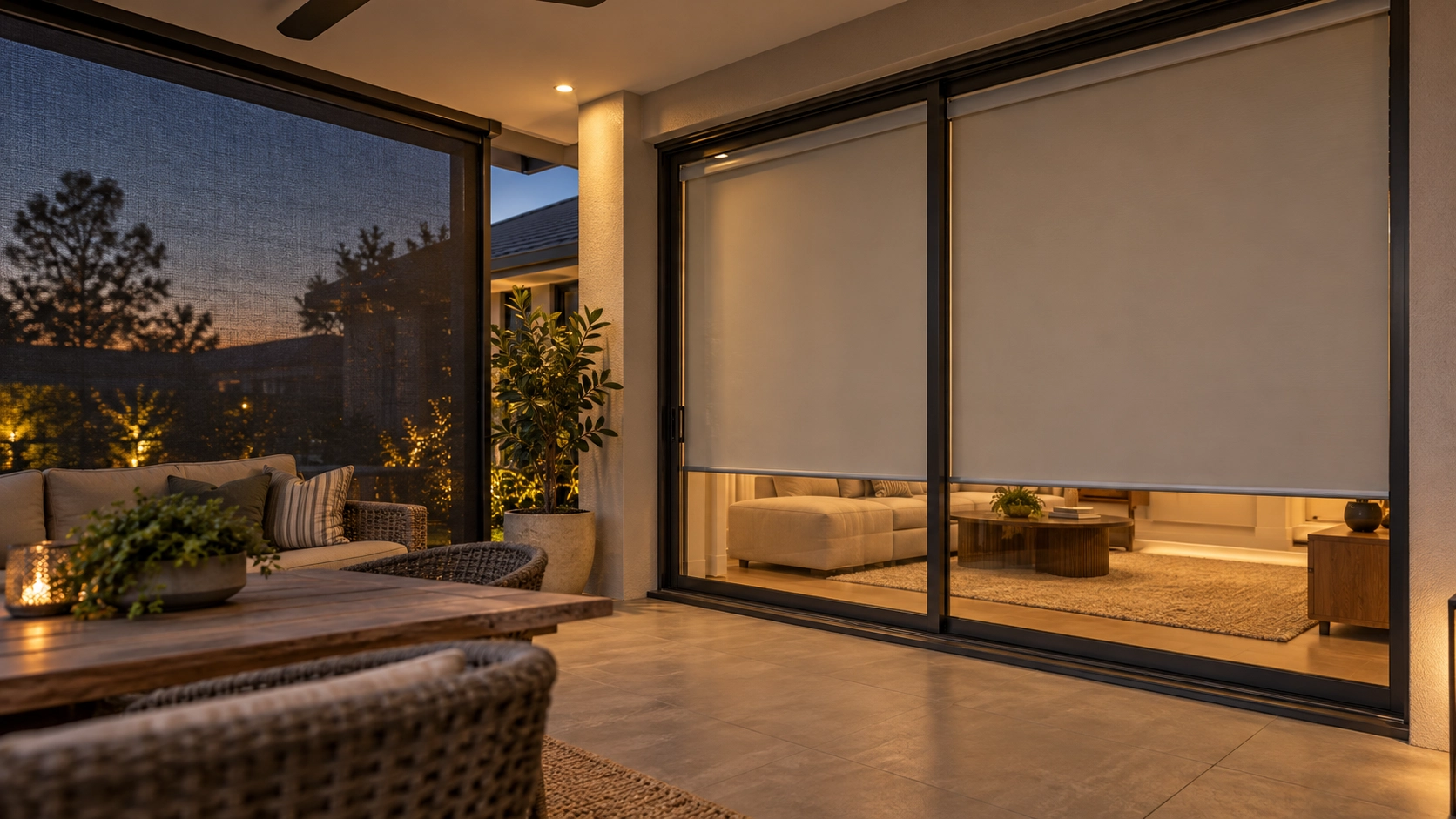
An indoor covering at the glass door protects the room when closed. Patio seating also needs the exposed outdoor directions assessed.
For a new project, annotate an installation photo or plan with these positions. For an existing screen, walk the accessible observation positions after dark. If an upper-floor view cannot be inspected, record it as unverified rather than claiming the entire patio is private.
Why can't 1%, dark fabric or UV blockage settle the question?
Mesh is not permanently one-way. In daylight, activity in a darker space behind a screen may be difficult to distinguish from a brighter exterior. At night, a room light or patio pendant changes that contrast. Phifer describes this change in its sun-control FAQ. Distance, viewing angle and a person's position behind the fabric also affect the result.
An openness factor describes the proportion of open area in a weave. It is not the percentage of people or objects an observer can see. Visible-light transmittance measures how much visible light passes through material under defined conditions; it is a separate specification, not a nighttime privacy grade. UV blockage concerns another part of performance. None of these numbers alone establishes whether someone can recognise activity on a particular patio.
One documented example shows why the specifications must stay separate. In Mermet's M Screen™ 1% Product Specifications Sheet, version 07.22 v1, the White/White and Charcoal/Charcoal colourways both have 1% nominal openness. Their reported visible-light transmittance values are 12% and 1%, respectively. These are Mermet's optical measurements for those fabrics, not nighttime privacy scores or NewHoo fabric data.
A darker colour is no shortcut. Phifer's privacy guidance notes that darker fabrics in its ranges generally preserve a clearer outward view but may provide less evening privacy. Seeing out and preventing others from seeing in are separate judgments.
When should you compare mesh? If some visibility is acceptable and you want less of it, compare a specific 1% candidate with your existing 5% material under the same nighttime conditions. If seeing a person or activity is unacceptable, assess an opaque covering instead of repeatedly reducing the openness number. For the broader fabric trade-offs, see NewHoo's 1%, 3%, 5% and 10% openness guide.
Which solution fits your situation?
Each route has a different purpose and limit. Decide what needs to be hidden before asking which product to buy.
| Route | Appropriate when | Limitation | Confirm |
|---|---|---|---|
| Keep the existing mesh | Its observed nighttime result meets the occupants' goal. | Mesh is not an opaque barrier. | Normal lights and all relevant viewpoints. |
| Compare a mesh upgrade | Less visibility is enough. | Lower openness is not a privacy rating. | Exact model, colour, nighttime result and system compatibility. |
| Add a room-side layer | The room behind glass needs privacy. | It does not hide patio occupants. | Closed covering and window-edge sightlines. |
| Cover patio openings | Outdoor activity must be hidden from particular directions. | Other openings or higher views may remain. | Sightlines, outdoor fabric and system suitability. |
| Use day and night modes | A daytime view and stronger nighttime screening are both needed. | The opaque layer removes the view when closed. | Fabric pairing, operation and installation environment. |
Keep an existing screen if its result is acceptable
Do not replace it merely because mesh can be seen through. On a particular patio, normal lighting, seating positions and observation angles may produce a result the occupants accept. Agree on that result, inspect it from outside and keep a record. If the screen passes, a new fabric may add cost without solving a real problem.
Diagnose a failed screen before upgrading
If a person is too distinct through the fabric, compare specific tighter weaves and colours under identical lighting. If the observer sees around a side or through a corner, replacing the fabric in the same panel will not block that path. If the requirement is no direct view of activity, assess a suitable opaque arrangement rather than assuming a change from 5% to 1% is sufficient.
Protect the room at the room opening
An exterior mesh can continue to provide daytime shade and a view. An opaque indoor blind or curtain then closes at night. Check its edges and normal closed position from outside: opaque material will not compensate for an uncovered part of the window.
NewHoo's WR130-180 dual-layer indoor guided blind is specified for indoor windows, with screen or light-filtering fabric on one layer and privacy or blackout fabric on the other. Its guided rails are designed to reduce side gaps. The final fabric and fit still need to be selected for the room. This is not an outdoor patio recommendation.
Cover the patio's exposed openings
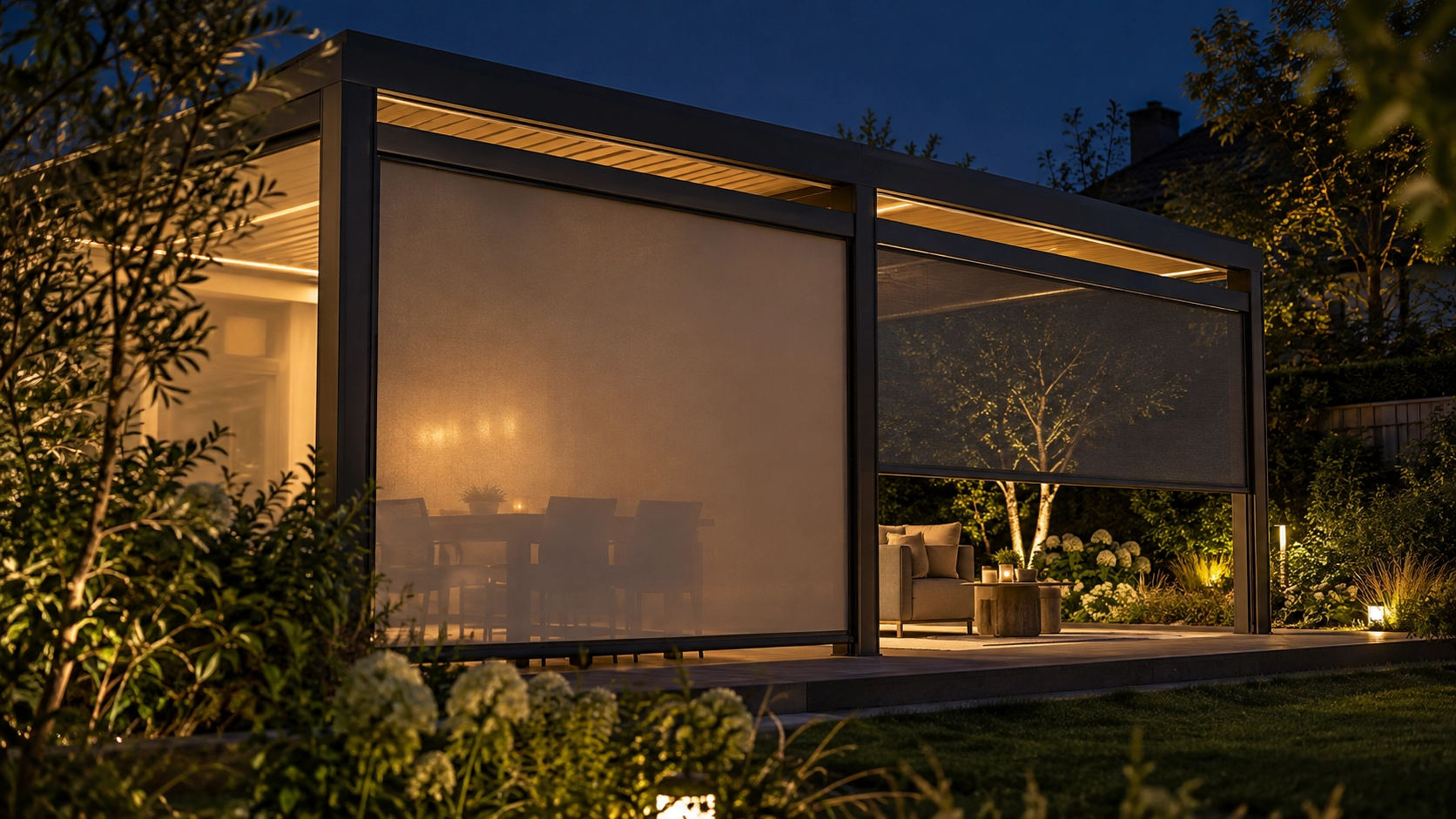
Start at the dining table or seating area. A street-facing opening may need strong screening while a garden-facing side preserves the view. An upstairs neighbour might still overlook seating despite a closed front screen. Resolve those sightlines before specifying fabric.
Where a direct view must be blocked, assess an opaque outdoor-suitable covering and its complete system. Check opening dimensions, the mounting structure and wind exposure. NewHoo's outdoor ZIP screen range is configured around those conditions. Do not assume an indoor blackout textile can simply replace the fabric in an exterior ZIP system.
Use separate day and night modes
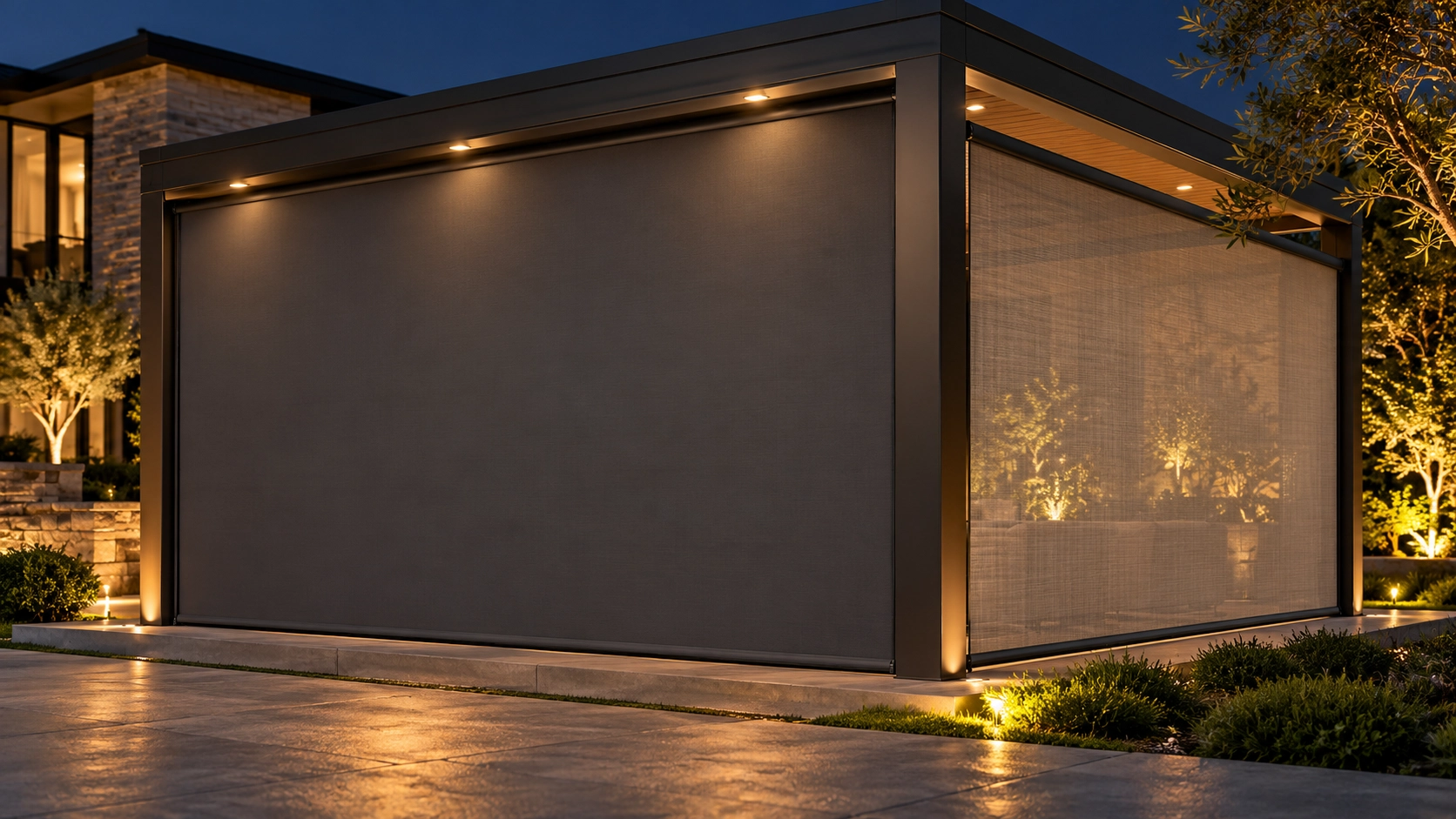
Use mesh for daytime shade and an outward view; close an appropriate second layer when privacy takes priority. NewHoo describes the WR150-230 double-layer motorized system for large outdoor openings, with independently operated layers and project-selected screen, dim-out or blackout options. It is a potential configuration, not proof that every fabric or size suits every exposed site. Confirm the outdoor fabric, system configuration and viewing result for the project. A “dim-out” label alone does not establish that direct views are blocked.
How do you test before ordering and inspect after installation?
Agree on a pass condition before testing. “Looks private” is too vague for a purchase decision. Two possible project-specific conditions are:
- Reduced visibility: From the agreed observer positions with normal evening lights, a presence may be detectable, but faces or specific activities should not be identifiable.
- Blocked direct view: From every agreed observer position, there should be no direct view of people or activity in the designated area, including around uncovered sides and through adjacent openings.
These are example acceptance criteria to agree with the buyer, not certified industry privacy classes. Change them if the occupants need a different standard. Mark any viewpoint you cannot access as unverified.
Before ordering: Identify the exact fabric model, colour, openness and intended indoor or outdoor use. A hand-sized swatch helps shortlist materials but cannot prove whole-opening performance. Ask for a larger demonstration or relevant installation when available. Recreate ordinary nighttime lighting, place a person at the actual seating or room position and observe from the agreed outside directions. Record whether you can detect a presence, movement, a recognisable person or specific activity. If testing a second covering, repeat with it closed.
After installation: Repeat the check with the actual screens in their normal closed positions. Examine the fabric, side edges, bottom, corners and neighbouring openings. Check the room and patio separately if both are in scope. Record the viewpoint and lights used. If photographs are taken with night mode or automatic exposure, do not treat the image alone as an exact record of unaided-eye visibility.
Compare the observation with the agreed condition. A visible person through the mesh suggests a fabric or covering decision to revisit; a clear view around a corner is a layout issue. Record the result and corrective action rather than signing off with “looks good.”
What should you send NewHoo for a useful recommendation?
Provide the width and height of each opening, quantities, photos or drawings, mounting structure and expected outdoor exposure. Mark the room or seating positions to protect and the street, side or upper-floor directions from which they may be seen. Describe the lights normally used at night. State whether reduced visibility is acceptable or direct views must be blocked, and whether retaining a daytime view is important.
That brief allows NewHoo to discuss a relevant system direction, compatible fabric options and viewpoints requiring site verification. A room may call for assessment of the WR130-180 indoor dual-layer system. A large outdoor opening with two operating modes may call for assessment of the WR150-230 outdoor double-layer system. Other patio layouts can start with the outdoor ZIP screen range. The final model and fabric should follow the dimensions, site and privacy goal.
Ask NewHoo to review your nighttime privacy layout. Send the opening measurements, site images, observation directions and usual lighting. We can then identify suitable configuration options and specify what must be verified on site before the privacy result is accepted.
Solar vs Wired Motorized Outdoor Blinds: Which Should You Choose?
Do Outdoor ZIP Screens Keep Rain Out?
Related Article