How to Choose ZIP Screens for High-Rise Balconies
A ZIP screen for a high-rise balcony should be selected from three things: site exposure, actual screen dimensions, and the verified system configuration at that size.
Floor number alone does not determine the product. An advertised “120 km/h wind resistance” figure does not either.
A 2 × 2 m screen and a 4 × 3.5 m screen may share the same product name, but the larger screen presents 3.5 times the projected area to wind pressure. A recessed balcony and an exposed corner balcony on the same floor can also experience very different local airflow.
For a high-rise project, the first job is therefore to identify what type of opening you actually have.
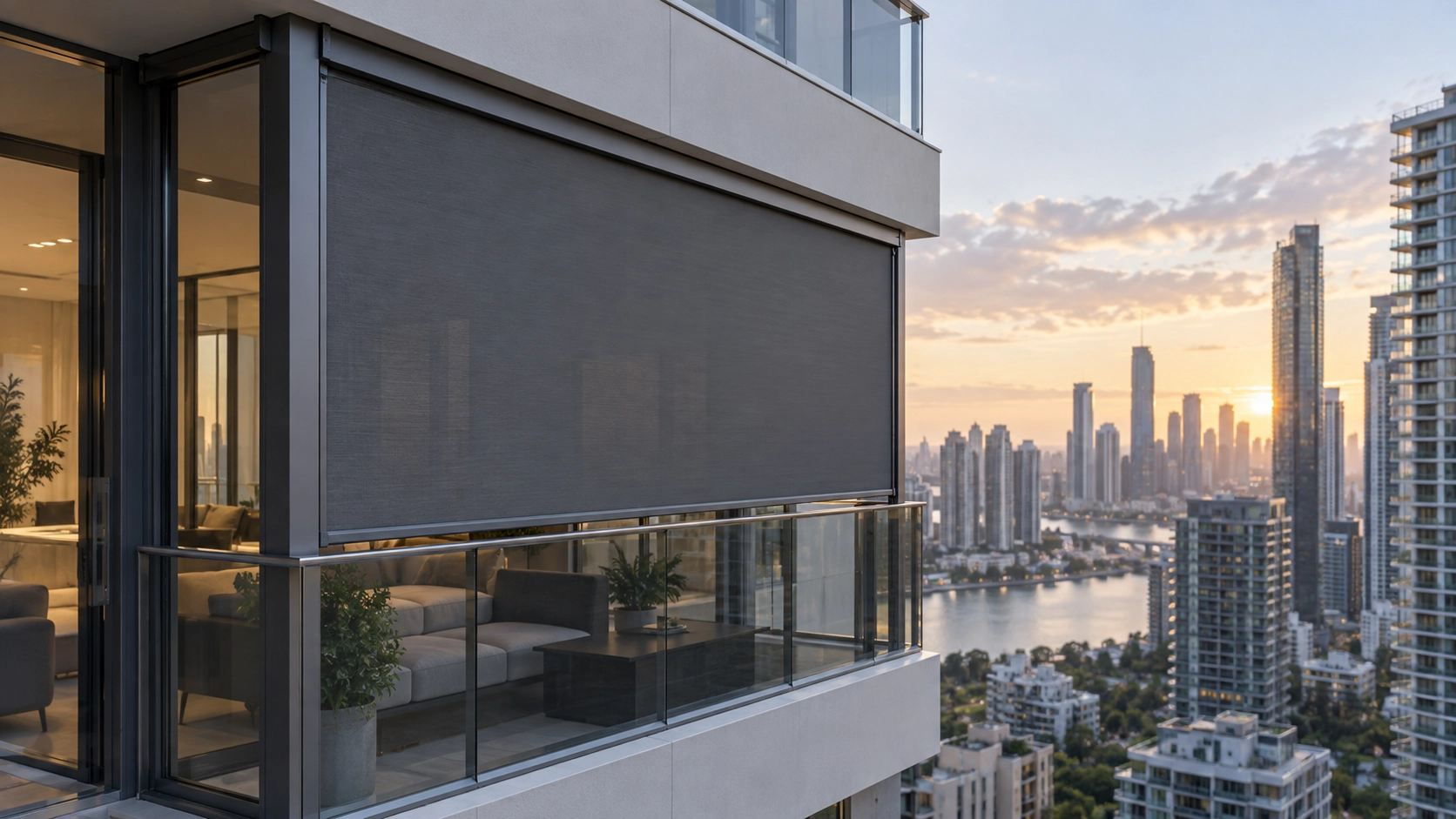
Quick Engineering Guide for High-Rise ZIP Screens
| Project Condition | Practical Starting Point | What Changes the Decision |
|---|---|---|
| Standard straight opening below about 4 m wide | A conventional ZIP-guided outdoor system may be suitable | Exposure, tested wind class, height and fixing structure |
| Opening approaching or exceeding 4 m | Review roller stiffness and oversized configurations | Do not simply enlarge a standard small-opening system |
| 4–5.4 m pergola opening | NewHoo WR110 uses a 78 mm double-layer tube in this width range | Published maximum height for this configuration is 2.8 m |
| Exposed corner or building-gap location | Project-specific review | Local exposure matters more than floor number alone |
| Extra-wide / extra-high opening | Use a dedicated oversized system | Width, height and maximum wind performance must be considered together |
| Coastal high-rise | Wind review plus corrosion review | Hardware, coating and maintenance environment |
| Unknown façade or decorative cladding | Do not finalize fixing design | Structural substrate must be identified first |
NewHoo's WR100 commonly uses a 63 mm tube for openings below 4 m wide. WR110 changes from a 63 mm grooved tube below 4 m to a 78 mm double-layer tube for pergola openings between 4 and 5.4 m; the published maximum height for that wider configuration is 2.8 m.[3]
These are product-configuration baselines, not universal rules for every high-rise ZIP screen.
For conventional balcony projects, start with NewHoo's Outdoor ZIP Screens range before moving into oversized configurations.
High-Rise Exposure: What Actually Matters
Higher elevation generally means a more exposed wind environment, but the building itself can alter airflow considerably.
An exposed corner, a recess protected by two side walls, and an opening facing the gap between two towers should not be treated as equivalent simply because they are on the same floor.
For product selection, use a practical exposure classification:
- Sheltered / recessed: opening partly protected by surrounding construction.
- Mid-façade exposed: open-facing balcony without substantial shielding.
- Corner exposed: opening near a major building edge.
- Channel exposed: opening facing a gap between large neighbouring buildings.
- Coastal exposed: wind exposure combined with salt-laden atmosphere.
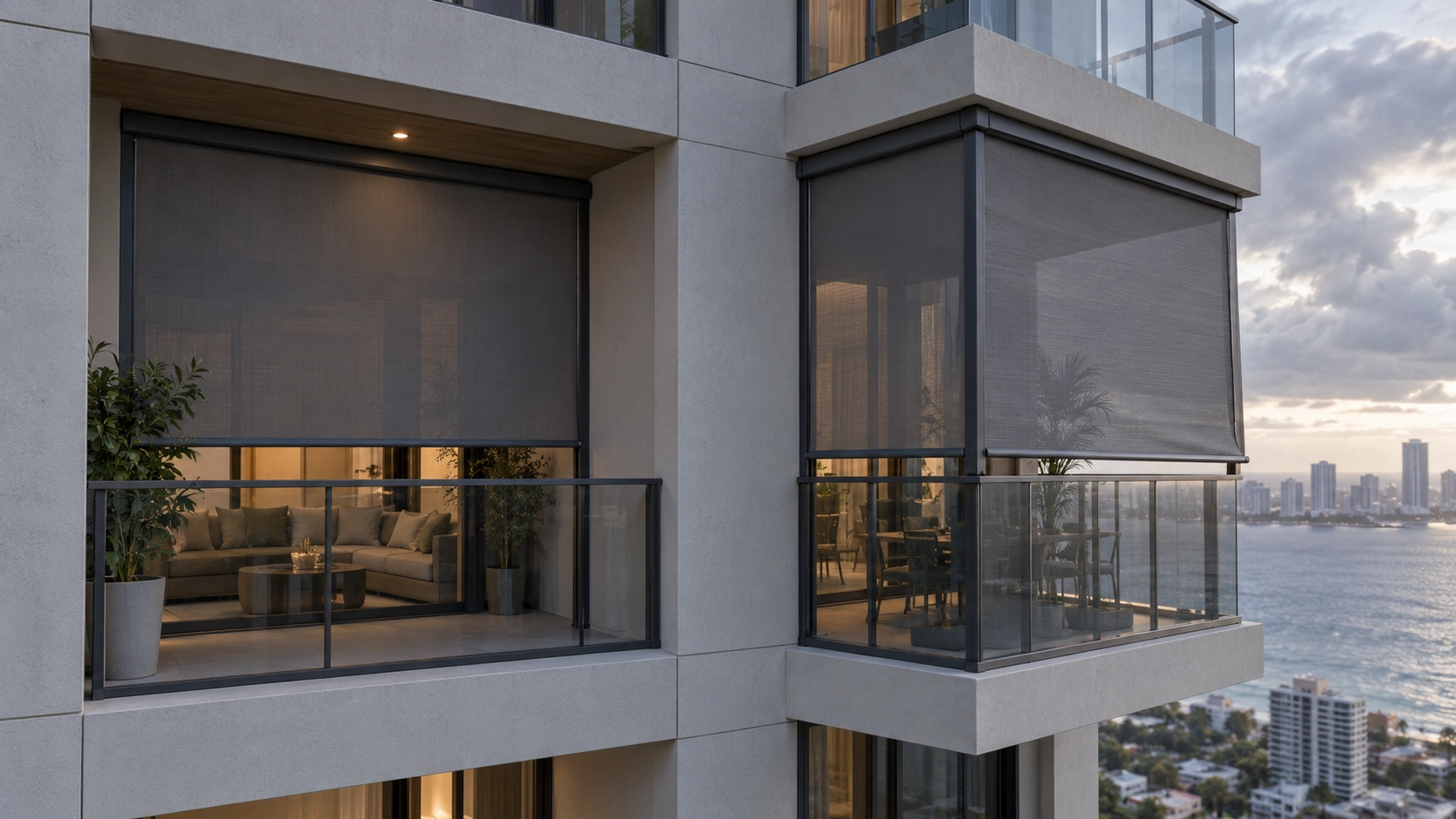
There is no reliable rule such as “all 20th-floor balconies need System X” or “all corner units have 40% more wind.” Building geometry, prevailing wind direction and surrounding structures affect the result.
This is also why the wind speed shown by a weather app cannot be treated as a product specification. It describes regional conditions, not the pressure acting on one particular opening.
Use EN 13561 Wind Classes to Understand the Test
For exterior blinds, EN 13561 provides a more useful reference than an unexplained maximum wind-speed claim.
EN 13561:2015/AC:2016 defines wind-resistance classes using nominal pressure pN and safety pressure pS.
| EN 13561 Class | Nominal Pressure pN | Safety Pressure pS |
|---|---|---|
| Class 0 | <40 N/m² | <48 N/m² |
| Class 1 | 40 N/m² | 48 N/m² |
| Class 2 | 70 N/m² | 84 N/m² |
| Class 3 | 110 N/m² | 132 N/m² |
| Class 4 | 170 N/m² | 204 N/m² |
| Class 5 | 270 N/m² | 324 N/m² |
| Class 6 | 400 N/m² | 480 N/m² |
Source: EN 13561:2015/AC:2016, Clause 4.1 and corrected Table 1.[1]
Nominal pressure represents the level at which the blind should continue operating without detrimental deformation or deterioration. Safety pressure is higher and addresses failures that could create danger, including breakage or a guided blind coming out of its tracks.
Classes 4–6 are specifically permitted for external blinds whose fabric runs in lateral guide rails and for pergola awnings.
A useful wind-class declaration therefore tells you about the tested blind system. It does not automatically approve the wall, fasteners or installation method on your balcony.
Why Screen Size Changes the Result So Quickly
Wind pressure acts across the projected area of the screen.
Take EN 13561 Class 4 nominal pressure as a simple comparison:
170 N/m²
For a 2 × 2 m screen:
4 m² × 170 N/m² = 680 N
For a 4 × 3.5 m screen:
14 m² × 170 N/m² = 2,380 N
The second screen has 3.5 times the area, so the simple pressure resultant is also 3.5 times larger.
The calculation does not determine an individual anchor size. It demonstrates why a wind test carried out on a relatively small screen cannot automatically be transferred to the largest size listed in a catalogue.
Width also changes the roller span. As the roller becomes longer, maintaining sufficient stiffness becomes harder. Excessive roller deflection can affect fabric winding and the alignment between the fabric edge and side-guidance system.
This is why NewHoo does not apply one roller configuration to every width.
The WR100 Classic Windproof Roller Blind commonly uses a 63 mm tube for openings below 4 m
On WR110 pergola systems, NewHoo uses a 63 mm grooved tube below 4 m and changes to a 78 mm double-layer tube between 4 and 5.4 m
More importantly, the 4–5.4 m WR110 configuration has a published maximum height of 2.8 m instead of simply retaining every smaller-system maximum.[3]
What Happens When Wind Loads a ZIP Screen
The fabric in a ZIP screen is flexible. Under positive or negative pressure, the fabric moves away from its unloaded plane and develops curvature.
Because the two edges remain retained in the guides, tension is transferred toward the ZIP edges and side-guide system.
Wind pressure → fabric membrane tension → retained ZIP edge → guide rail → guide fixings → structural substrate
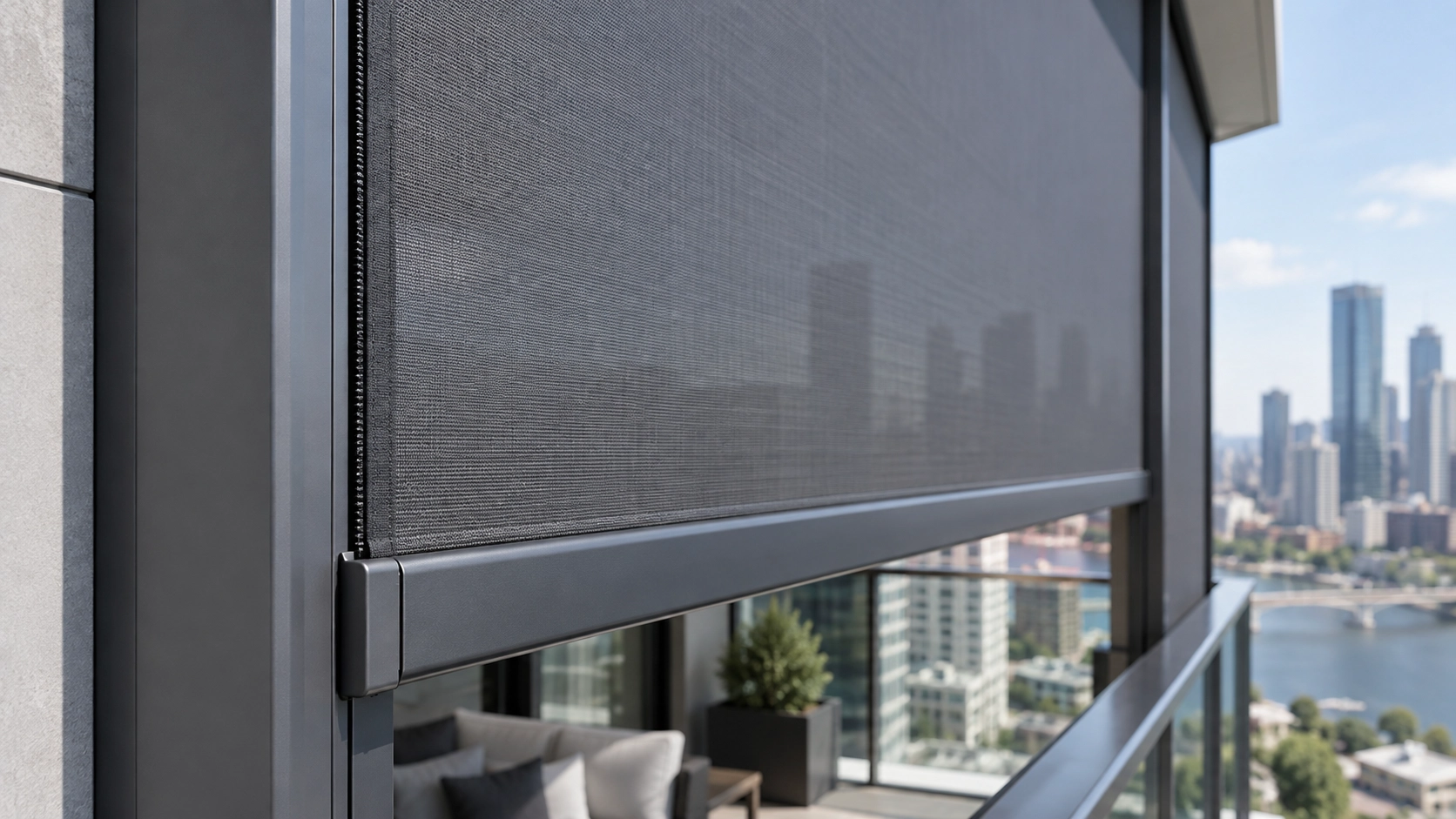
This explains why increasing fabric strength alone does not solve every wind problem.
If the retained edge or guide configuration reaches its limit, the fabric can disengage from the guide. EN 13561 specifically identifies “exit from guiding tracks” as an unacceptable dangerous failure under safety-pressure conditions.[1]
If the roller has insufficient stiffness for the span, winding geometry and fabric alignment can also deteriorate.
If the guide itself is strong but the substrate or anchors are inadequate, the weak point simply moves into the building connection.
A high-wind ZIP screen therefore has to work as one load path. Fabric GSM, tube diameter or guide-rail depth cannot be judged in isolation.
A 3.8 × 3.0 m High-Rise Balcony Example
Consider a 3.8 m wide × 3.0 m high straight opening on an exposed high-rise balcony.
Projected area:
3.8 × 3.0 = 11.4 m²
Using Class 4 nominal pressure as a comparison baseline:
11.4 × 170 = 1,938 N
At 3.8 m wide, the opening remains within the <4 m range where NewHoo WR100 commonly uses its 63 mm tube.
That gives a dimensional starting configuration. The next step is to confirm whether the applicable wind-performance evidence covers the actual screen size and installation condition.
Now increase the opening to 4.8 m.
The opening has moved beyond WR100's normal <4 m 63 mm configuration. At this stage, continuing to stretch the same standard structure is no longer the preferred selection method.
The project should move into an Extra-Wide & Extra-High ZIP Screens review.
NewHoo also explicitly states that maximum width and maximum height cannot automatically be combined in one blind.
One Large Screen or Two Smaller Screens?
Large architectural openings do not always need to be covered by one screen.
Take a 6 × 3 m opening.
One screen:
18 m² × 170 N/m² = 3,060 N
Two 3 × 3 m screens:
9 m² × 170 N/m² = 1,530 N per screen
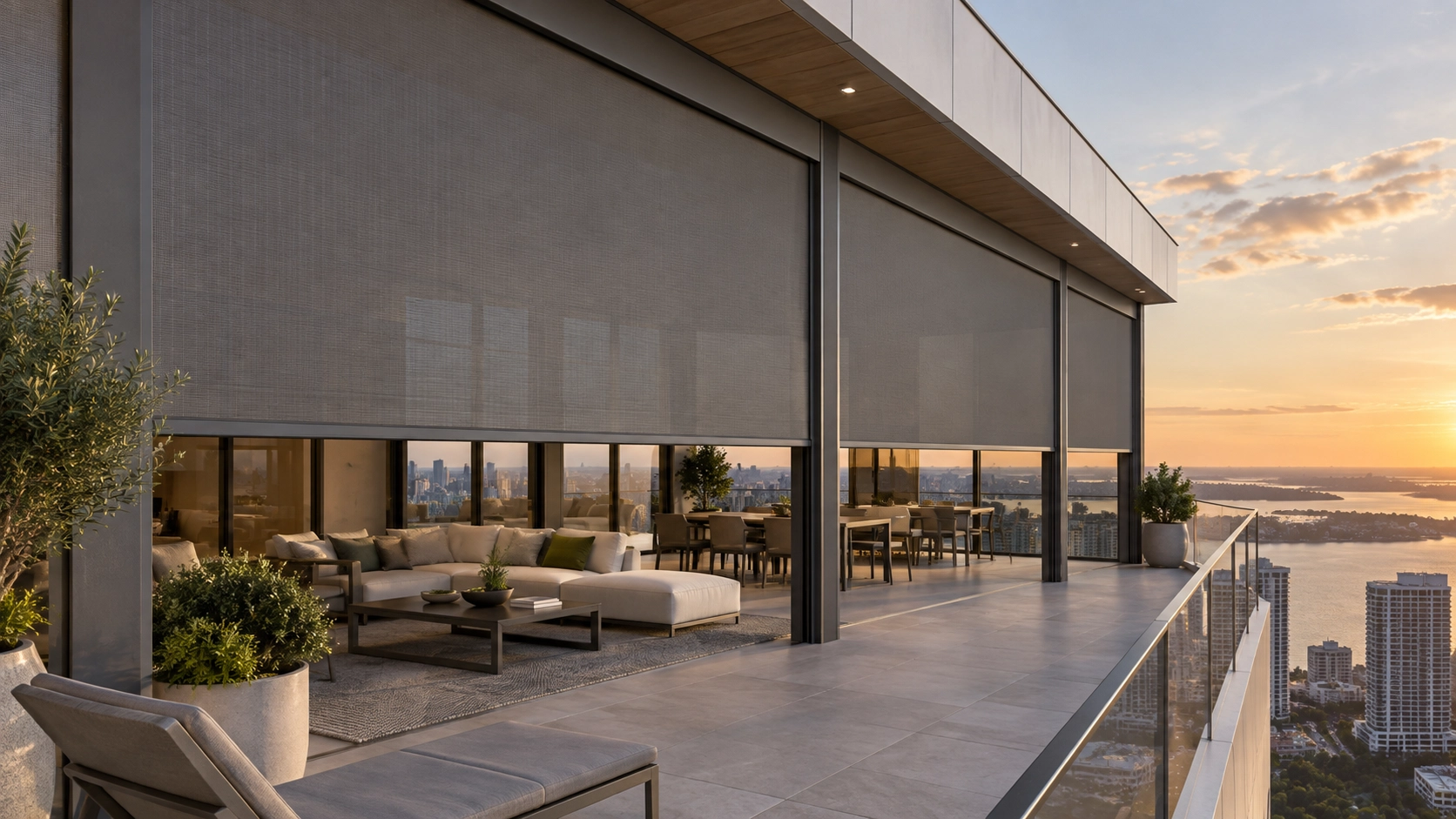
The total exposed area has not changed, but each roller now spans 3 m instead of 6 m.
A single screen provides a cleaner façade with fewer vertical lines, but requires a longer roller, larger components and more demanding transportation.
Dividing the opening reduces individual roller span and usually simplifies transport and servicing, but introduces an additional guide line and potentially another motor.
For very wide high-rise projects, this decision should be made before simply quoting the largest possible single unit.
Installation and Fixing Cannot Be Left Until the End
Knowing the opening dimensions is not enough to select the anchorage.
A guide may be fixed to reinforced concrete, masonry, structural aluminium, steel or a façade system containing non-structural finishes in front of the real substrate.
Anchor capacity depends on variables such as:
- structural material;
- embedment depth;
- edge distance;
- fastener spacing;
- load direction.
That is why a universal rule such as “use M10 anchors above the 20th floor” would be misleading.
EN 13561 makes the same separation: the blind's static wind-pressure classification does not define its anchorage to the building.
For large high-rise screens, transport should also be checked before production. The longest cassette, roller or guide profile must actually fit through the service lift, stairwell or other approved access route.
Coastal High-Rise Projects Need a Corrosion Check
A coastal project adds another variable that wind testing does not solve.
Exposed fasteners, brackets, aluminium finishes and interfaces between dissimilar metals may all be affected by salt-laden air.
Wind performance and corrosion durability should therefore be treated as separate specifications.
Instead of accepting descriptions such as “marine grade” or “outdoor grade,” obtain the actual material or coating specification for the exposed hardware.
What a Useful High-Rise Quotation Should Contain
A buyer does not need to calculate the structural system personally. A useful quotation should simply show enough information to demonstrate that the project has been reviewed properly.
For a high-rise ZIP screen, look for:
- actual width × height;
- roller configuration at that size;
- side-guide / ZIP-retention configuration;
- applicable wind class or test information;
- tested specimen size where available;
- identified mounting substrate;
- operating / retraction limits;
- corrosion specification where relevant.
A quotation stating only:
leaves too many variables undefined.
A specification connecting the wind-performance claim to the actual screen size and system configuration is far more useful.
Final Selection Checklist
- Actual width and height are finalized.
- Balcony exposure has been identified: sheltered, mid-façade, corner, channel or coastal.
- The roller and guide configuration corresponds to the actual size.
- Wind-performance data is linked to a known test configuration.
- The structural fixing substrate is known.
- Operating and retraction limits are understood.
- Oversized projects have been checked for transportation and future servicing.
If these points are defined, comparing two quotations becomes much easier.
If they are not, two suppliers may appear to be quoting the same ZIP screen while actually offering very different systems.
FAQ
Is a 63 mm roller tube enough for a high-rise ZIP screen?
There is no floor-based answer. NewHoo WR100 commonly uses a 63 mm tube for openings below 4 m wide. High-rise suitability still depends on width × height, exposure, guide configuration, wind-performance evidence and mounting conditions.
When does NewHoo use a 78 mm double-layer tube?
NewHoo's WR110 pergola system changes to a 78 mm double-layer tube for widths from 4 to 5.4 m. The published maximum height for that wide configuration is 2.8 m.[3] This is a verified NewHoo pergola configuration, not a universal rule that every ZIP screen above 4 m must use exactly the same tube.
Does EN 13561 Class 6 mean a ZIP screen is suitable for any high-rise balcony?
No. Class 6 corresponds to a nominal pressure of 400 N/m² and a safety pressure of 480 N/m². EN 13561 also states that the static test does not account for repeated turbulence in actual service and does not define the blind's anchorage to the building.
Can maximum width and maximum height be combined?
Only when the manufacturer confirms that exact configuration. NewHoo's oversized-system guidance specifically states that maximum width and maximum height cannot automatically be combined in one blind.[4]
Does a stronger motor improve wind resistance?
A stronger motor can operate a heavier blind assembly. It does not increase the strength of the fabric edge, guide rail, roller or building connection when the screen is deployed.
Get a High-Rise ZIP Screen Project Review
For an exposed, corner, coastal or oversized balcony opening, send NewHoo your opening width × height, floor level, project city, balcony position, structural fixing surface and clear installation photos.
These project conditions allow the roller configuration, ZIP-guided structure and installation requirements to be reviewed before the final quotation.
Get a High-Rise ZIP Screen Project ReviewHow to Choose Skylight Blinds for Large Glass Roofs
ZIP Screen Fabric Openness: 1% vs 3% vs 5% vs 10% — Which Should You Choose?
Related Article