Is a Retractable Awning Waterproof or Water-Resistant?
That difference matters.
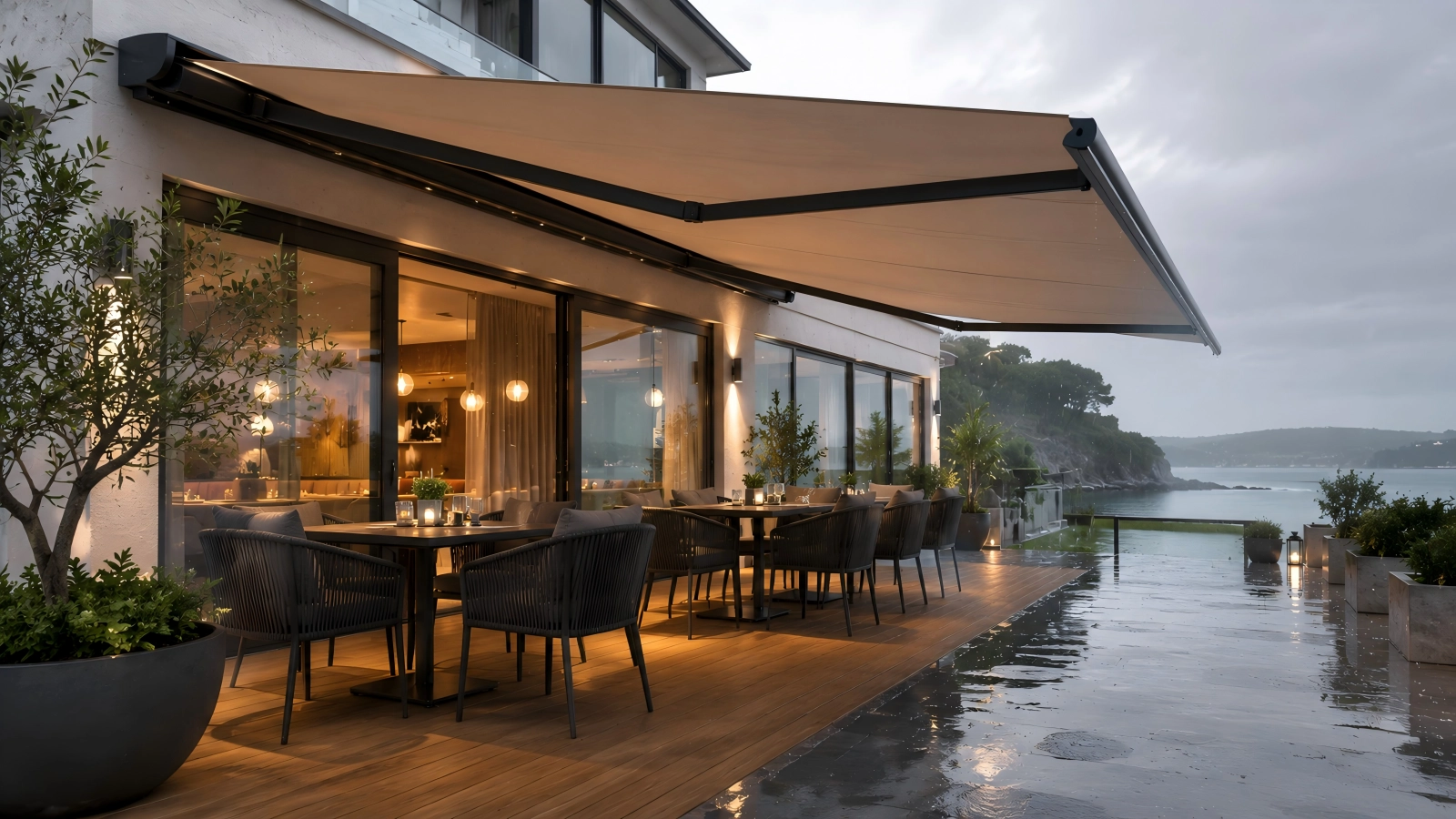
In real use, the question is not simply whether the fabric can repel water. The real question is whether the awning can drain rain safely before water starts pooling, stretching the fabric, loading the arms, and stressing the wall anchors.
For most homeowners, restaurant owners, and project buyers, the practical answer is this:
-
Light rain: usually acceptable if the awning is properly pitched.
-
Moderate rain: monitor closely and retract if water begins to collect.
-
Heavy rain, storm, snow, or strong wind: retract immediately.
-
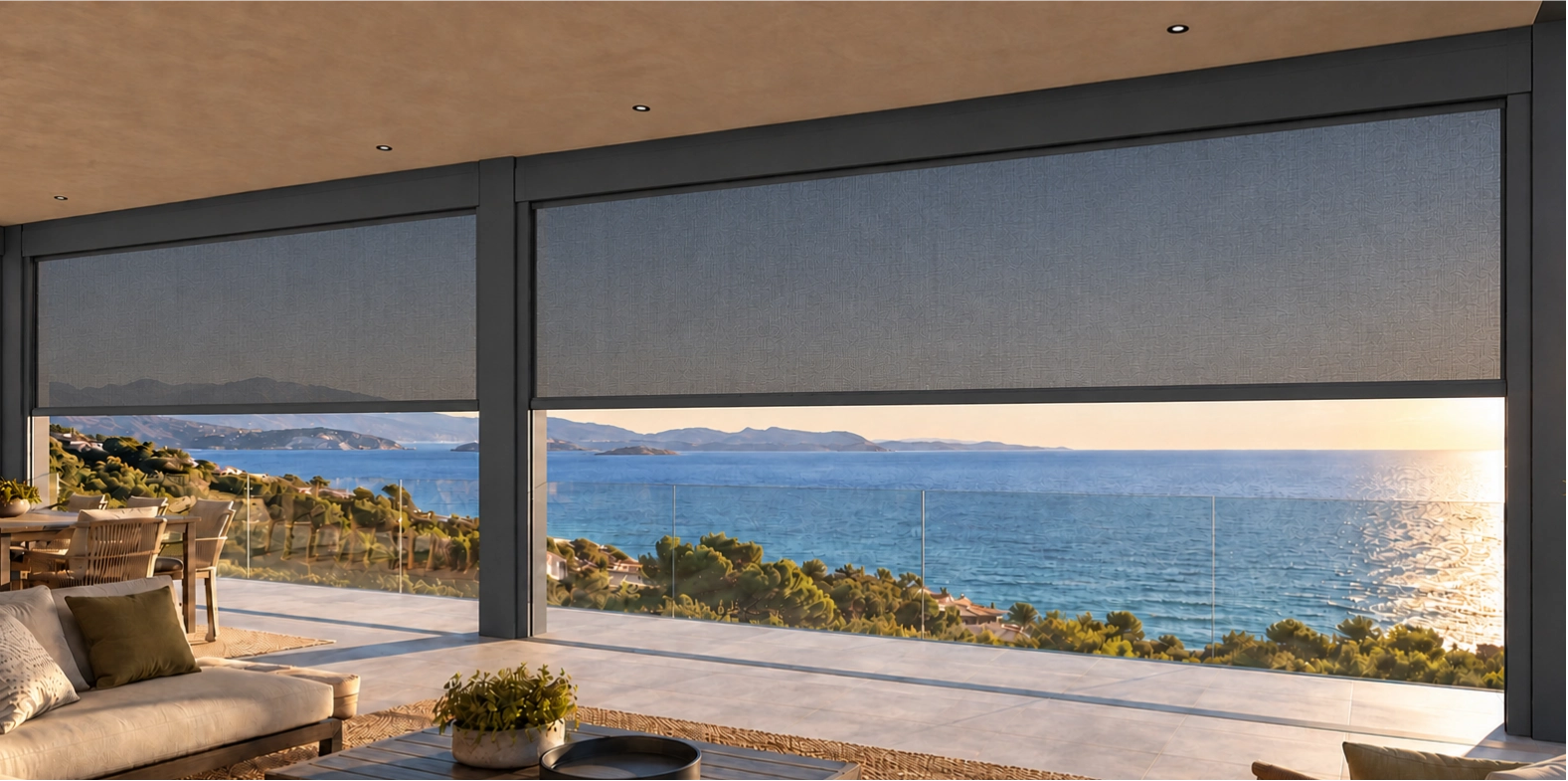
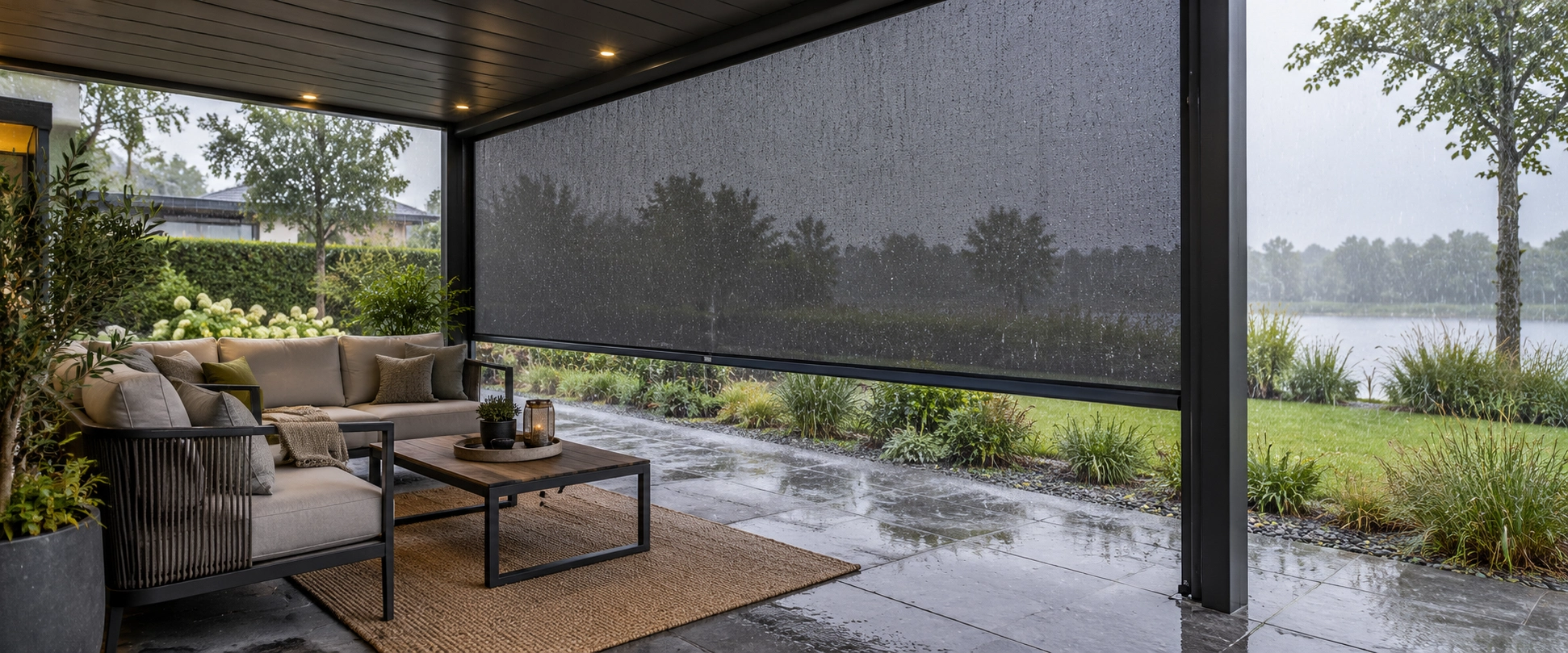
Wind-driven rain: a top awning alone is not enough; use side protection such as outdoor zipper blinds or zip track outdoor blinds.
A retractable awning can improve outdoor comfort. It should not be used as a substitute for a fixed roof.
Weather Operation Matrix: When Can You Use a Retractable Awning?
| Weather Condition | Can You Use It? | What Happens in Real Life | Main Risk | Correct Action |
|---|---|---|---|---|
| Drizzle / Light Rain | Usually yes | Water beads up and runs off if the fabric is clean and the pitch is correct. The center area can stay comfortable. | Edges may get mist, splash, or light dripping. | Keep monitoring. Never roll up the awning while wet just for appearance. If forced to retract, reopen to air dry fully within 24 hours. |
| Short Light Shower | Usually yes with supervision | Useful for finishing coffee, meals, or short outdoor seating. | Wet fabric trapped in the roll or cassette can develop odor, stains, or mildew. | Let the fabric dry before long-term storage. |
| Steady Moderate Rain | Caution | Water runoff slows. Seams, front edges, and low points may start dripping. | Early sagging and water pooling. | Retract once a low pocket or puddle appears. |
| Heavy Rain | No | Rain volume can exceed the awning’s drainage capacity. | Water load, fabric stretch, arm stress, bracket stress. | Retract immediately. |
| Thunderstorm / Strong Wind | No | Wind pushes rain from the front and sides while adding dynamic load to the structure. | Unsafe operation and structural damage. | Keep fully retracted. |
| Snow / Ice | No | Static weight can build on the fabric and frame. | Fabric tearing, arm bending, bracket failure. | Keep retracted. |
| Wind-Driven Rain | Awning alone is not enough | The top is covered, but people, furniture, and tables can still get wet from the sides. | Poor outdoor usability. | Add outdoor zipper blinds, zip track outdoor blinds, or track-guided side screens. |
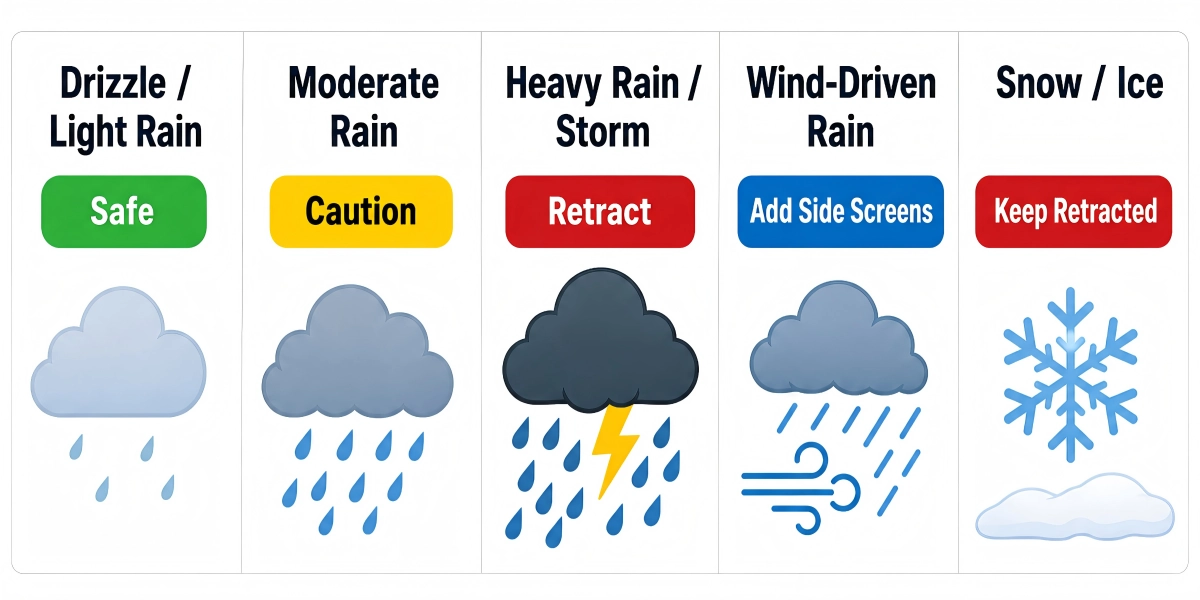
This table is the most important rule of the whole article: use an awning when rain is light and moving off the fabric; retract it when water starts staying on the fabric.
Many awning owner guides give similar operating boundaries. For example, some manuals state that awnings should not be used in strong wind, rain, hail, or snow, and should be retracted when unsafe weather is expected.
The Real Danger Is Not Rain — It Is Water Pooling
Rain touching the fabric is not the biggest problem.
Water staying on the fabric is the real danger.
A retractable awning fabric is flexible. That flexibility is useful because the fabric can extend, roll, and retract. But it also means the fabric is not designed to hold standing water like a rigid roof panel.
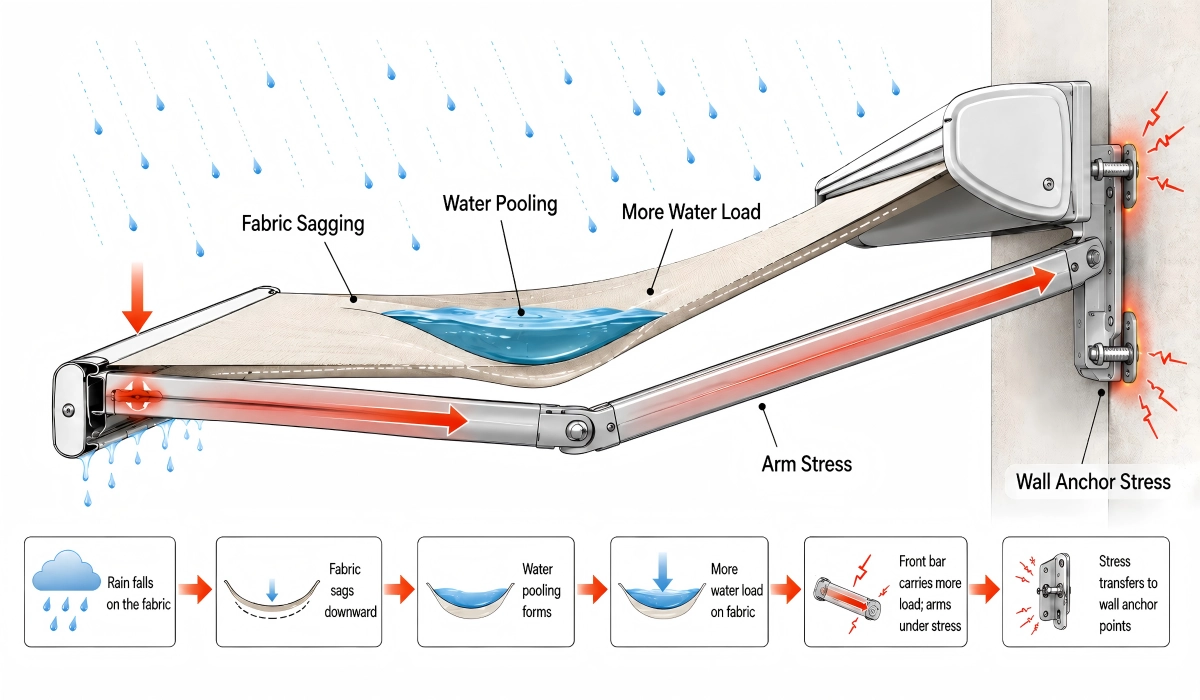
Once water begins to pool, the damage chain is simple:
-
Water collects on the fabric.
-
The fabric sags under the weight.
-
The sagging area becomes a pocket.
-
The pocket holds more water.
-
More water adds more weight.
-
The load pulls on the front bar, folding arms, brackets, anchors, and wall structure.
At that point, the awning is no longer acting like a sloped rain-shedding surface. It is acting like a soft water container.
That is why a small puddle should not be ignored. It is the first visible sign that the awning has moved from comfort mode into structural risk mode.
Why a Small Puddle Can Become a Big Load
Water is heavy.
The U.S. Geological Survey explains that water has a density of roughly 1 gram per milliliter, which means 1 liter of water is about 1 kilogram.
That means even a shallow puddle spread across a wide awning surface can add real weight. The larger the fabric area, the faster this load becomes meaningful.
The damage usually does not stay in the fabric only. Load transfers through the whole system:
fabric → front bar → folding arms → brackets → wall anchors → wall structure
Typical damage signs include:
-
stretched fabric
-
permanent sagging
-
seam stress
-
fabric tearing
-
bent arms
-
twisted front bar
-
uneven retraction
-
loose brackets
-
cracks near wall fixing points
Action rule:
If you see water sitting on the fabric, retract the awning. Do not wait to see whether the puddle clears by itself.
The Leverage Problem: Why Large Projections Are Riskier
A deeper projection gives more shade, but it also increases structural leverage.
When an awning extends several meters from the wall, water collected near the front bar acts far away from the mounting point. That creates a larger overturning moment at the brackets and wall anchors.
In plain language:
The farther the water load is from the wall, the harder it pulls against the wall fixings.
For a small residential awning, this may simply mean fabric sagging or rough retraction. For a large storefront, restaurant patio, or wide commercial façade, it can mean bracket stress, anchor movement, arm deformation, or wall damage.
Engineering note: for a conservative worst-case risk check, pooled water can be assumed to collect near the front bar. In that simplified scenario, the load acts near the far end of the projection and increases the overturning moment at the mounting brackets. Real force distribution depends on projection, pitch, bracket spacing, arm geometry, wall substrate, fastener depth, and installation quality.
Action rule:
Do not choose the largest projection your wall can physically hold. Choose the largest projection that can still drain properly and be safely anchored.
Why Pitch Decides Whether Rain Drains or Pools
Pitch is one of the most important factors in rain performance.
Fabric helps water bead up.
Pitch helps water leave.
A flat awning may look cleaner on the façade, but it is more likely to hold water. A sloped awning drains better in real weather.
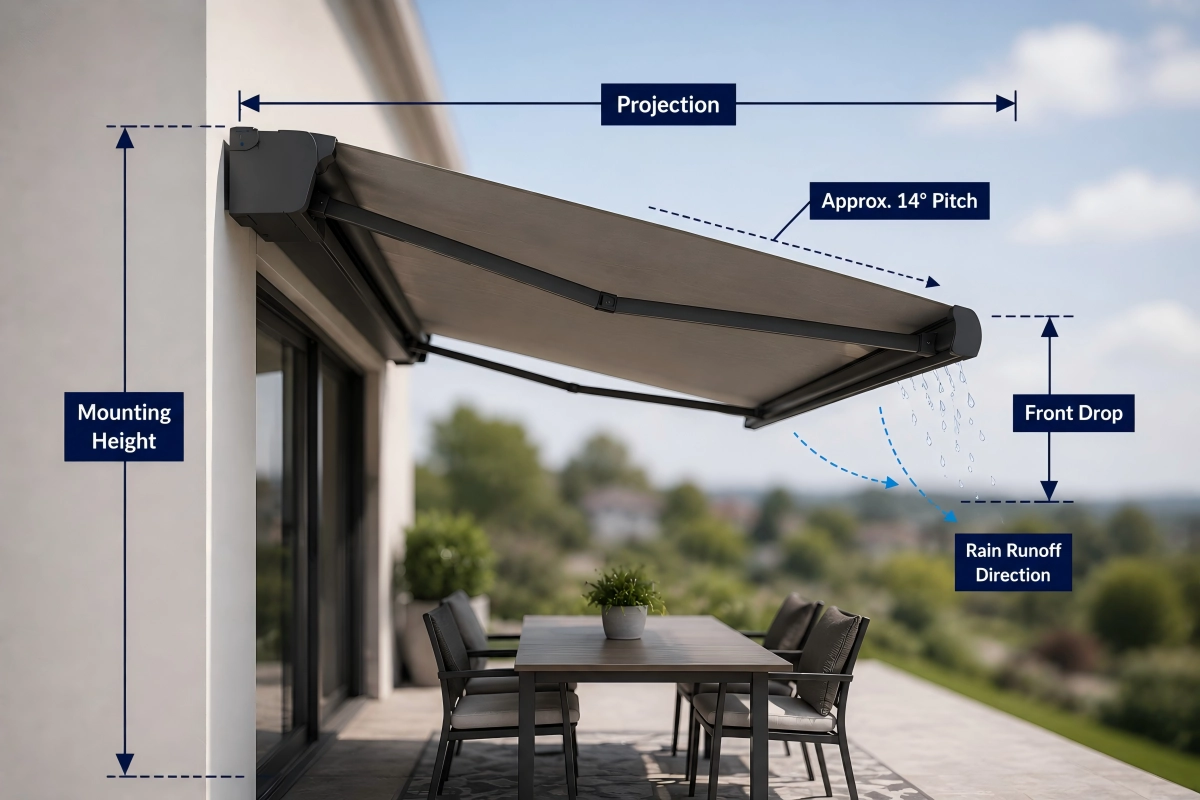
A pitch of around 14° is commonly used as a practical rain-runoff reference for patio awnings. Caribbean Blinds states that patio awnings should be set at 14° or greater to help rainwater run off and avoid pooling.
This does not mean 14° is a magic guarantee. Fabric tension, awning size, installation height, local rainfall, and fabric condition still matter. But it gives buyers a useful planning reference.
Simple rule:
Every 1 meter of projection needs about 25 cm of front drop to approach a 14° pitch.
| Awning Projection | Approximate Front Drop at 14° Pitch | What It Means |
|---|---|---|
| 2.0 m | About 50 cm | Easier to achieve on many residential walls |
| 2.5 m | About 62 cm | Needs enough mounting height |
| 3.0 m | About 75 cm | Common patio size, but drainage must be checked |
| 3.5 m | About 87 cm | Requires a higher mounting position |
| 4.0 m | About 100 cm | Risky on low walls without design adjustment |
This table is not a universal installation rule. It is a quick way to understand the trade-off between projection and drainage.
The common mistake is choosing a large projection on a low wall. The awning becomes too flat, rain slows down, and pooling begins.
For a residential patio, the better solution may be a slightly smaller projection or a different mounting position.
For a restaurant terrace, a larger projection can work if the mounting height and front clearance allow enough pitch. But drainage should not be sacrificed just to keep the awning visually flat.
Will People and Furniture Stay Dry Under a Retractable Awning?
In light rain, the center area under a properly pitched awning can stay comfortable. This is the best-case use scenario.
But an awning does not create a sealed outdoor room.
The edges remain exposed to:
-
mist
-
splash
-
dripping
-
runoff from the front bar
-
wind-blown rain
-
side rain
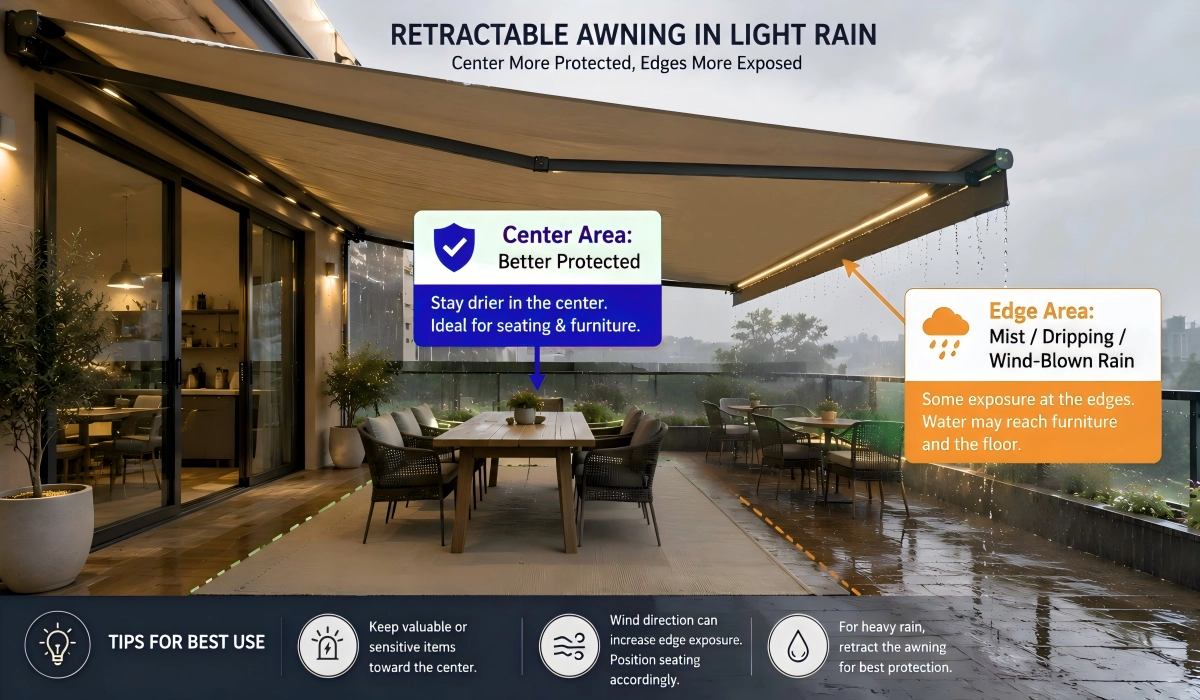
If something cannot get wet, do not place it near the front or side edges of the awning.
For homeowners, this means cushions, rugs, wood furniture, electronics, and fabric chairs should be placed deeper inside the covered area or stored before bad weather.
For restaurants and cafés, this means the outer tables are the first to become unusable when rain turns windy.
Action rule:
Use the center area for light rain comfort. Do not rely on the awning edges to protect valuable furniture.
Wind-Driven Rain: The Problem Most Buyers Discover Too Late
A retractable awning protects the top. It does not close the sides.
That is why a patio can look covered from above but still feel wet and uncomfortable in real weather.
A restaurant may install a beautiful awning over its outdoor seating area. On sunny days, it performs well. During light vertical rain, it helps. But when wind pushes rain from the front, the outer tables get wet, guests move indoors, and the outdoor seating area loses value.
The awning did not fail. It solved only the overhead problem.
A standalone retractable awning mainly helps with:
-
sun
-
overhead heat
-
vertical light rain
-
glare from above
It does not fully solve:
-
wind-driven rain
-
side wind
-
low-angle sunlight
-
privacy exposure
-
cold drafts
-
rain entering from open sides
This is where the question changes.
Instead of asking, “Is the awning waterproof?”
A better question is, “How do we make the whole outdoor space usable in real weather?”
Better Outdoor Protection: Awning + Outdoor Zipper Blinds
For many balconies, patios, restaurants, hotels, and commercial outdoor areas, the better system is:
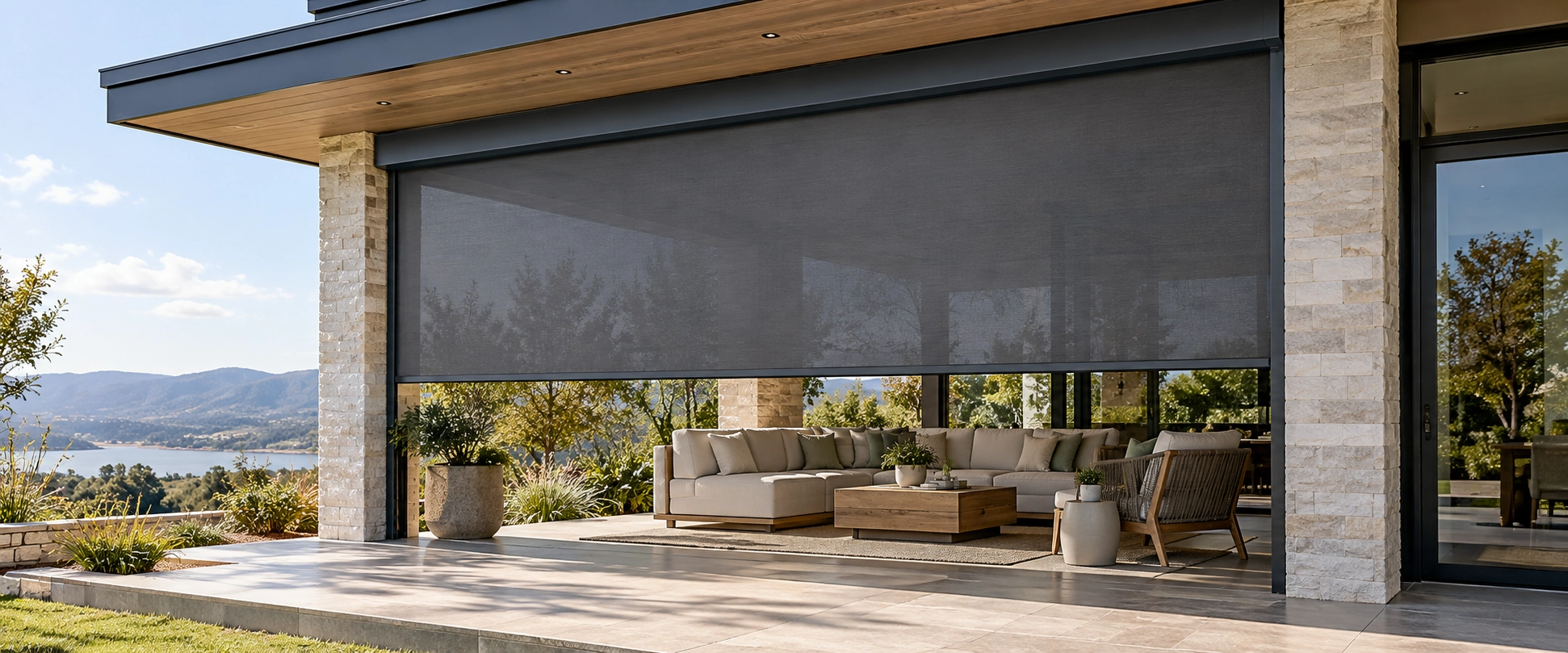
Retractable awning for top coverage + outdoor zipper blinds for side protection.
The awning handles overhead sun and light vertical rain.
The side screens help reduce:
-
wind-driven rain
-
side wind
-
low-angle glare
-
privacy exposure
-
heat gain
-
guest discomfort
This is where outdoor zipper blinds, zip track outdoor blinds, zipper-guided track blinds, and track-guided outdoor screens become more useful than simply buying a larger awning.
A top awning alone covers the area.
A top-and-side system improves the way the area can actually be used.
This combination is especially valuable for:
-
restaurant patios
-
café outdoor seating
-
hotel terraces
-
balcony seating areas
-
pergola openings
-
storefronts
-
rooftop bars
-
commercial outdoor dining areas
For NewHoo projects, this is usually where the design moves from a single product to a complete shading system. The goal is not only to block sunlight from above, but to reduce side exposure so the space remains more comfortable during changing weather.
Which Awning Style Handles Rain Better?
Different awning structures solve different problems. Instead of choosing only by price or appearance, match the structure to the real weather problem.
Standard / Open-Bar Retractable Awning
An open-bar awning is suitable when the main goal is sun shade and occasional light rain comfort.
It is commonly used for:
-
standard patios
-
storefronts
-
mild weather areas
-
budget-sensitive projects
-
spaces where full enclosure is not required
Its limitation is exposure. When closed, the fabric and arms are not as protected as they would be inside a cassette.
For larger storefronts or wider patios, the key is not just the fabric. Brackets, arm strength, profile thickness, fasteners, wall material, and installation quality all matter.
NewHoo CAU40M can be positioned for project buyers who need a practical open-bar retractable awning for patios, storefronts, and commercial openings, especially where ordinary retail-grade structures are not suitable.
Full Cassette Retractable Awning
A full cassette awning’s main rain-related advantage is protection when closed.
When retracted, the cassette helps protect the fabric, motor, arms, and mechanism from rain, dust, UV exposure, debris, and environmental aging. SunSetter also describes full or semi-cassette housing as protection for the awning when it is retracted.
This makes full cassette systems suitable for:
-
villas
-
hotels
-
rainy regions
-
coastal areas
-
premium façades
-
commercial properties
-
projects where appearance and closed-state protection matter
But the clarification is important:
A full cassette protects the system when closed. It does not turn the extended awning into a waterproof roof.
Even a full cassette awning should be retracted during heavy rain, storms, snow, strong wind, or water pooling.
For NewHoo, CAF260-150M-C can be positioned for higher-end residential and commercial projects where closed-state protection and façade appearance are important.
Awning + Zip Track Outdoor Blinds
If the buyer only needs shade, a retractable awning may be enough.
If the buyer wants a patio, balcony, restaurant terrace, or hotel outdoor area to remain more usable during changing weather, side protection becomes essential.
System logic:
-
awning: overhead sun and light rain protection
-
zip track outdoor blinds: side rain, wind, glare, privacy, and heat control
-
combined system: better comfort than a top awning alone
This is the strongest system upgrade because it solves the weakness that even a high-quality awning cannot solve by itself: open sides.
Smart Rain and Wind Sensors: Useful Backup, Not a Design Shortcut
Smart rain and wind sensors can help automatically retract motorized awnings when weather changes. They are useful for homes, cafés, restaurants, hotels, and commercial patios where the awning may be open without constant supervision.
But sensors are backup protection, not a design shortcut.
They cannot fix:
-
insufficient pitch
-
weak anchors
-
low mounting height
-
excessive projection
-
poor wall substrate
-
loose fabric
-
extreme weather exposure
Action rule:
A sensor can help when someone forgets to retract the awning. It cannot save an awning that was installed too flat or anchored into the wrong structure.
Good design comes first. Sensors come second.
Post-Rain Maintenance Checklist
Rain care does not end when the rain stops. Poor after-rain handling can lead to odor, stains, mildew, and weaker water repellency.
Rule #1: Reopen Wet Fabric to Dry
If the awning was retracted while wet, reopen it as soon as weather allows and let it dry fully.
Wet fabric trapped inside a roll or cassette can lead to odor, staining, and mildew-related problems.
Practical rule:
If forced to roll up wet, extend to dry within 24 hours.
Rule #2: Do Not Use a Pressure Washer
Do not use a pressure washer on awning fabric. High pressure can damage the surface finish, seams, stitching, and coating.
Sunbrella’s care guidance recommends mild soap, cold to lukewarm water, thorough rinsing, and air drying, and specifically says not to use a power washer or sprayer.
Use:
-
soft brush
-
mild soap
-
clean water
-
gentle rinsing
-
air drying
Avoid:
-
pressure washer
-
harsh solvents
-
abrasive scrubbing
-
heat drying
-
machine washing
Rule #3: Remove Leaves, Dust, and Debris
Leaves and debris trap moisture and slow water runoff. Dirt can also support mildew growth on the surface.
Clean the awning after:
-
storms
-
falling leaves
-
dusty weather
-
bird droppings
-
tree sap exposure
-
long periods without use
Rule #4: Inspect After Heavy Rain or Pooling
After heavy rain or visible pooling, inspect the awning before normal use.
Check for:
-
fabric sagging
-
stretched seams
-
uneven front bar
-
bent arms
-
loose brackets
-
abnormal motor sound
-
rough retraction
-
wall cracks near fixing points
-
visible water marks
-
fabric deformation
Call a professional if the awning no longer retracts smoothly, the brackets feel loose, the front bar is not level, the arms look uneven, or the motor struggles.
How to Choose the Right System Without Guessing Online
Many online awnings are selected only by width and projection. That is not enough for real projects.
Rain performance depends on:
-
wall material
-
mounting height
-
desired width
-
desired projection
-
front clearance
-
local rain exposure
-
wind direction
-
residential or commercial use
-
furniture or dining layout
-
need for side protection
-
motorized operation preference
-
need for rain or wind sensors
-
site photos or drawings
For NewHoo projects, the goal is not to sell the largest awning. The goal is to match the system to the site.
| Project Goal | Recommended NewHoo Solution | Why |
|---|---|---|
| Basic sun shade | Open-bar retractable awning | Cost-effective shade for patios and storefronts |
| Better closed-state protection | Full cassette retractable awning | Protects fabric, motor, and arms when retracted |
| Light rain comfort | Properly pitched water-resistant awning | Helps with drizzle and short light showers |
| Rainy or coastal area | Full cassette awning with careful pitch design | Better protection when closed and better drainage planning |
| Restaurant patio seating | Awning + outdoor zipper blinds | Improves top and side comfort for guests |
| Balcony privacy and side rain | Zip track outdoor blinds | Reduces side rain, glare, and privacy exposure |
| Wind-driven rain control | Zipper-guided track blinds / track-guided screens | Helps protect open sides from slanted rain and wind |
| Large commercial façade | Custom-engineered shading system | Requires site-specific sizing, anchoring, and weather review |
Before choosing a system, NewHoo reviews the site photos, wall material, mounting height, target projection, weather exposure, wind direction, and whether side protection is needed. This is how a shading system should be selected: by project conditions, not by product photos alone.
Conclusion: A Retractable Awning Can Handle Light Rain, But It Is Not a Waterproof Roof
A retractable awning can improve outdoor comfort in sun, heat, glare, and light rain. But it should not be treated as a permanent waterproof roof.
The biggest danger is not a few drops passing through the fabric. The real danger is water pooling, added weight, fabric sagging, arm stress, bracket stress, and wall-anchor damage.
Pitch, projection, mounting height, wall structure, and installation quality decide whether rain drains properly or becomes a structural risk.
If your goal is basic shade, a properly selected retractable awning may be enough. If your goal is to make a balcony, patio, restaurant terrace, hotel outdoor area, or commercial space more usable during changing weather, a top awning alone may not be enough.
The better solution may be:
retractable awning for overhead shade + outdoor zipper blinds or zip track outdoor blinds for side protection.
Contact NewHoo to get a custom outdoor shading blueprint based on your project size, wall condition, rain exposure, wind direction, and comfort goals.
Can You See Through Outdoor Roller Blinds?
Applications of Electric Roller Blinds
Related Article