What Is the Maximum Width of an Outdoor Roller Blind?
Most outdoor roller blinds can cover openings several metres wide, and purpose-built ZIP-guided systems can go considerably wider.
But if you are buying a blind for a 5 m, 6 m or 7 m patio, pergola or balcony, maximum width is not the number that should drive the decision.
The real risk is finding a supplier who says, “Yes, we can make it,” then discovering after delivery that the screen is difficult to install, rolls unevenly, moves excessively in wind, or requires expensive structural changes to operate reliably.
So the practical question is:
Use width as the first filter—not the final specification.
Quick Answer: Where Should You Start?
| Opening Width | Where to Start | Main Risk to Check |
|---|---|---|
| Under 4 m | Standard guided or ZIP system | Height, fixing surface and exposure |
| 4–6 m | Evaluate one screen using the three-step rule below | Area, roller tube, guide rails and structure |
| Over 6 m | Compare extra-wide and split layouts | Logistics, installation and maintenance |
| High-rise or exposed site | Project-specific assessment | Wind exposure and anchorage may become the main limit |
These are practical screening ranges, not universal product limits.
A supplier still needs to confirm the actual combination of width, drop, total area, fabric, roller tube, guide system and mounting conditions.
Why a Wide Outdoor Blind Can Fail Even When It Fits the Opening
A wide blind is not simply a standard roller blind with a longer piece of fabric.
Once the span becomes large, three factors become much more important: screen area, roller-tube stiffness and structural support.
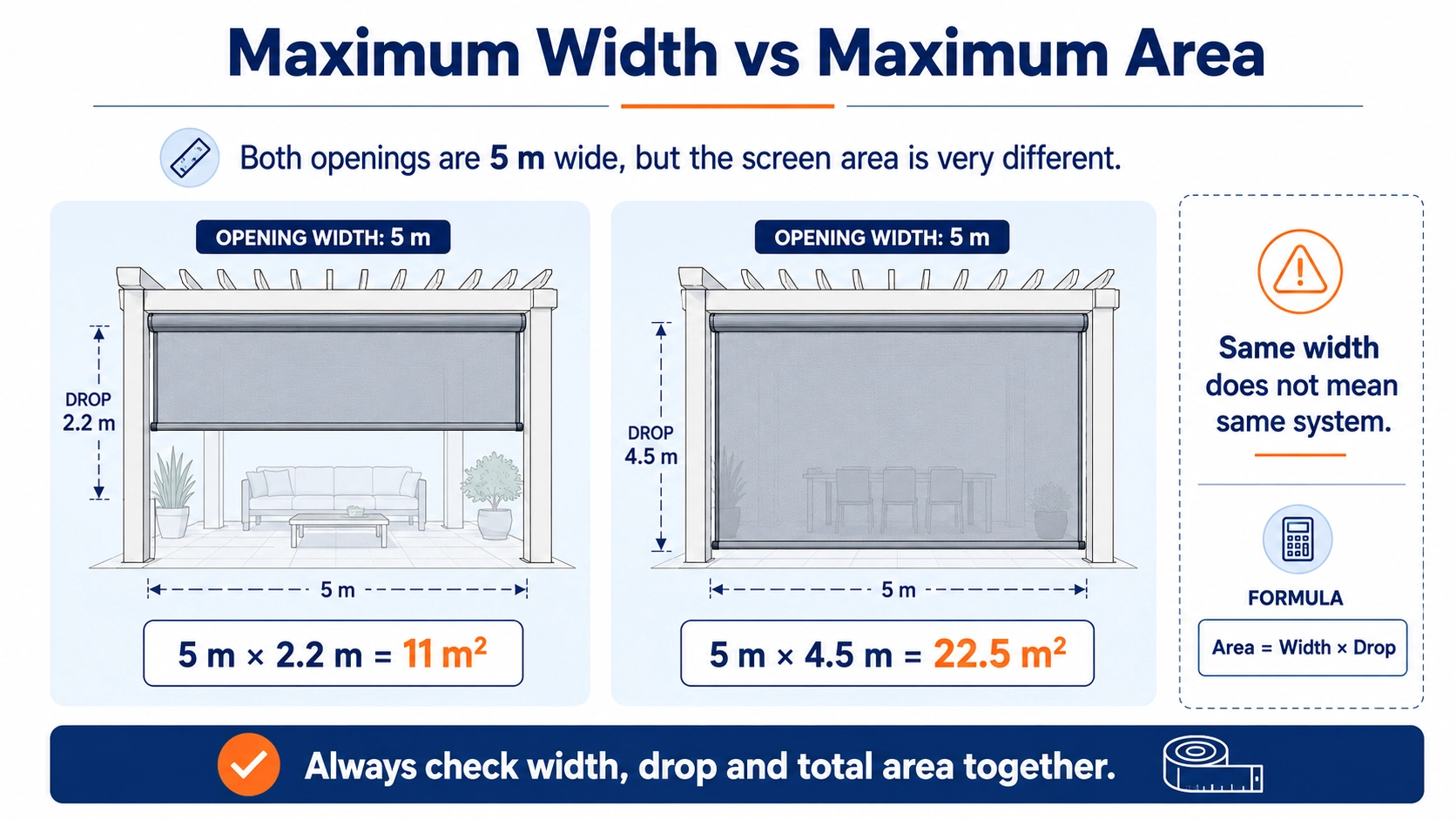
5 m × 2.2 m = 11 m²
5 m × 4.5 m = 22.5 m²
Both are 5 m wide. But the second has more than twice the fabric area.
Under the same simplified wind-pressure assumption, the larger surface transfers substantially more total force through the system:
Real wind loading is more complicated than area alone. Building height, surrounding structures, façade position, corners and gust conditions can all affect the pressure acting on an outdoor screen.
But the example explains an important purchasing principle:
Ask instead: “Can your recommended system operate at my exact 5 m × 4.5 m size, with this fabric and installation condition?”
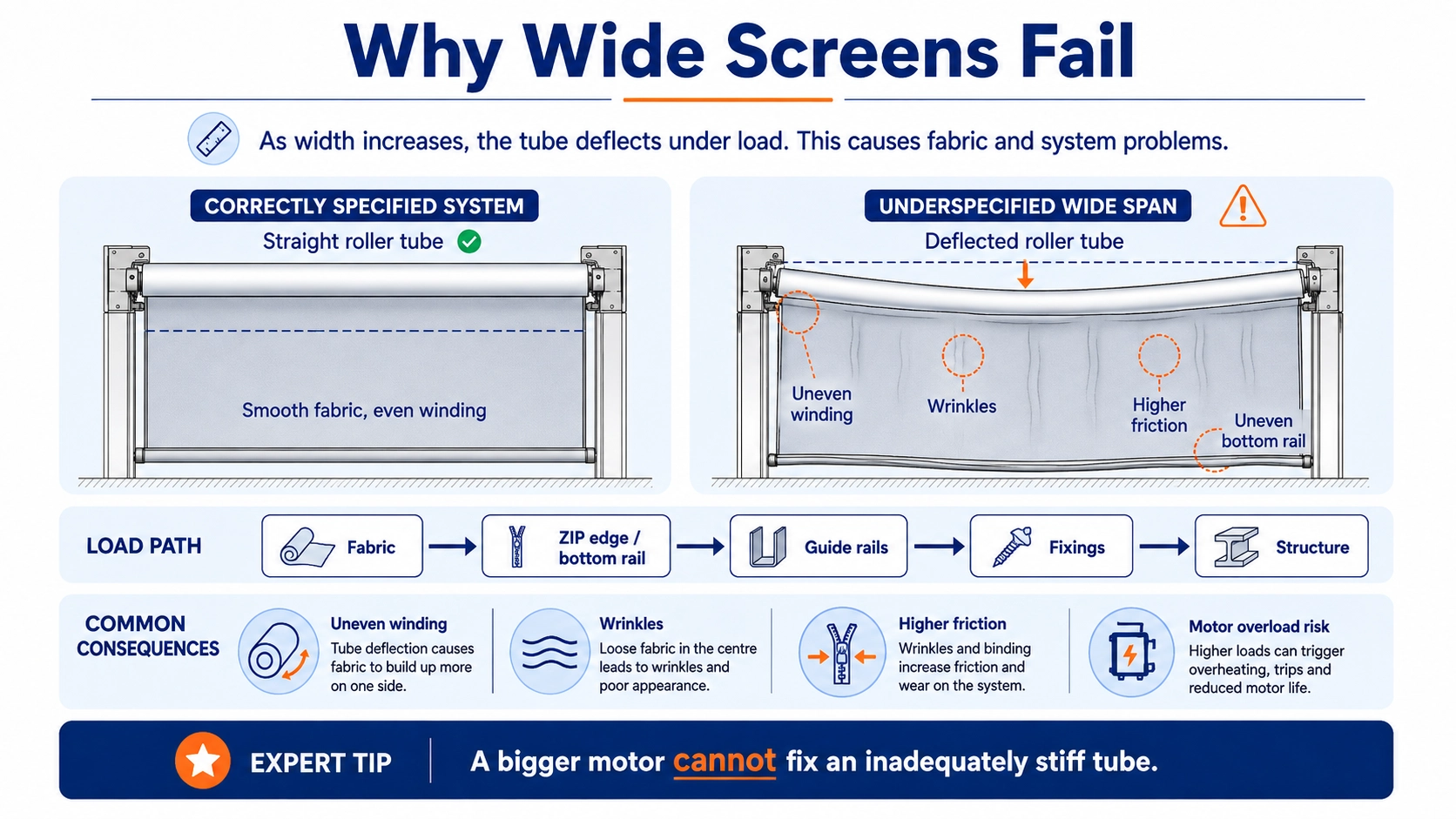
Roller Tube Deflection: The Risk Buyers Rarely See in a Brochure
Why can't a manufacturer simply use a longer roller tube?
Because a roller tube behaves like a beam.
As its unsupported span increases, resistance to bending becomes increasingly important. The fabric, bottom rail and other system components all add load across that span.
If the tube is not sufficiently stiff, it can develop a shallow downward deflection through the centre.
It may not look dramatic at first. But the fabric is no longer winding around a perfectly straight axis.
That can lead to:
- uneven fabric winding;
- wrinkles during operation;
- fabric tracking toward one side;
- bottom-rail misalignment;
- additional friction and abnormal operating noise.
When friction increases, the drive system also has to work harder.
This does not mean every 5 m or 6 m blind will visibly sag or damage its motor. A properly configured wide system is designed to control these effects.
The problem appears when a long opening is treated like a standard residential blind and the roller tube is selected only because it can physically be manufactured at that length.
For a 5–6 m screen, do not ask only what motor is installed. Ask which roller-tube configuration is specified for your actual width, drop and fabric.
A larger motor cannot compensate for an inadequately stiff roller tube.
The same principle applies to the guide rails.
A strong ZIP edge provides little benefit if the side rails cannot remain parallel or are attached to a weak decorative surface.
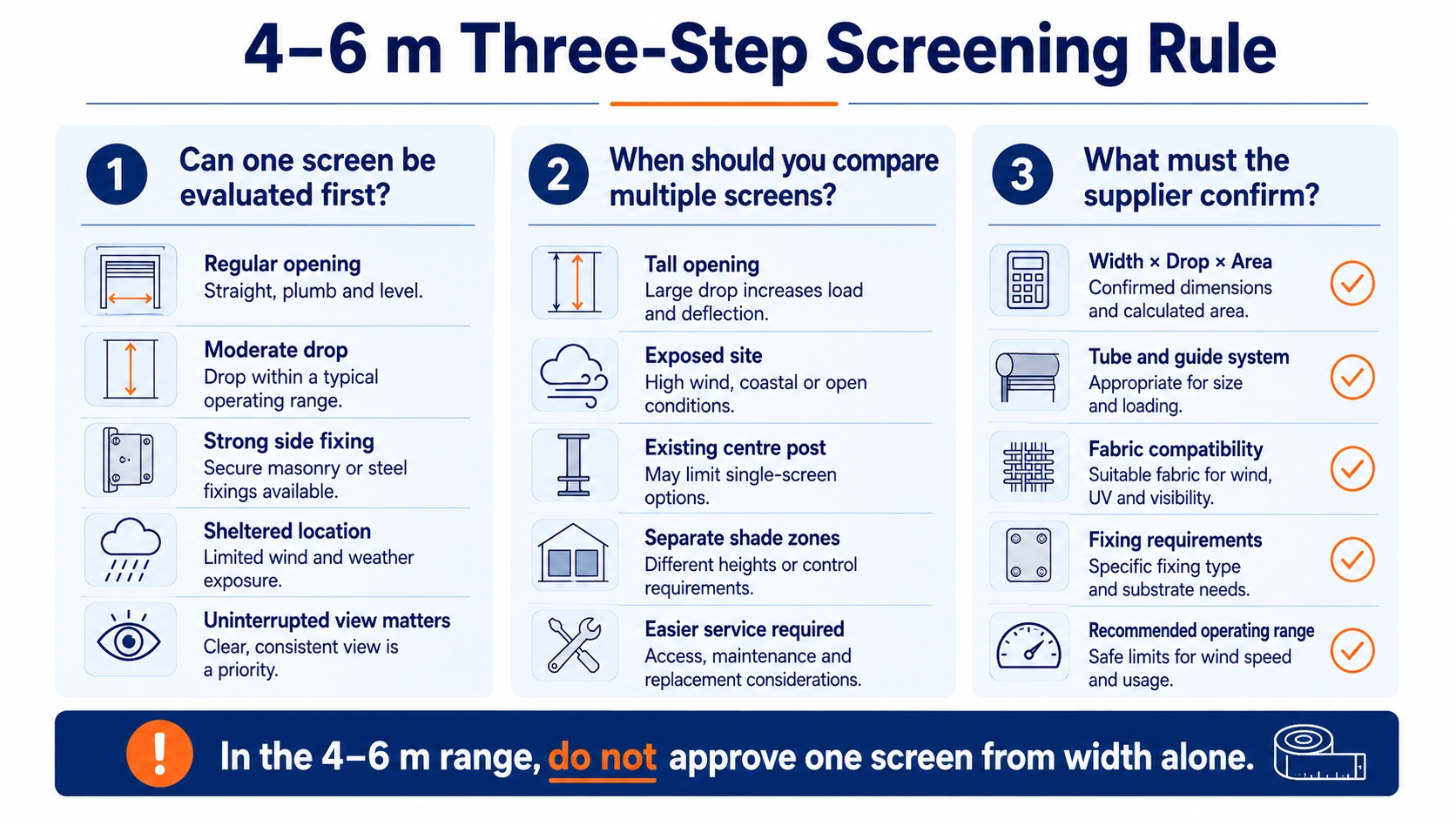
Your Opening Is 4–6 m Wide: Use This Three-Step Screening Rule
This is the range where buyers most often need a clearer decision.
A 5.5 m patio still looks like one opening, so the natural reaction is: “I want one blind across the whole thing.”
That may be the right solution. But do these three checks first.
Step 1: Is One Screen Still a Sensible Starting Point?
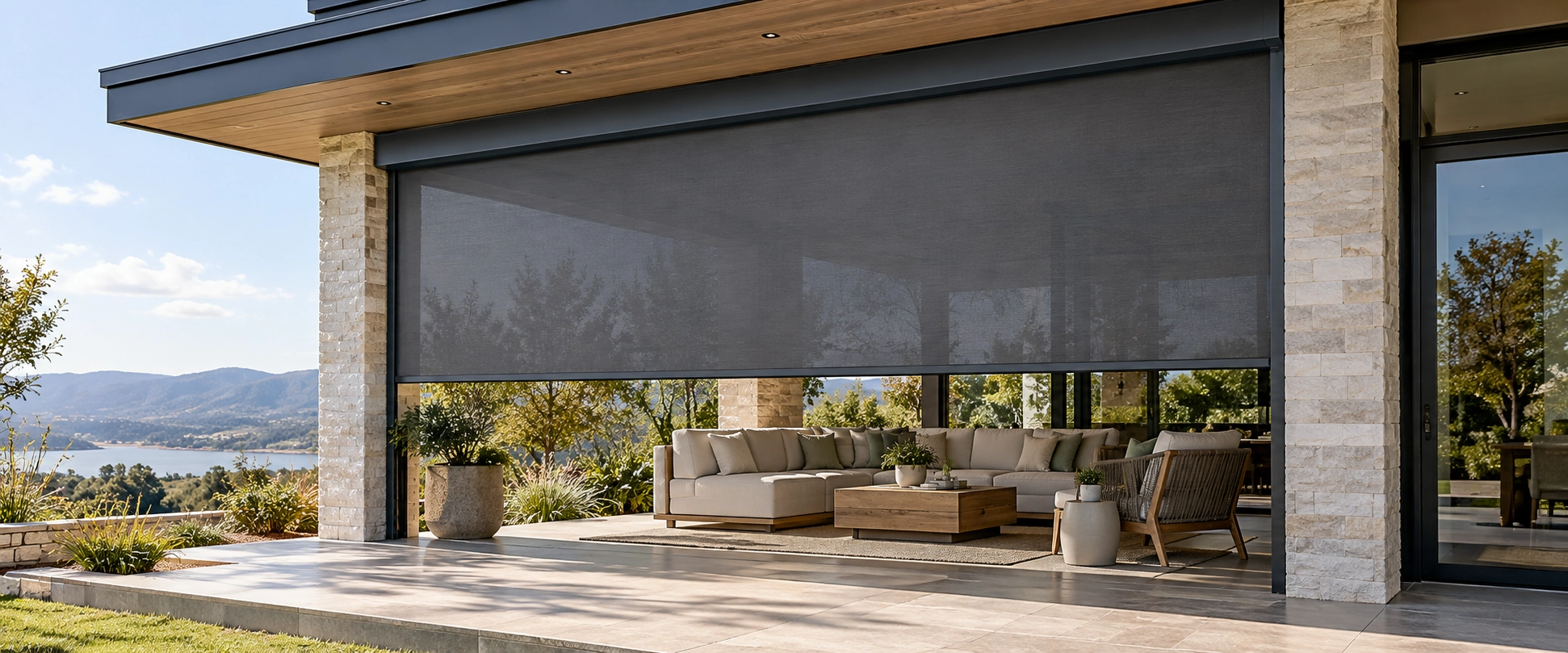
Start by evaluating one large screen when the opening is regular, the side structures are strong and straight, the drop is moderate, and an uninterrupted view is genuinely important.
Total area: 11 m²
This may be a reasonable candidate for one large ZIP-guided screen, provided the selected system and fixing conditions are suitable.
The important word is candidate. “One screen can be evaluated” is not the same as “one screen is automatically approved.”
Step 2: When Should You Compare Multiple Screens First?
Total area: 22.5 m²
Same width. More than twice the area.
This project should not be treated like the 5 m × 2.2 m patio above.
A split layout should be compared early when the opening is both wide and tall, the site is highly exposed, the pergola already has structural centre posts, or different sections need independent shade or privacy control.
Maintenance matters too.
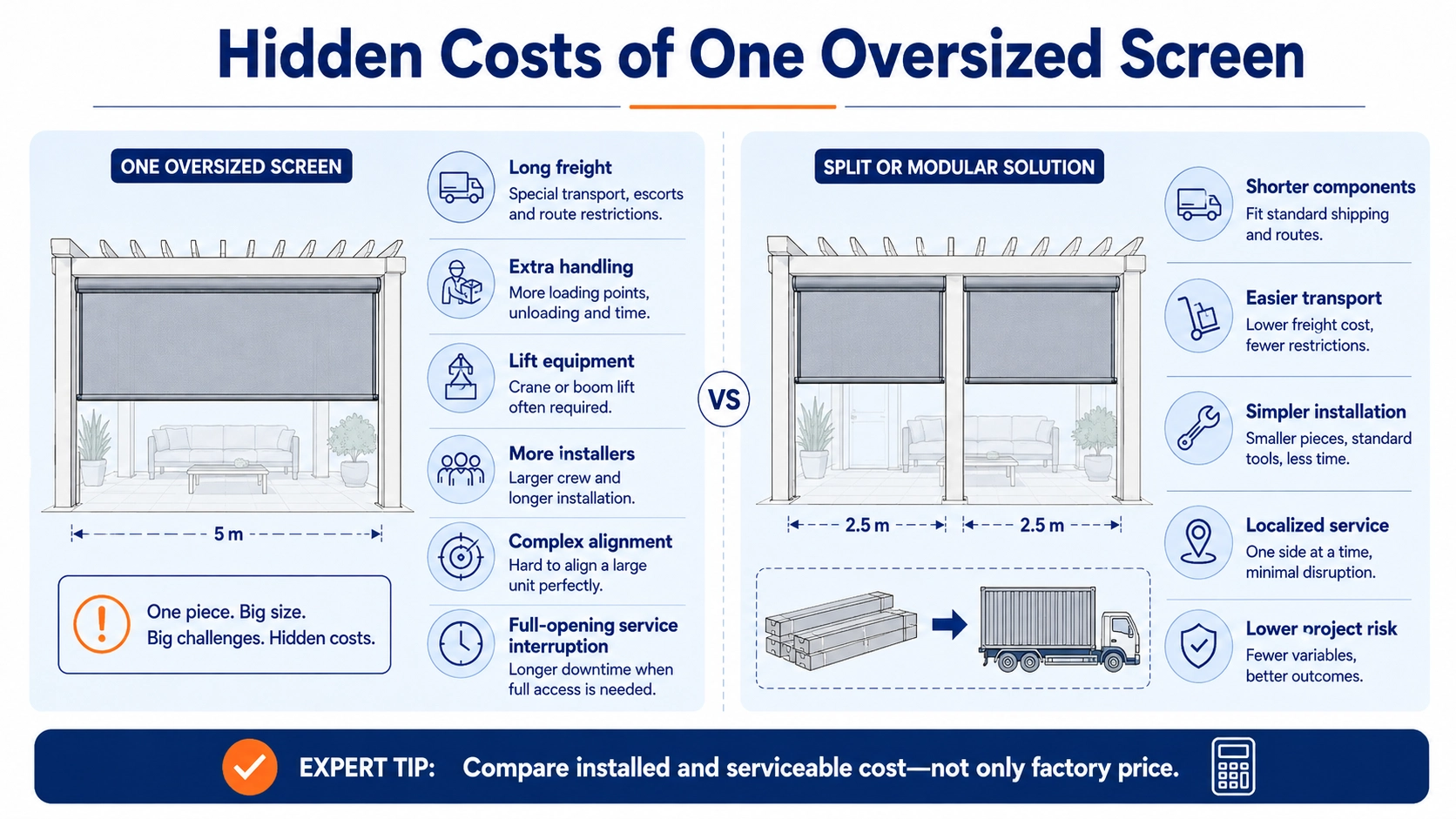
One oversized screen means one motor, one fabric assembly and one operating system serve the entire opening. If major service is required, the whole opening may be unavailable.
Two independent screens localize that risk. You introduce a centre division, but you may gain easier installation, simpler servicing and more flexible operation.
If a pergola already has a strong centre post, ask what you are actually gaining by forcing one screen across both bays.
Sometimes removing one visual line creates several technical problems in return.
Step 3: Make the Supplier Confirm the Whole Configuration
Before approving a 4–6 m outdoor blind, ask the supplier to confirm three things.
- What width × drop × total area are recommended together?
- What roller tube, guide rail, ZIP retention, fabric and drive system are specified for your exact dimensions?
- Is this the recommended long-term operating configuration, or simply the largest size the supplier can manufacture?
A supplier saying “we can produce 6 m” is not the same as demonstrating that your exact 6 m × 4 m configuration sits comfortably within the intended operating range.
Over 6 m: The Hidden Cost Is Not Just the Blind
Above 6 m, many buyers focus on one goal:
But contractors and project buyers should ask another question first:
Very long blinds create costs that often do not appear in the initial product price.
A long one-piece cassette or roller tube can create problems with transportation, access, lifting and on-site alignment.
Imagine a 7 m cassette arriving at a hotel renovation.
Can it reach the terrace through the building? Can it turn through the access route? Does it need to be lifted externally? How many installers are required to position it while keeping the cassette and guide rails aligned?
These are not minor site details. They affect the actual installed cost.
Why Modular Construction Matters
For genuinely wide openings, modular construction can solve a logistics problem as well as a shading problem.
Depending on the system architecture, cassette sections, roller tubes or bottom rails may be transported in shorter sections and connected or assembled on site.
The Maintenance Cost of One Oversized Screen
Installation is only the first cost.
What happens several years later if the motor requires replacement, the fabric is damaged or an internal component needs servicing?
With one oversized screen, a major service event can affect the whole opening. With multiple independent screens, the problem may remain limited to one section.
That is why project buyers should compare:
A split layout can sometimes cost more in visible hardware but less over the full project life if it reduces transportation, lifting, installation and future service complexity.
A 7 m Pergola: One Screen or Two?
A 7 m opening shows why there is no universal answer.
Scenario A: There Is Already a Strong Centre Post
Opening: 7 m × 2.5 m
The pergola already has a structural centre post. The customer wants afternoon shade and privacy but does not always need both sides closed.
Two independent screens are a strong starting point.
The structure is already divided into two bays. Each side can operate independently, components are easier to transport, and servicing one screen does not necessarily stop the other from operating.
Scenario B: There Is No Centre Post
Opening: 7 m × 2.5 m
Now the customer has a pool or landscaped garden outside and wants to preserve an uninterrupted view.
The side and head structures are suitable.
Here, automatically adding a centre post may solve the wrong problem.
A purpose-built extra-wide ZIP screen should be evaluated first. Before approval, the supplier should confirm total screen area, roller-tube configuration, guide system, fabric compatibility, fixing structure, exposure, transportation and future service access.
How NewHoo Approaches Wide-Opening Projects
NewHoo does not apply one universal maximum-width number to every outdoor roller blind.
A wide-opening project should first be matched to the appropriate system direction, then the exact dimensional limits should be confirmed from the current technical specification.
| System Direction | Suitable Starting Point | What Must Be Confirmed |
|---|---|---|
| Standard ZIP System | Regular patio, balcony or pergola opening | Width × drop × area, fabric and fixing surface |
| Reinforced ZIP System | Wider, taller or more demanding opening | Roller tube, guide rails, motor, area and mounting |
| Extra-Wide Solution | Opening beyond conventional single-screen range | Single, modular or split layout, logistics and maintenance |
This approach is more useful than publishing one large number and implying that it applies to every project.
For very wide openings, NewHoo can evaluate whether the project is better suited to a reinforced single ZIP screen, a purpose-built extra-wide solution, a modular configuration or multiple independent screens.
Before You Order, Ask These Four Questions
If the supplier provides only maximum width, ask for the corresponding drop and total area.
Do not accept “our standard system” as a complete technical answer for a large opening.
Ask which screen size, guide configuration, fixing arrangement and operating conditions the claim applies to.
For an extra-wide screen, logistics and maintenance are part of system design—not issues to solve after production.
What Should You Send for an Initial Size Check?
You do not need final production drawings just to determine which system direction makes sense.
1. Approximate opening width × height
2. One clear photo showing the complete opening, top structure and both sides
3. Project location and whether the site is sheltered, open, high-rise or coastal
From this information, the project can first be screened for a standard ZIP system, reinforced system, extra-wide solution or split layout.
Final Decision Framework
Under 4 m: Start with a standard guided or ZIP system, then verify the drop and fixing surfaces.
4–6 m: Check whether a single span is sensible, compare a split layout where it adds real value, and require confirmation of the complete width × drop × area configuration.
Over 6 m: Compare a purpose-built extra-wide system with a split or modular layout before choosing based on appearance alone.
High-rise, highly exposed or weak structure: Site exposure and anchorage may become more important than nominal width.
Frequently Asked Questions
Can an Outdoor Roller Blind Be 5 or 6 Metres Wide?
Yes. Large-format ZIP systems can be evaluated for openings in this range. However, screen height, total area, roller tube, guide rails, fabric and fixing conditions must also be confirmed before a single unit is approved.
Can One ZIP Screen Cover a 7 m Pergola Opening?
Possibly. If the pergola already has a structural centre post or needs independent operating zones, two screens may be more practical. If uninterrupted views are important and the supporting structure is suitable, a purpose-built extra-wide system can be evaluated.
Is One Large ZIP Screen Better Than Two Smaller Screens?
Not automatically. One large screen provides a cleaner uninterrupted view. Multiple screens can provide independent operation and may reduce transportation, installation and service complexity.
Does a Wider Blind Need a Stronger Roller Tube?
As span and supported load increase, roller-tube stiffness becomes more important. The appropriate tube should therefore be selected according to width, drop, fabric and the complete system configuration.
What Information Does NewHoo Need for an Initial Recommendation?
Start with your approximate opening width and height, one clear opening photo and the project location or basic exposure conditions. Detailed measurements and fixing information can be confirmed after the initial system direction is identified.
How to Measure for ZIP Screens Before Ordering
Can ZIP Screens Be Installed on Uneven or Out-of-Square Openings?
Related Article