Large Outdoor Roller Shades for Wide and Tall Openings
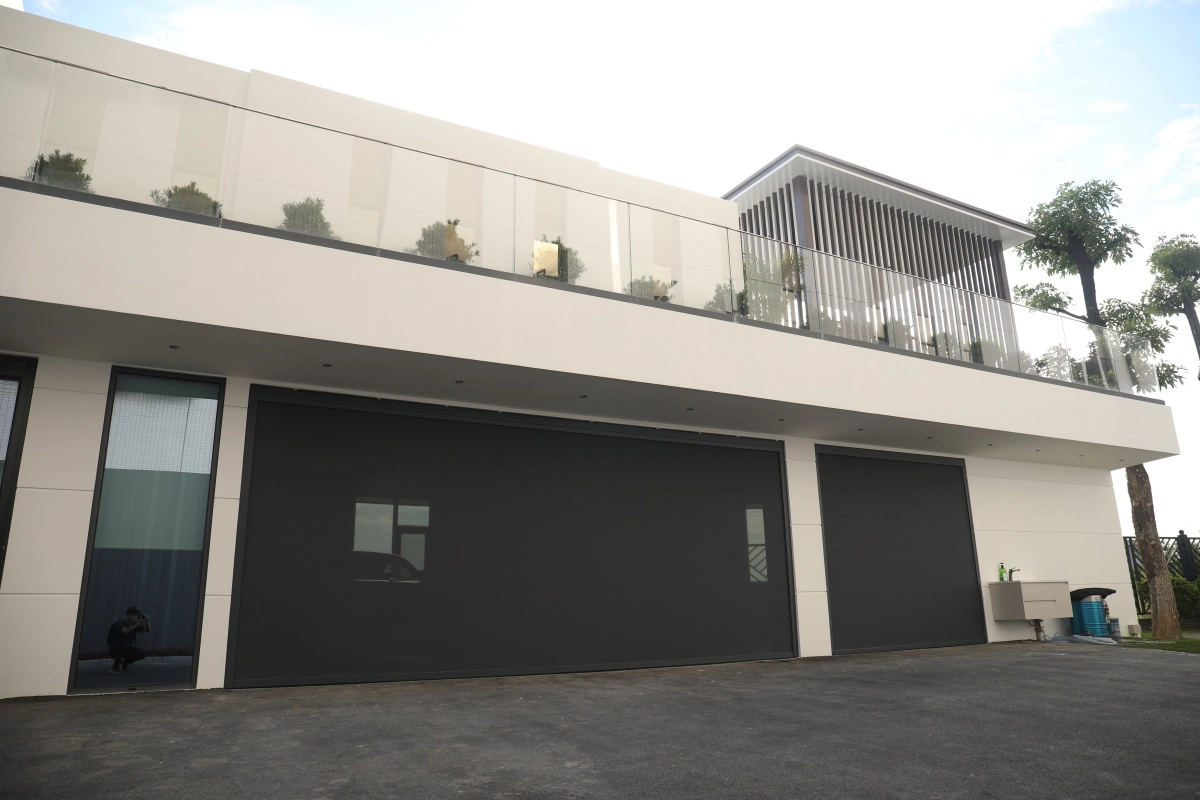
A wide patio span or a tall glass wall can look simple in a drawing. The opening is clear, the shade line is clean, and the specification seems easy: make the shade wide enough or tall enough to cover the space.
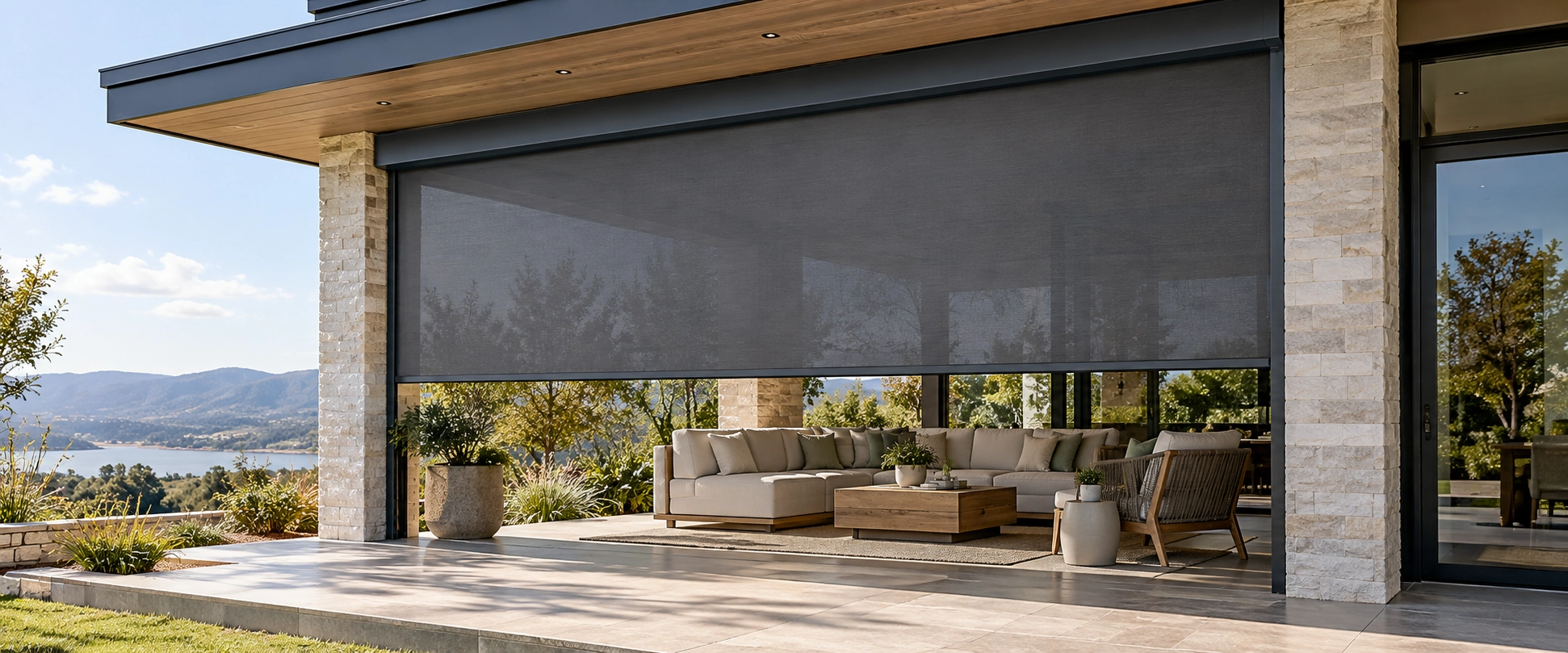
On site, large outdoor roller shades behave differently. Once the opening reaches several meters in width or height, the system is no longer just a larger version of a standard patio shade. The fabric area increases, the roller tube carries more load, the side channels work harder to hold the fabric edge, and the motor must lift the system through longer or heavier cycles.
For distributors, hotel contractors, pergola builders, façade designers, and outdoor shading suppliers, the real question is not only “What is the maximum size?” The better question is: can the complete system control tube deflection, wind load, fabric tension, motor torque, and long-term operation without creating service problems later?
In B2B specifications, these systems may also be called large-size windproof roller blinds, extra-wide windproof roller blinds, extra-high windproof roller blinds, large-size zip screen blinds, or motorized exterior roller shades. This guide explains what to check before specifying large outdoor roller shades for wide or tall openings.
Quick Summary
Large outdoor roller shades need more than a wider fabric panel. A reliable system usually depends on five technical areas.
First, wind-resistant performance comes from a side-channel or zip-guided fabric retention system, not from free-hanging fabric alone. Second, the roller tube must be strong enough to control deflection across wide spans. Third, the bottom rail must provide enough tension without overloading the motor. Fourth, the fabric edge and any spliced seams should be made for outdoor UV, moisture, and friction. Fifth, the motor and control system must match the size, use frequency, and project integration needs.
For large projects, motorized operation is normally the practical baseline. Manual chain drive or bead chain operation may work for small blinds, but it is not suitable for extra-wide or extra-high outdoor systems.
Wide and Tall Openings Create Different Mechanical Loads
A wide opening and a tall opening do not fail in the same way.
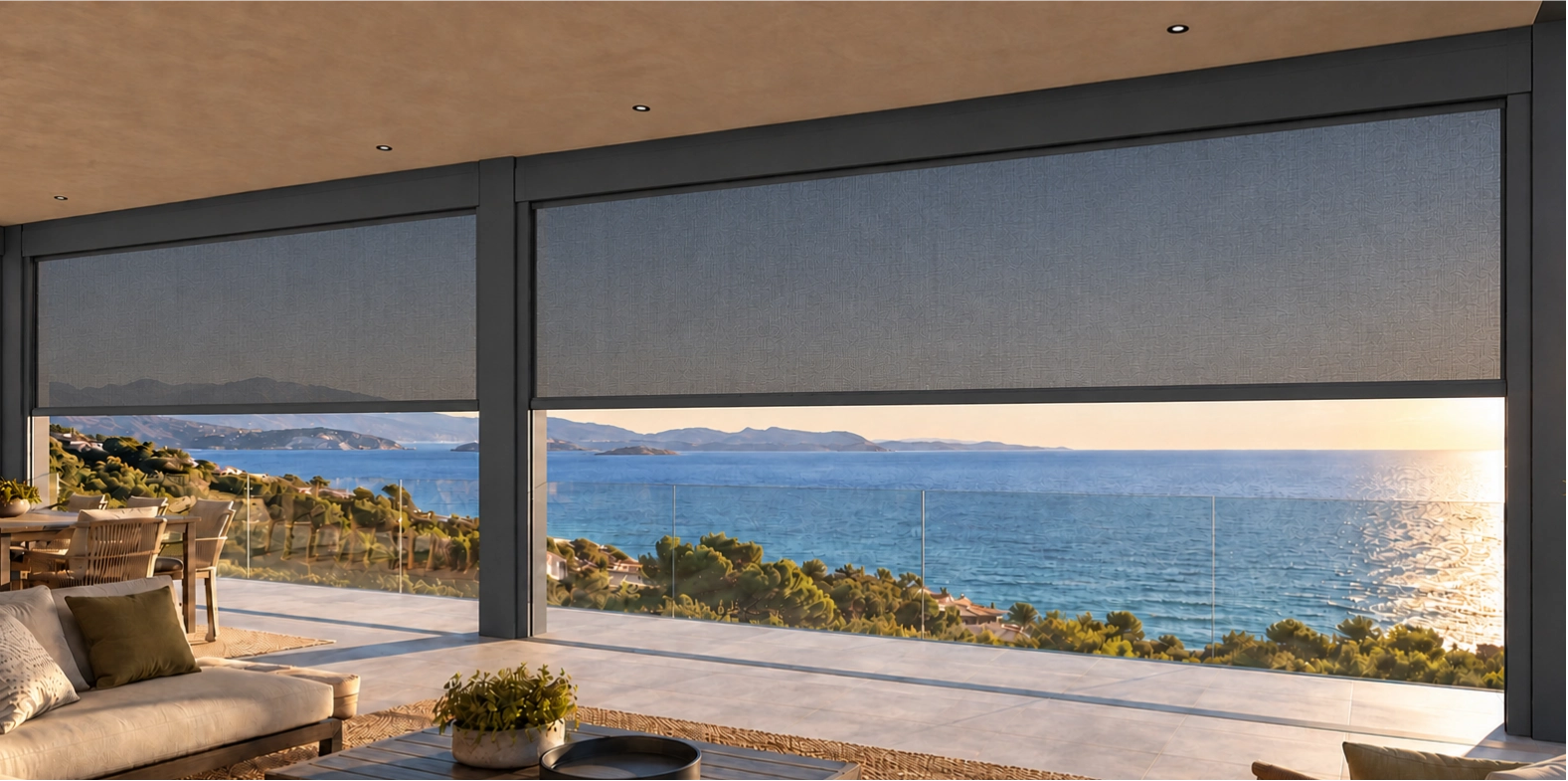
For an extra-wide opening, the main challenge is span control. A roller tube that spans five or six meters must resist bending across the center. If the tube is underspecified, even small deflection can disturb fabric tension, cause horizontal wrinkles, and affect how the fabric edge tracks inside the side channels.
For an extra-high opening, the main challenge shifts to vertical load and travel alignment. As the shade drops several meters, more fabric is deployed, the motor carries more load, and small guide-rail alignment errors become more visible over the full travel distance. A small mismatch at the top can become fabric tracking noise, zipper-edge stress, or uneven rolling after repeated use.
That is why a wide-but-short opening and a narrow-but-tall opening should not automatically use the same system. Both may be large outdoor roller shades, but they require different tube, motor, side-channel, bottom-rail, and fabric decisions.
Reference Engineering Factors for Large Outdoor Roller Shades
For preliminary project discussion, the following factors are usually more useful than a single “maximum size” claim.
| Engineering Factor | What to Check |
|---|---|
| Single-unit width | Final width depends on wind exposure, fabric type, tube strength, and installation surface. |
| Single-unit drop | Taller drops need matched motor torque, side-channel alignment, and bottom rail weight. |
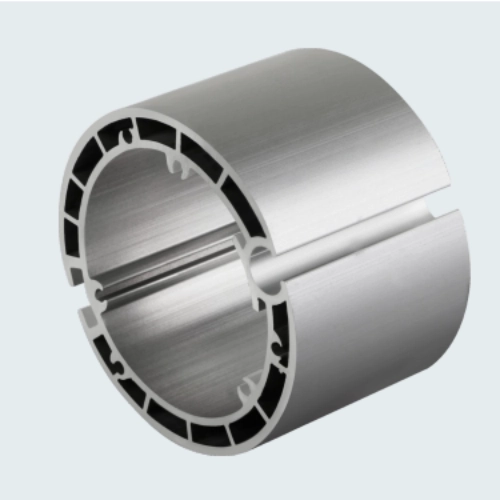
| Roller tube | Larger-diameter or reinforced tubes help control tube deflection. |
| Profile material | 6063-T5 extruded aluminum is commonly used for strength, profile stability, and outdoor durability. |
| Fabric edge and seams | High-frequency welding can create cleaner seams and stronger fabric-edge construction than standard stitching. |
| Motor torque | Large systems may require higher-torque tubular motors depending on fabric weight, tube size, and bottom rail load. |
| Automation | RS485, Dry Contact, Zigbee, Matter, Somfy, Dooya, Tuya, or project-specific control integration may be required. |
| Wind performance | Wind rating must be confirmed according to size, installation condition, fabric, fixing structure, and local exposure. |
The key point is simple: maximum size is only a reference. A large outdoor shade installed in a protected courtyard does not face the same load as one installed on a coastal terrace, exposed façade, or high-level balcony.
Smart Balancer: A Self-Centering Fabric Entry Guide
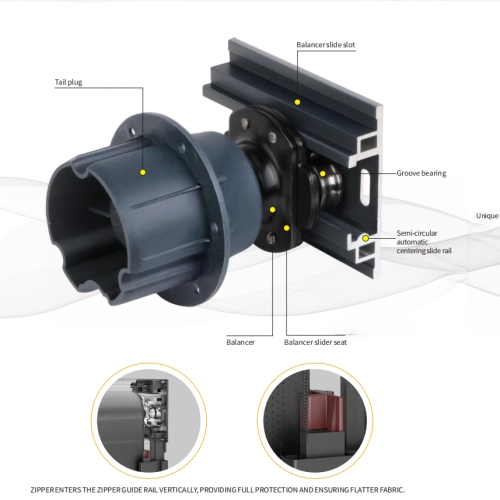
On large outdoor roller shades, the fabric edge has to enter the side channel smoothly every time the shade moves. That is easy to say and harder to achieve when the system is very wide, very tall, or exposed to shifting outdoor airflow.
NewHoo’s Smart Balancer works as a self-centering entry guide at the headbox-to-side-channel area. Its job is to help the fabric edge enter the channel straighter, rather than scraping into the track at an angle. This helps reduce unnecessary friction, zipper-edge wear, fabric offset, and tracking resistance during repeated operation.
This part is especially useful for extra-wide windproof roller blinds and extra-high windproof roller blinds. Larger systems have less tolerance for poor fabric entry. If the fabric edge enters the channel at a slight angle every day, that small misalignment can become a real maintenance issue over time.
The Smart Balancer is not a decorative feature. It is a small hardware detail designed to protect the running path of a large zip screen system.
High-Frequency Welding and Fabric Splicing
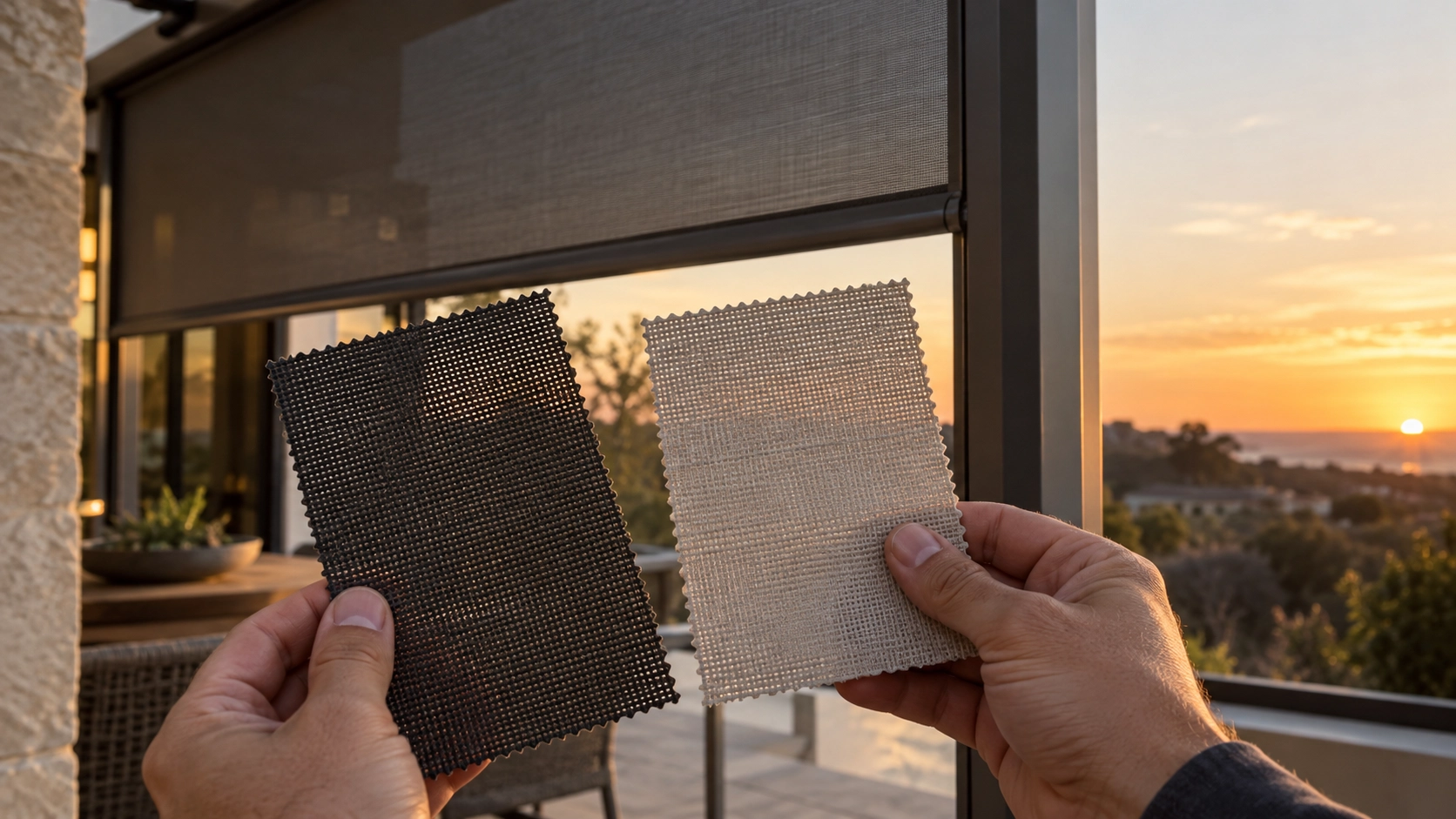
Fabric width is often the hidden bottleneck in large outdoor roller shades. Many outdoor screen fabrics are produced in standard roll widths. When a project requires a very wide or tall single unit, fabric splicing may become part of the solution.
This is where seam quality matters. Traditional stitching creates needle holes and thread lines that can weaken under long-term UV exposure, moisture, and repeated edge friction. In large-size exterior shading, the seam is also more visible because the fabric surface is larger.
High-frequency welding, often called HFW, fuses fabric panels together without the same needle-hole structure created by sewing. For large outdoor roller shades, HFW can help create a flatter seam, improve water resistance at the joint, and support better surface uniformity across wide fabric areas.
Fabric splicing should not be treated as a late-stage production detail. For visible hotel façades, premium residential terraces, restaurants, and commercial outdoor spaces, the splicing method can affect both appearance and long-term acceptance.
Motorization: Torque Is Not the Whole Story
For large outdoor roller shades, motorized operation is normally the standard choice. The system is too heavy for normal manual chain drive or bead chain operation, especially when the shade uses a larger tube, heavier outdoor fabric, and a weighted bottom rail.
Motor torque matters, but torque alone does not solve every problem. A high-torque motor installed into a weak tube can create new stress. A strong tube with an undersized motor can still run slowly, stop unevenly, or overheat. The motor, tube, fabric weight, bottom rail, and running resistance have to be matched together.
For commercial projects, control compatibility also matters. Hotels, pergolas, restaurants, and façade projects may require wall switch control, remote control, group control, smart control, or building management system integration. RS485, Dry Contact, Zigbee, Matter, Somfy, Dooya, and Tuya compatibility may need to be discussed before production, not after installation.
For extra-wide and extra-high systems, motorization is not a premium upgrade. It is part of the basic operating structure.
Side Channels, Bottom Rail, and Anchoring Surface
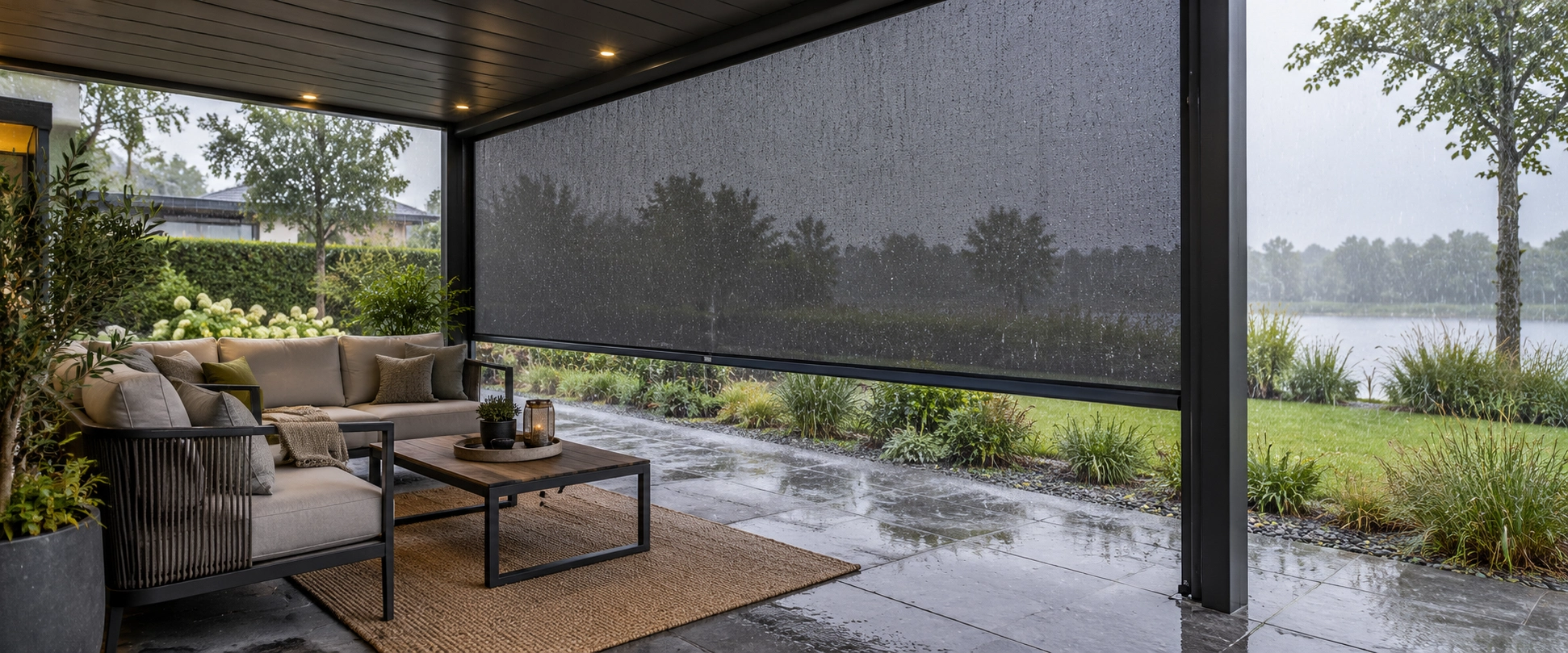
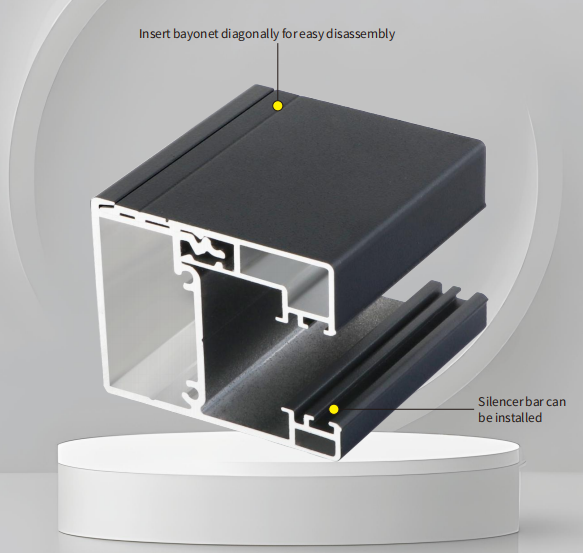
Side channels are not decorative tracks. In large-size zip screen blinds, they retain the fabric edge and help the shade stay stable under wind load. Channel depth, profile rigidity, internal clearance, and fixing strength all affect how the shade performs.
The bottom rail also has a direct effect on operation. Too light, and the fabric may not lower smoothly. Too heavy, and the motor and tube carry unnecessary load. The correct bottom rail keeps the fabric under tension without turning the system into a heavy, overloaded assembly.
The fixing surface deserves the same attention. A large outdoor shade behaves like a sail when wind hits the fabric. This does not mean the system is unsafe; it means the cassette and side channels need to be fixed to reliable structural surfaces, such as structural concrete, reinforced steel, or approved framing. Weak cladding, thin timber, or non-structural surfaces can turn a good shade system into a bad installation.
For large outdoor roller shades, the product and the substrate must be considered together.
Common Project Mistakes
One common mistake is specifying by maximum size alone. A catalog may list a large width or drop, but that number changes meaning depending on wind exposure, fabric type, tube structure, and installation condition.
Another mistake is blaming every wrinkle on the fabric. When a large shade sags or rolls unevenly, fabric quality is not always the root cause. Tube deflection, bottom rail mismatch, side-channel misalignment, or insufficient motor torque may be the real problem.
A third mistake is treating motorization as optional. For extra-wide windproof roller blinds and extra-high windproof roller blinds, manual operation usually creates a poor user experience and increases the chance of complaints later.
The fourth mistake is ignoring the installation surface. Even a well-engineered large-size windproof roller blind can perform poorly if the top housing and side channels are not fixed into a structure that can handle the load.
What an Engineering-Focused Manufacturer Should Provide
For large outdoor roller shades, a manufacturer should support more than basic production. Project buyers usually need structural recommendations, fabric matching, motor compatibility, CAD submittals, packaging protection, and stable repeat supply.
For example, a serious B2B supplier should be able to discuss whether the project needs reinforced roller tubes, 6063-T5 aluminum profiles, HFW fabric welding, Smart Balancer fabric guidance, high-torque motor options, or specific control protocols.
NewHoo supports this type of project discussion through heavy-duty aluminum system design, high-frequency welding capability, Smart Balancer fabric guidance, and motor integration options for brands and platforms such as Somfy, Dooya, Tuya, RS485, Dry Contact, Zigbee, and Matter. For oversized components, packaging and transport protection also need to be planned early so long profiles arrive straight and usable on site.
The point is not to choose a product name first. The point is to match the system to the project risk.
Project Information to Prepare Before RFQ
For an accurate technical quote, prepare the opening width and height, installation location, wind exposure condition, mounting surface, fabric type, color and openness factor, splicing acceptance, motor preference, control protocol, project quantity, shipping destination, and available drawings or site photos.
For extra-wide projects, tube deflection control, side-channel rigidity, bottom rail matching, and fabric flatness deserve early review. For extra-high projects, motor torque, fabric travel, vertical guide alignment, and service access need more attention.
The better the project information, the more accurate the system recommendation. A shade that only fits the opening is not enough; it must also run smoothly, resist wind movement, and stay serviceable after installation.
Conclusion
Large outdoor roller shades for wide and tall openings are not standard patio shades with larger dimensions. They are exterior shading systems where fabric, tube, motor, side channels, bottom rail, Smart Balancer, seam method, and anchoring structure all affect the final result.
For wide openings, the first risk is tube deflection. For tall openings, the first risk is vertical load and travel alignment. For exposed outdoor spaces, wind load and fabric retention must be reviewed together with size.
A reliable large outdoor roller shade is defined by how well the system controls movement at scale: the tube stays stiff, the fabric stays flat, the side channels hold the fabric edge, the motor runs within its load range, and the installation structure can support the system in real outdoor conditions.
Applications of Electric Roller Blinds
Indoor Guided Roller Blinds for Windows and Enclosed Balconies
Related Article