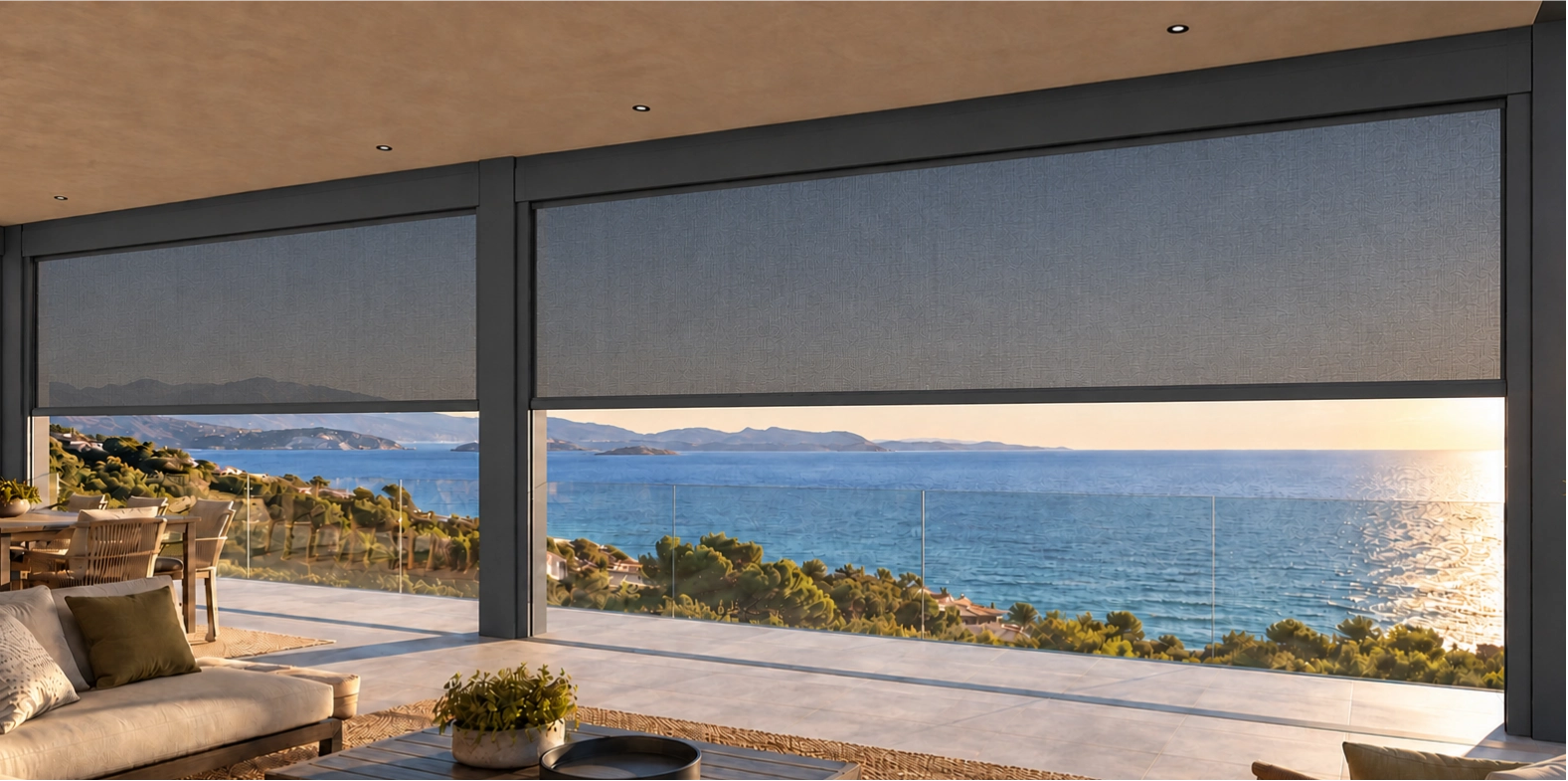
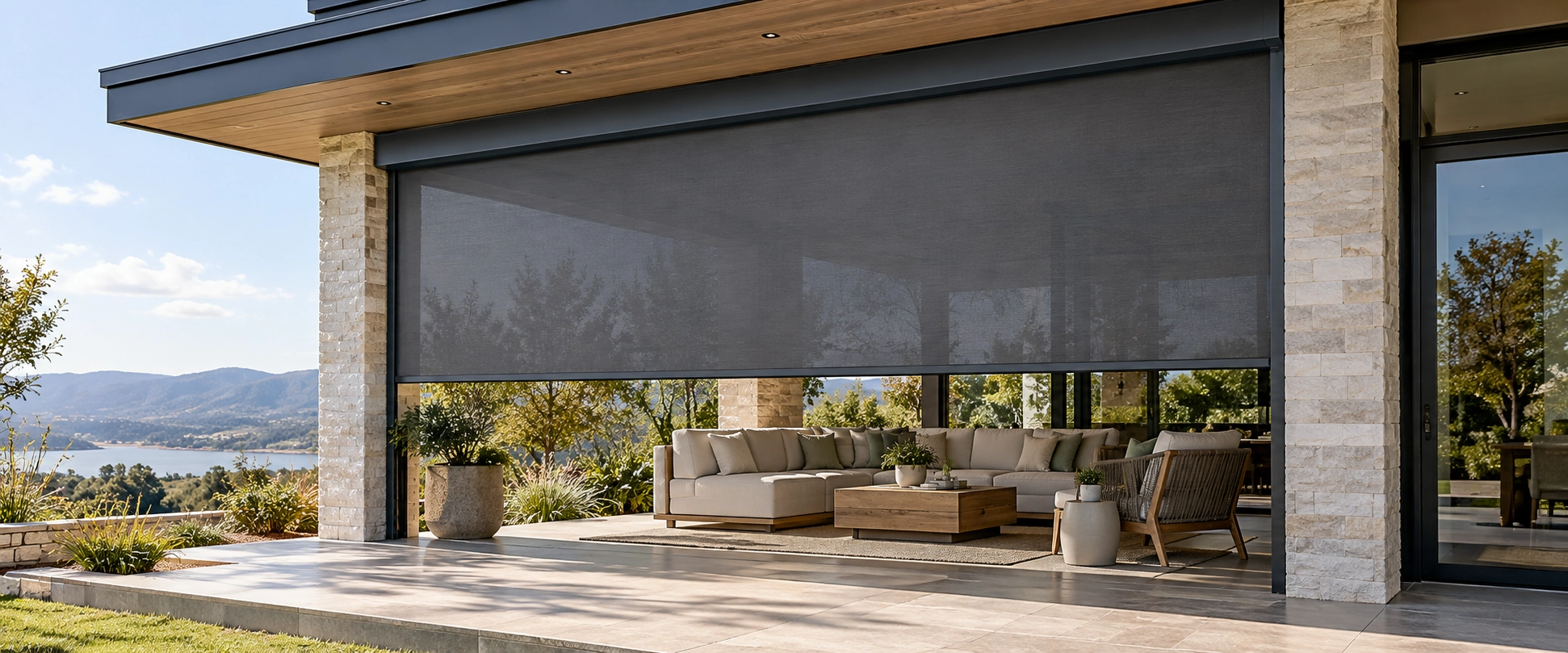
How Do Windproof Roller Blinds Resist Wind—and Why Do ZIP Tracks Jam?
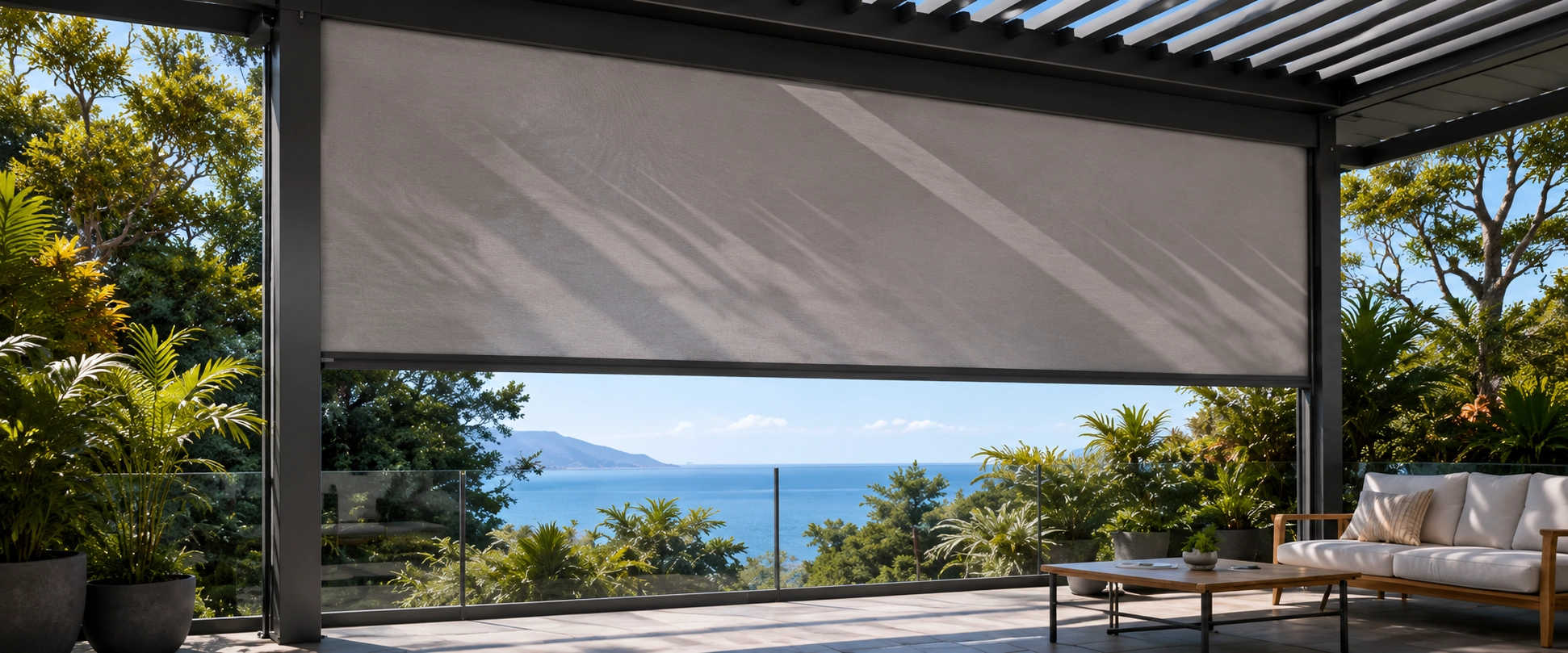
A gust hits the patio. The blind squeaks on one side, the bottom rail tilts, and the motor stops halfway. Pressing the remote again changes nothing.
The motor is often blamed first. In practice, it may only be reacting to a deeper problem: non-parallel tracks, wind pressure pushing the ZIP edge against the guide, roller-tube deflection, or fabric tightening after hours in direct sun.
For project buyers, distributors and installers, the key point is simple:
A windproof roller blind is not just fabric held between two rails. It is a complete load-transfer and guidance system.
How a ZIP Blind Transfers Wind Load
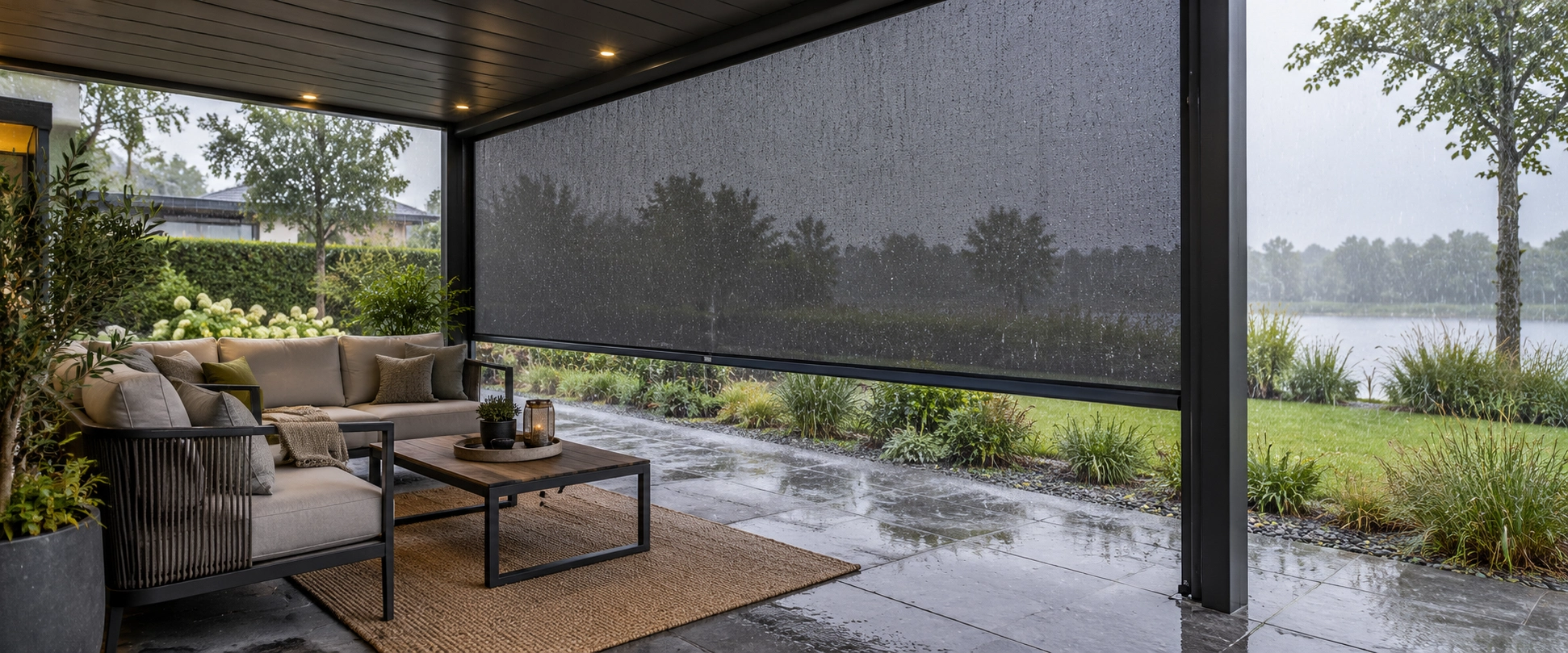
A conventional outdoor roller blind relies heavily on the bottom rail and fabric weight. The fabric edges remain relatively free, so wind can make the blind billow, flap or move sideways.
A ZIP-guided blind works differently.
Wind pressure acting on the fabric is transferred through a continuous structural path:
Fabric → ZIP edge → guide insert → side rail → fastener → supporting structure
Each component has a specific job:
- The fabric receives the wind pressure.
- The reinforced ZIP edges control lateral fabric movement.
- The internal guides hold the ZIP edges inside the rails.
- The aluminum rails transfer the load into the fixings.
- The fasteners transfer the load into the wall, post or frame.
If one part is weak, thicker fabric will not rescue the system. Common weak points include an undersized roller tube, widely spaced fixings, anchors installed only into insulation, an unreinforced aluminum post or a damaged guide insert.
WR100 is NewHoo’s practical starting point for standard balconies, patios and outdoor openings. It commonly uses a 63 mm tube for openings under 4 m wide, with selected 55 mm bead-chain configurations for narrower openings. Motorized, manual-push, bead-chain and manual-crank options allow the system to match different heights, power conditions and budgets.
The Mounting Surface Is Part of the Blind
Concrete, hollow brick, timber framing, steelwork, aluminum posts and insulated façades require different fixing methods.
A rail fixed mainly into render or insulation may feel secure initially but loosen under repeated loading. Where the substrate is unknown, project-specific pull-out testing can help establish the selected fastener’s capacity in the actual material.
Site Check
Confirm the structural material, anchor type, fixing depth and screw spacing before production.
“Tested to 130 km/h” is not enough information to approve a blind.
Dynamic pressure can be expressed as:
q=12ρV2q=\frac{1}{2}\rho V^2q=21ρV2NASA defines dynamic pressure as one-half of air density multiplied by velocity squared. The practical result is that pressure rises with the square of wind speed.
Using an air density of 1.225 kg/m³:
| Wind Speed | Approximate Dynamic Pressure |
|---|---|
| 61 km/h | 176 Pa |
| 88 km/h | 366 Pa |
| 130 km/h | 799 Pa |
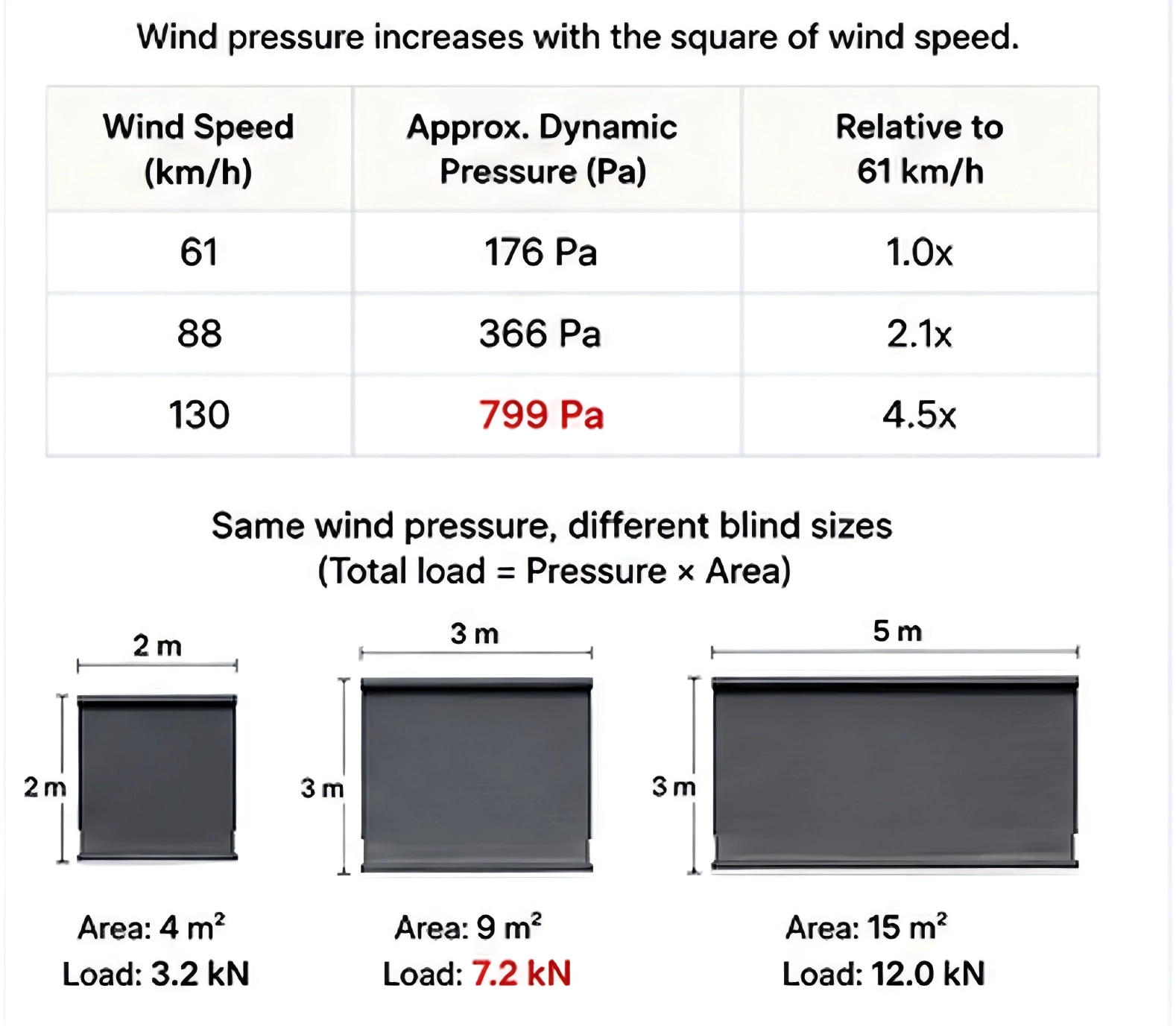
A 48% increase from 88 to 130 km/h therefore produces more than twice the dynamic pressure.
Blind area then multiplies the effect. A 3 m × 3 m blind has an area of 9 m². At 799 Pa, the simplified total load across the surface is about 7.2 kN.
The point is not that one rail receives all that force. It is that a rating obtained from a small test blind cannot automatically be applied to a much larger opening.
Before accepting a wind claim, ask for:
- Tested width, height and area
- Fabric type and openness
- Roller-tube diameter
- Side-rail and guide configuration
- Fastener type, spacing and substrate
- Applied pressure, duration and pass criteria
- Whether the blind remained operational afterward
A specimen that stayed attached but could no longer run normally is not equivalent to one that remained aligned and usable.
Maximum width and maximum height should not be combined automatically. WR120A uses different 60, 70 and 78 mm tube configurations and keeps the recommended area within 16 m²; the widest and tallest published dimensions do not form one permitted size.
Buyer Action
Compare the tested area, tube, rail, fixing and substrate—not just the headline wind speed.
3. Why ZIP Tracks Jam or Squeak
Roller-Tube Deflection
A tube that is too small can bend under the fabric and bottom-rail weight. The fabric then winds unevenly, one ZIP edge reaches the guide before the other, and friction rises on one side.
A stronger motor does not straighten the tube. It may force the misaligned edge harder into the guide.
WR100 suits regular outdoor openings. Pergolas need a different approach because airflow can enter from several directions.
WR110 is designed for pergolas, gazebos and terraces. It commonly uses a 63 mm tube below 4 m wide, while a 78 mm double-layer tube supports wider openings up to 5.4 m. WR110A adds a Smart Balancer for smoother fabric entry, while WR110B uses a plug-in mounting seat for easier installation and maintenance.
Tracks That Are Not Parallel
A blind that runs freely near the top but tightens near the bottom usually points to geometry, not motor torque.
Typical causes include:
- An opening that is not square
- A headbox that is not level
- Rail spacing that narrows toward the bottom
- Uneven walls or flexible pergola posts
- Long profiles bent during transport
Measure the width at the top, middle and bottom. Record the height on the left, center and right, and check both diagonals.
Restricted access can create alignment problems before installation begins. WR120C allows selected components to be transported in sections and connected on site, with a recommended width up to 5 m and a total area within 16 m².
Fabric Stability Under Temperature
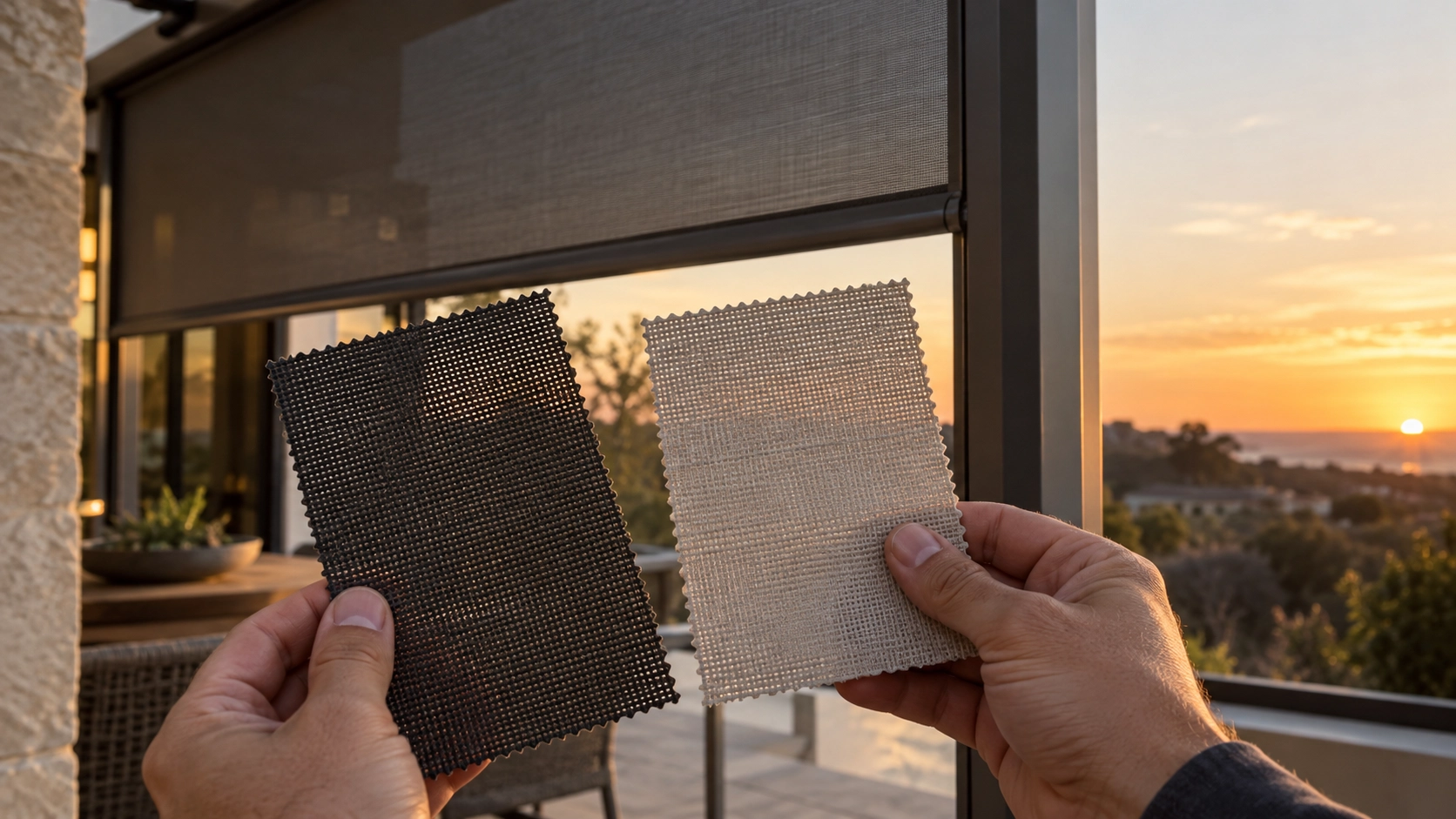
Project buyers do not need to memorize every possible material change. They need the correct data sheet.
A fabric may become tighter after several hours of direct sun, changing its width, stiffness or ZIP engagement.
Request the data sheet for the exact fabric and check:
- Exterior-use suitability
- Dimensional stability
- Recommended temperature range
- UV resistance
- Base fabric and coating construction
Do not accept “zero shrinkage” without supporting test data.
Dirt and Salt
Dust, sand, pollen, insects, salt crystals and dried cleaning residue reduce working clearance inside the guide.
Coastal projects need more frequent inspection because salt buildup can increase friction even when the rails remain structurally sound.
4. A 60-Second Fault Diagnosis
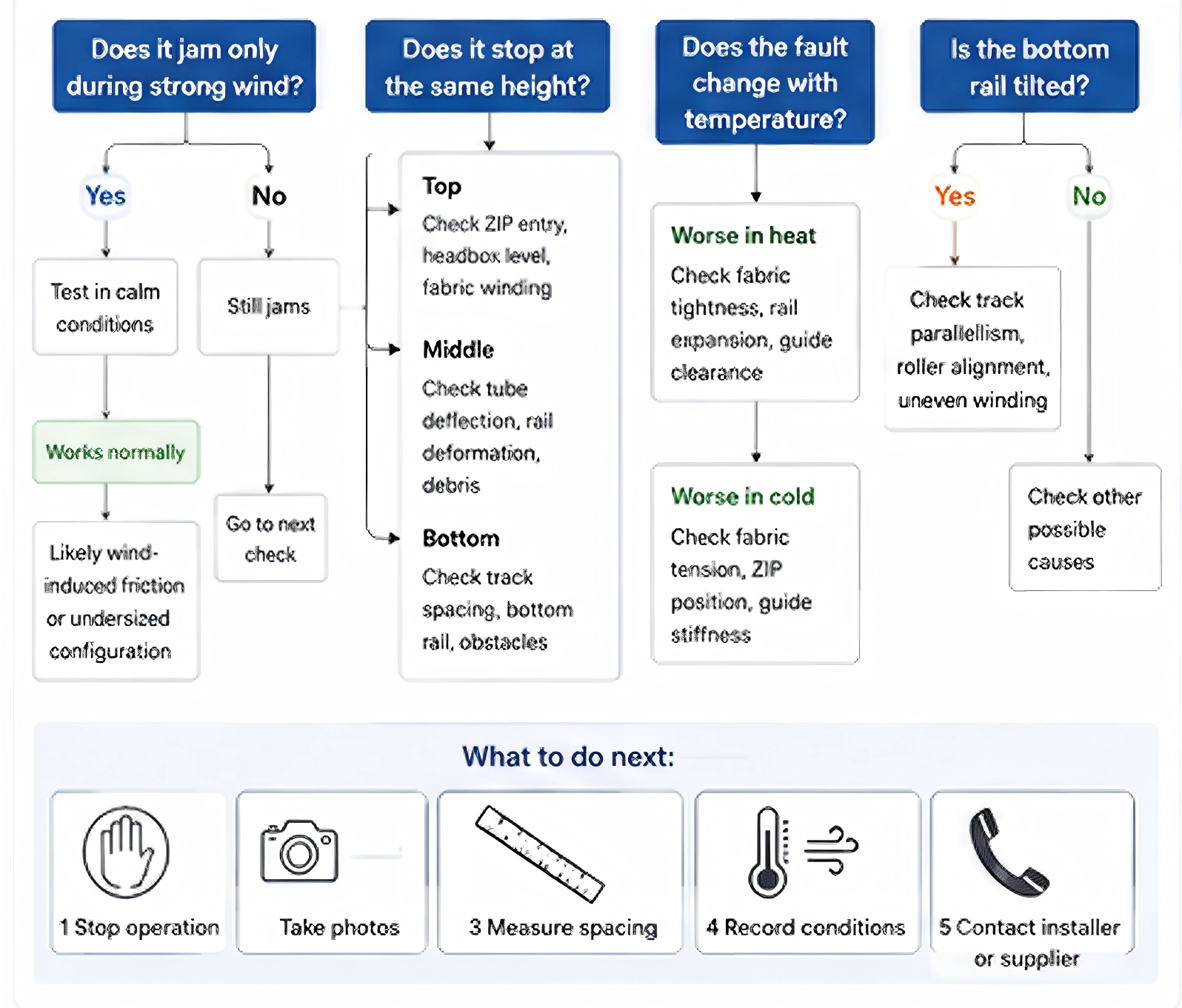
Does the Blind Jam Only During Strong Wind?
Test it again in calm conditions.
- Works normally when calm: likely wind-induced side friction or a configuration that is too light for the exposure.
- Still jams: continue to the next check.
Does It Stop at the Same Height?
- Near the top: check ZIP entry, headbox level and fabric winding.
- In the middle: check tube deflection, local rail deformation and debris.
- Near the bottom: check narrowing tracks, bottom-rail alignment and obstacles.
Does the Fault Change With Temperature?
- Worse at midday: check fabric tightness, rail expansion and guide clearance.
- Worse in cold conditions: check fabric tension, ZIP position and guide stiffness.
Is the Bottom Rail Tilted?
A persistent tilt usually points to non-parallel tracks, uneven winding, roller misalignment or an obstruction on one side.
What to Do Next
- Stop repeatedly operating the blind.
- Photograph the headbox, both tracks, bottom rail and stopping position.
- Measure track spacing at the top, middle and bottom.
- Record the wind and temperature conditions.
- Send the evidence to the installer or supplier.
If the ZIP edge has left the guide, a rail moves under light hand pressure or the bottom rail remains tilted, stop operation until the system has been inspected.
5. How to Inspect and Maintain a ZIP Blind
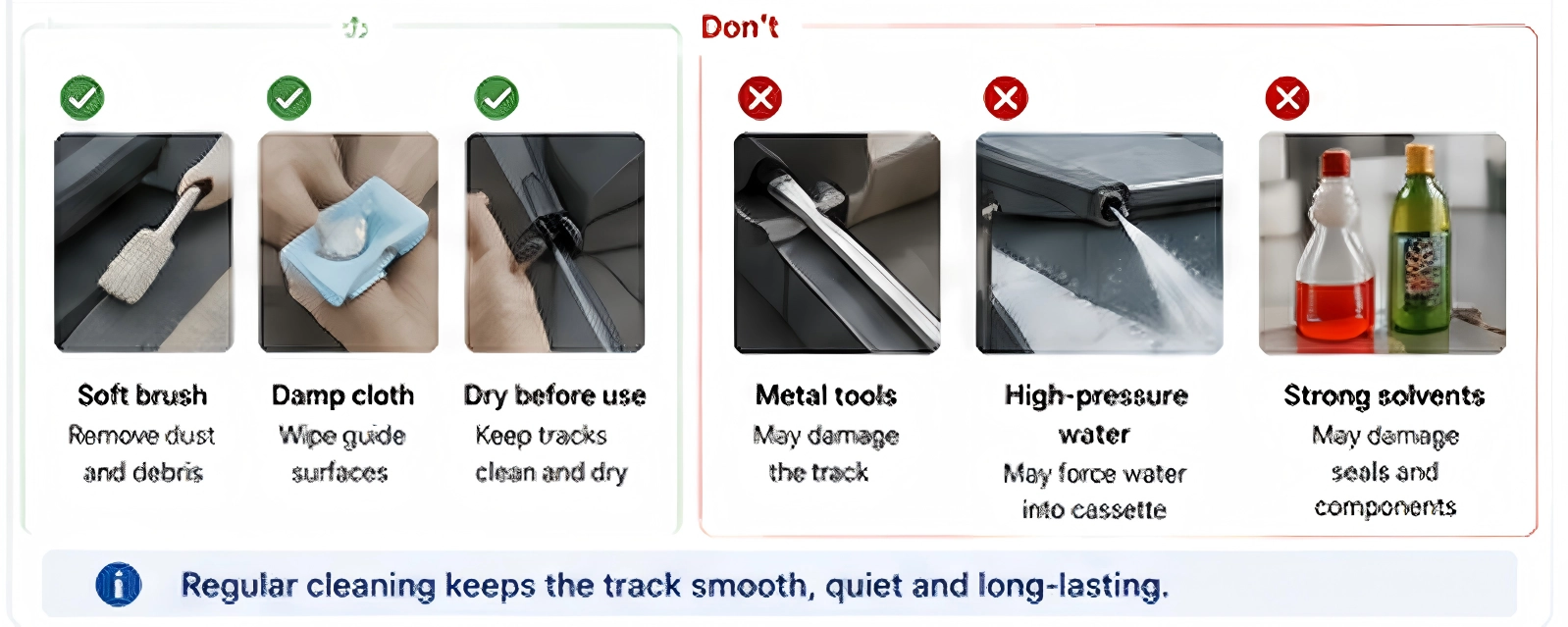
Start with cleaning, not lubricant.
Remove loose material with a soft brush. Wipe accessible guide surfaces with a soft damp cloth, allow them to dry and test the blind again in calm conditions.
Avoid:
- Metal scrapers
- Abrasive pads
- Strong solvents
- High-pressure water directed into the cassette
- Unapproved oil-based sprays
Lubrication depends on the guide material, so use only the product specified by the supplier.
Request professional adjustment when:
- The ZIP edge has left the guide
- The internal guide is split or deformed
- The bottom rail remains tilted
- The motor repeatedly stops
- The fabric rolls diagonally
- Fasteners are loose
- The cassette is no longer level
A ZIP-guided blind is not automatically a hurricane shutter. Severe weather normally requires advance retraction unless the exact installed configuration has been approved for continued deployment.
6. How to Select the Right NewHoo System
The correct system depends on the project problem, not only the opening width.
| Project Condition | Main Requirement | NewHoo System |
|---|---|---|
| Standard balcony, patio or outdoor window | Compact ZIP guidance and multiple operation methods | WR100 |
| Pergola, gazebo or semi-open terrace | Stable guidance under multi-directional airflow | WR110 |
| Standard project requiring advanced configuration | Tube selection and controlled ZIP entry | WR120A |
| Repeated commercial installation | Faster fixing and easier service access | WR120B |
| Restricted elevator or stair access | Sectional transport and on-site connection | WR120C |
| Shading plus evening lighting | Integrated motorized LED system | WR120D |
| Minor wall deviation | Adjustable side-rail compensation | WR120E |
| No reserved external power | Wired or solar motorized operation | WR120F |
| Opening exceeds standard limits | Larger tube and structural evaluation | NewHoo large-opening series |
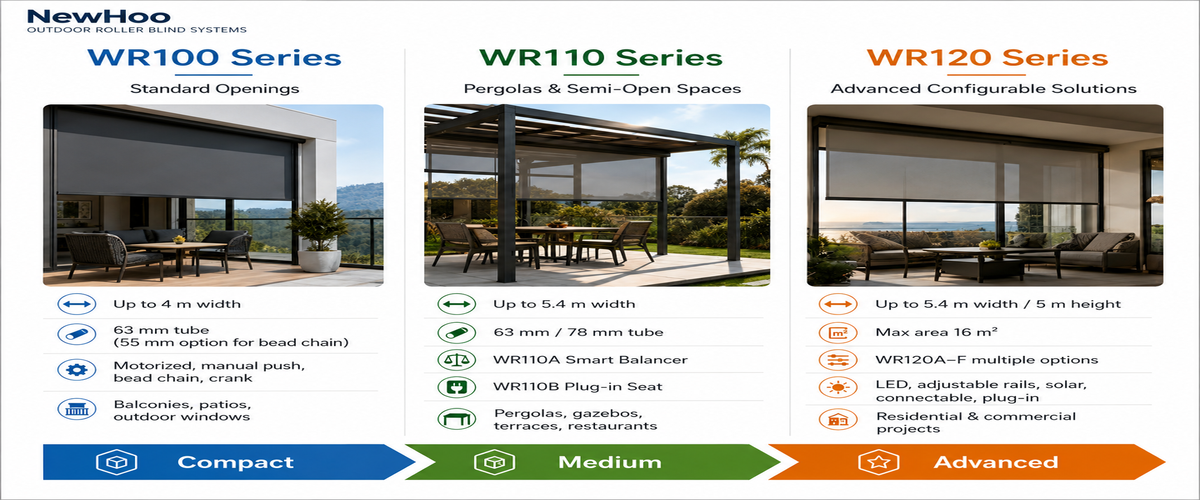
WR100 is the flexible baseline for regular outdoor openings.
WR110 is purpose-built for pergolas and semi-open structures, with WR110A prioritizing smoother fabric entry and WR110B prioritizing installation and service access.
Within the WR120 family, WR120A uses Smart Balancer and tube options for openings up to 16 m². WR120B uses plug-in fixing seats for repeated installation, while WR120C solves long-component transport problems through on-site connection.
WR120D integrates LED lighting with motorized shading. WR120E compensates for minor wall deviation, and WR120F offers wired or built-in solar motorized versions. Electrical and waterproofing details should be confirmed in the project documents and comply with local requirements.
Information to Prepare Before Ordering
Send NewHoo:
- Top, middle and bottom widths
- Left, center and right heights
- Both diagonal measurements
- Installation photographs
- Wall or post material
- Available fixing depth
- Floor level and access route
- Wind and sun exposure
- Expected temperature range
- Fabric and privacy requirements
- Preferred operation method
- Available power supply
With this information, the roller tube, guide structure, fabric, fixing method, operation system and delivery plan can be evaluated together.
Conclusion
For project buyers, three checks matter more than any marketing headline:
- How does the wind load reach the supporting structure?
- Was the claimed performance tested on a comparable size and fixing configuration?
- Will the tube, track geometry and fabric remain compatible under actual site conditions?
WR100 covers standard outdoor openings. WR110 addresses pergolas and semi-open spaces. WR120A–F add specialist solutions for controlled fabric entry, repeated installation, restricted transport, integrated lighting, minor wall deviation and solar motorization.
Send NewHoo your measurements, site photographs, mounting substrate, wind exposure, fabric requirements and access conditions to receive a project-specific configuration.
Get a ZIP-Guided Blind Configuration for Your Project
Technical note: The pressure values above are simplified comparisons. Project-specific wind loads, anchor design and structural requirements should be confirmed according to local codes and site conditions.
How to Choose Outdoor Blinds: A Practical Guide Based on Real Project Challenges
Do Cordless Roller Shades Really Stop at Any Position?
Related Article