Do Cordless Roller Shades Really Stop at Any Position?
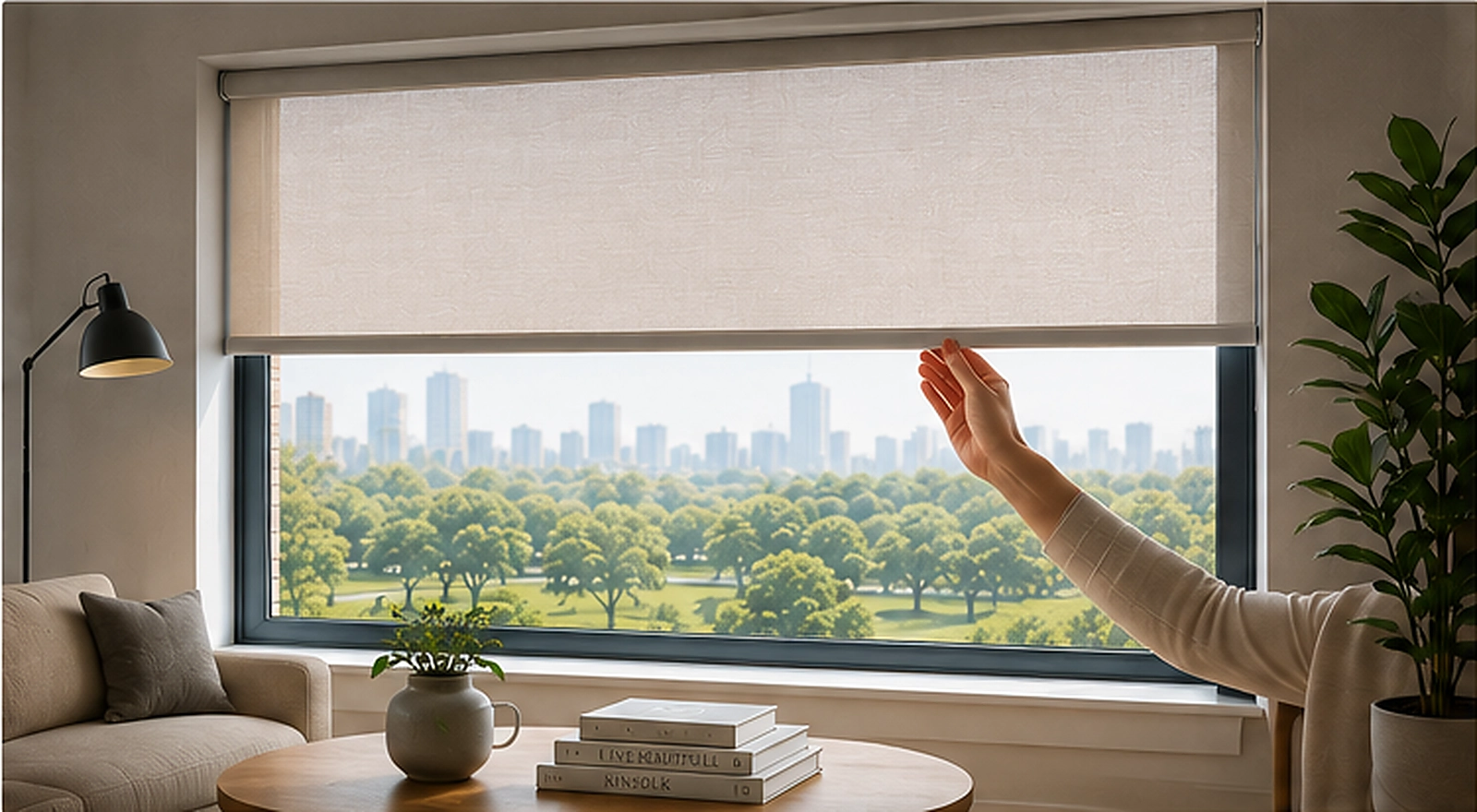
Yes, cordless roller shades can stay at different positions, but only when the spring torque is correctly matched to the complete moving load.
Fabric weight, bottom rail, roller tube rigidity, friction control and installation accuracy all influence whether a shade holds, falls, or rolls upward.
A buyer usually asks one simple question:
“My window is two metres wide. Will the cordless shade stay exactly where I leave it?”
The honest answer is not an immediate yes.
A two-metre-wide shade may work perfectly with a lightweight sunscreen fabric and short drop.
However, the same width with a heavy blackout fabric, reinforced bottom rail and longer height creates a completely different mechanical challenge.
That is the reality behind free-stop roller shades.
A reliable cordless roller shade does not stay in position because of one spring hidden inside the tube.
It works because the complete system is balanced:
- Spring torque
- Fabric weight
- Bottom rail load
- Roller tube rigidity
- Controlled friction
- Installation accuracy
The real question is:
Can this system be configured, tested and maintained for my actual project?
Why Does My Cordless Roller Shade Keep Falling or Rolling Up?
When a cordless shade starts moving by itself, many people immediately assume:
“The spring is broken.”
Sometimes that is true.
But in many cases, the spring is only one part of the problem.
A shade that slowly falls may be caused by:
- insufficient spring torque;
- heavier production fabric than the approved sample;
- incorrect bottom rail weight;
- installation alignment problems.
If the fabric moves toward one side during operation, the industry terms are usually:
- off-centre tracking;
- telescoping;
- uneven fabric winding.
Increasing spring tension will not correct a roller tube that is not level.
Free-Stop Troubleshooting Table
| Symptom | Possible Cause | First Check |
|---|---|---|
| Shade slowly falls down | Insufficient spring support | Fabric GSM and moving load |
| Shade rolls upward | Spring torque too high | Spring setting |
| Shade tracks to one side | Telescoping or alignment issue | Brackets and tube level |
| Shade feels heavy | Excess friction | Guide rails and mechanism |
| Holds only at one position | Incorrect tension range | Full travel test |
A proper test should not only check the middle position.
The shade should be tested:
- fully raised;
- halfway open;
- nearly closed.
A system that performs well at one position may still have an imbalance across the full travel.
How Does a Free-Stop Roller Shade Stay in Place?
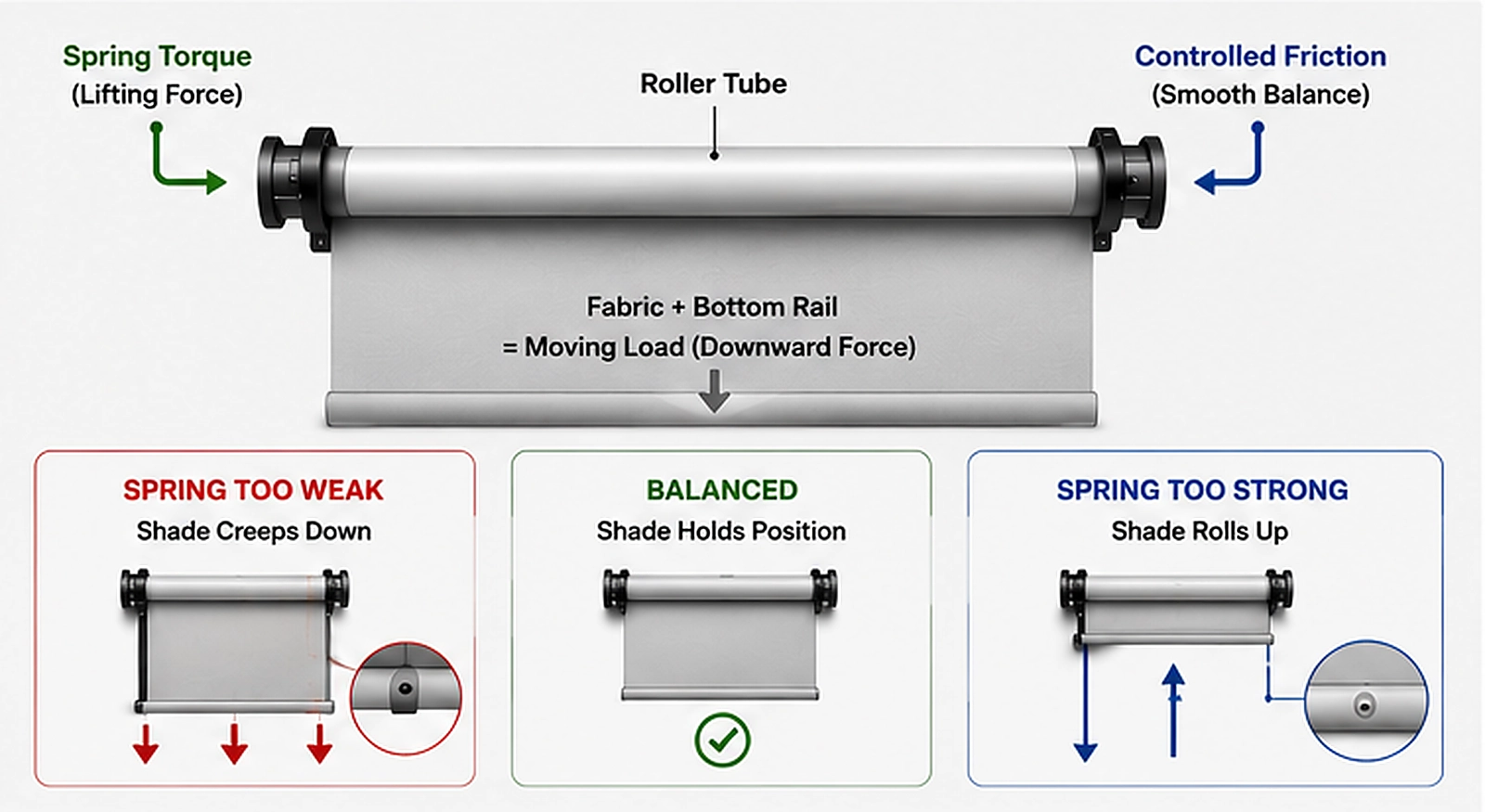
A free-stop shade works by balancing upward spring torque against downward moving load.
The first calculation is the fabric mass:
Mfabric = W × H × ρfabricWhere:
- Mfabric = fabric mass
- W = finished width
- H = finished drop or height
- ρfabric = fabric areal density in kg/m²
GSM Conversion
ρfabric = GSM ÷ 1,000
Example
350 GSM = 0.35 kg/m²
For a blind measuring 2.0 m × 2.0 m:
Mfabric = 2.0 m × 2.0 m × 0.35 kg/m² = 1.40 kg
This 1.40 kg represents the fabric only. The bottom rail, handle, ZIP edges and other moving components must be added separately.
The complete moving load also includes:
- bottom rail;
- handle;
- zipper edges;
- additional accessories.
The spring must create enough torque to balance this total load.
Too little torque:
→ shade creeps downward
Too much torque:
→ shade rolls upward
A friction clutch mechanism or controlled resistance may help stabilize the final position, but friction should only fine-tune a correctly balanced system.
It should not compensate for an incorrectly selected spring.
Why Different Roller Shades Need Different Spring Systems
“Cordless” describes the operating method.
It does not describe the internal mechanism.
Different shade structures require different balancing solutions.
B75-38 Spring Zebra Blind
A spring-balanced roller structure is used to match:
- fabric weight;
- roller tube;
- bottom rail;
- operating force.
The spring system must be selected according to the actual fabric and finished dimensions.
VM45 Honeycomb Blind
Honeycomb fabric distributes load differently from roller fabric.
The VM45 system uses constant-force spring modules and synchronized lifting components to create smoother manual operation.
Because honeycomb shades have different movement characteristics, the spring force curve must also be different from traditional roller shades.
WR70 ZIP-Guided Roller Blind
ZIP-guided systems introduce another variable:
Side rail friction.
Even when the spring is correctly selected, poor guide alignment can create:
- heavy operation;
- uneven movement;
- tracking problems.
The key principle is:
The mechanism should be selected according to the blind structure and load—not only the window width.
Can a Two-Metre-Wide Cordless Shade Use Free-Stop Operation?
The answer depends on more than width.
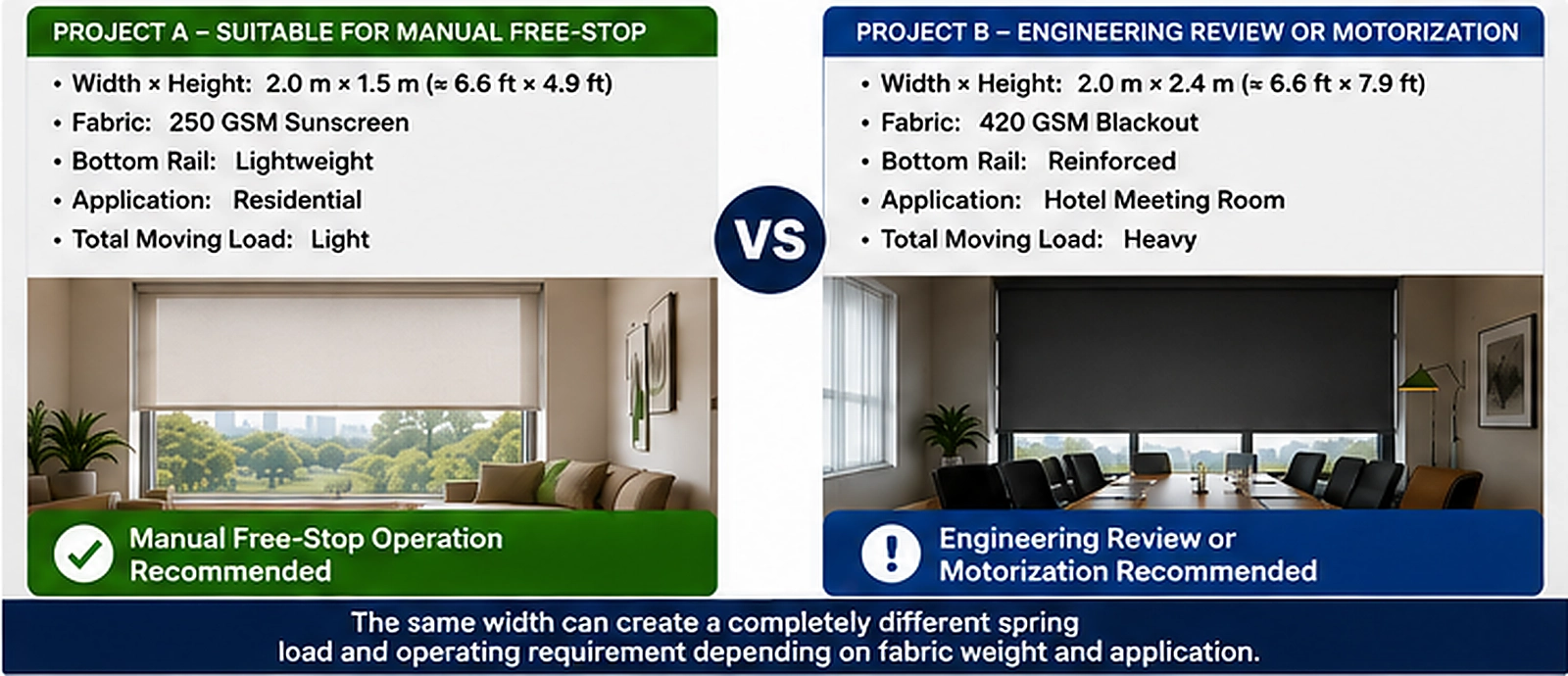
Two projects can have the same width but completely different requirements.
Project A
Residential Window
- Width: 2.0m
- Height: 1.5m
- Fabric: 250 GSM sunscreen
- Lightweight bottom rail
Expected:
Manual free-stop operation may be suitable.
Project B
Hotel Meeting Room
- Width: 2.0m
- Height: 2.4m
- Fabric: 420 GSM blackout
- Reinforced bottom rail
Expected:
Requires engineering evaluation.
The width is identical.
The mechanical load is not.
Practical Decision Guide
| Condition | Recommendation |
|---|---|
| Light fabric + short drop | Manual free-stop |
| Heavy fabric | Confirm total moving load |
| Wide opening | Check tube rigidity |
| High frequency use | Consider motorization |
| Difficult access | Motorized system |
For NewHoo projects, the selected model’s published limits should always be followed.
Window size alone is not enough.
A professional configuration should include:
- width;
- height;
- fabric GSM;
- bottom rail;
- application;
- operating frequency.
Why Wide Roller Shades Develop V-Shaped Wrinkles
Large shades create another challenge:
roller tube deflection.
Imagine a long shelf supported only at both ends.
The longer the span, the greater the possibility of bending.
A roller tube behaves in the same way.
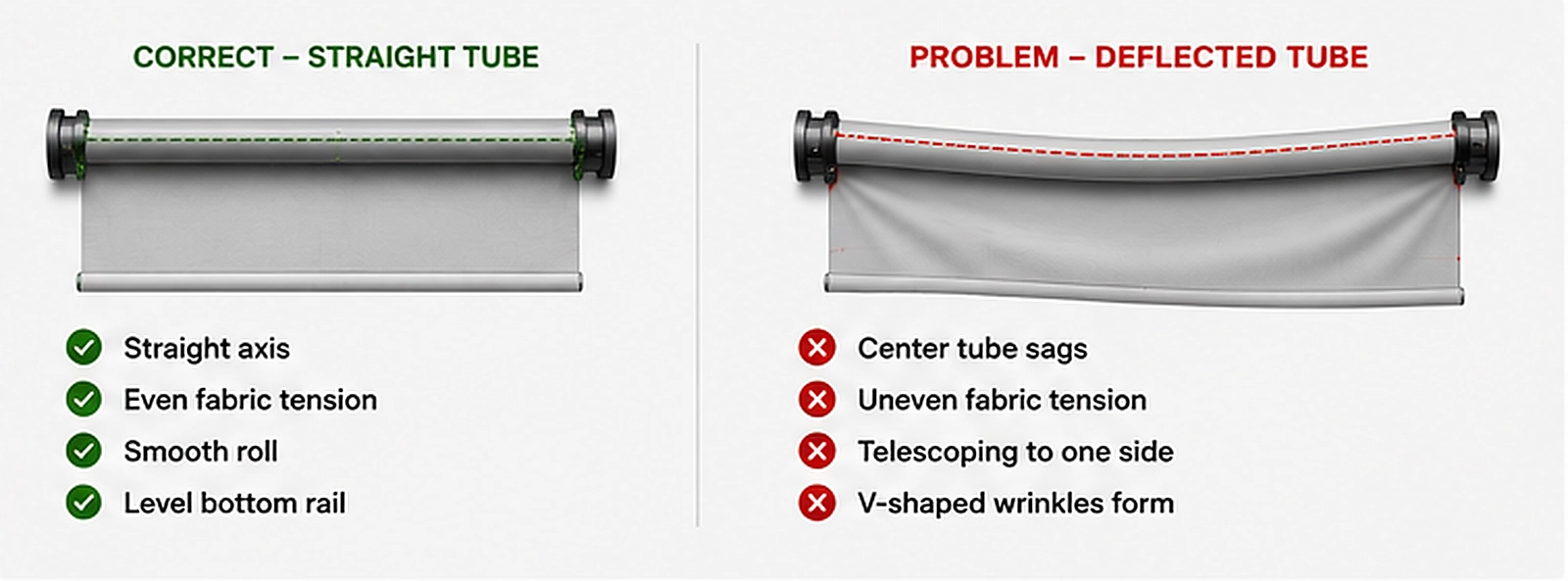
Once the tube deflects, the fabric no longer winds around a perfectly straight axis.
This can create:
- uneven fabric tension;
- telescoping;
- centre wrinkles;
- V-shaped deformation.
Adding more spring tension cannot fix this problem.
The spring may provide more lifting force, but it cannot straighten an undersized tube.
A structural problem needs a structural solution:
- larger tube diameter;
- stronger tube structure;
- divided shades;
- motorization.
A spring problem can often be adjusted.
A tube problem must be redesigned.
How a Balance Regulator Reduces Repeated Adjustment in Indoor Roller Blinds
A conventional spring-operated roller blind depends heavily on its initial spring setting.
If the spring torque is slightly lower than the moving load, the shade may creep downward. If the spring is set too strongly, the shade may roll upward or feel difficult to push.
The common response is to adjust the spring and test the blind again.
For one window, this may be manageable. Across a hotel, office or apartment project with many window sizes, repeated manual tuning quickly becomes inefficient.
For compatible indoor roller blind systems, NewHoo can add a balance regulator between the spring mechanism and the controller.
The regulator is designed to coordinate:
- Spring torque;
- Fabric and bottom-rail load;
- Resistance during upward and downward movement.
Instead of relying only on a fixed spring setting, the regulator introduces controlled damping that helps the complete blind remain closer to its balanced operating condition.
It does not replace correct spring selection. The spring, fabric, bottom rail and roller tube must still be properly matched. Its role is to improve tolerance for smaller load and operating differences that might otherwise require repeated adjustment.
| Conventional spring-only system | System with a balance regulator |
|---|---|
| Relies mainly on the initial spring setting | Adds controlled damping to support balance |
| More sensitive to small load differences | Better tolerance for minor variations |
| May require repeated manual tuning | Helps reduce repeated adjustment |
| Too much tension makes operation heavy | Supports smoother upward and downward movement |
| Each blind may need more individual commissioning | Improves consistency across multi-window projects |
This technology is especially useful where the same indoor roller blind design is used across rooms with slightly different widths, drops or fabric loads.
A hotel project may use the same visual system in dozens of rooms, but not every window is identical. The balance regulator helps reduce the need to repeatedly open, retension and retest each spring mechanism.
It cannot correct:
- A deflecting roller tube;
- Misaligned brackets;
- Severe telescoping;
- Excessive guide friction;
- Damaged parts;
- A blind operating outside its rated load range.
The correct sequence remains:
Calculate the load → select the spring → choose the roller tube → install accurately → use the balance regulator to improve operating consistency.
How Auto-Unlock on Mount Protects the Mechanism During Shipping
For B2B buyers, reliable operation begins before installation.
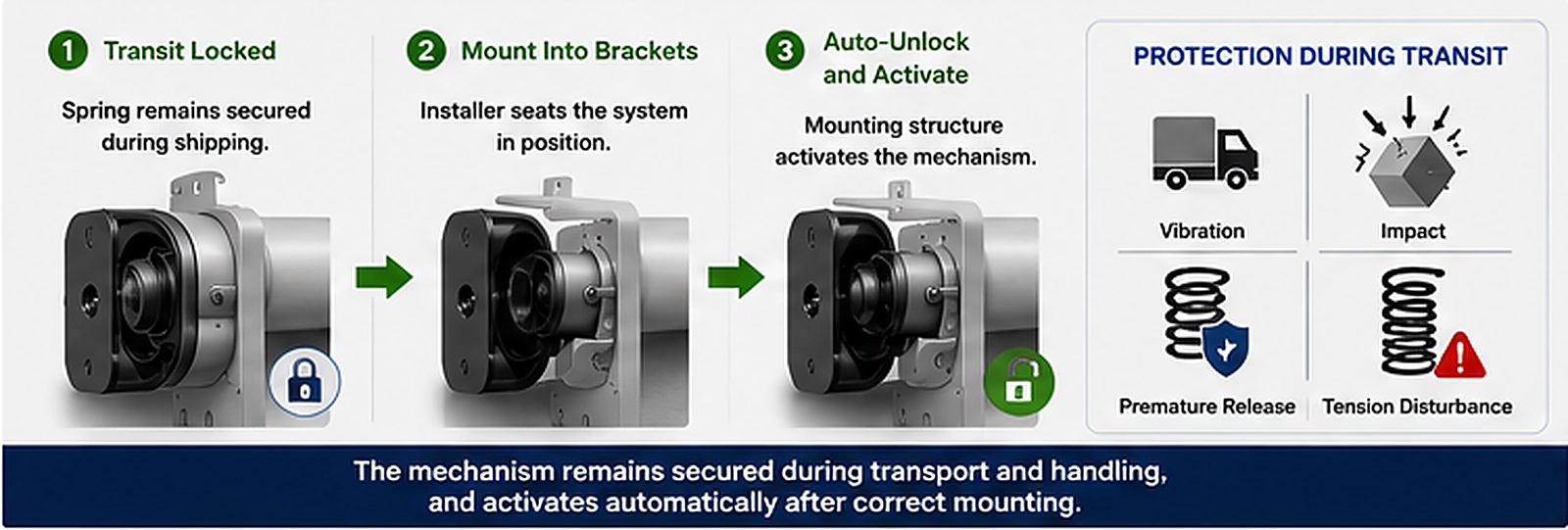
A pre-tensioned cordless mechanism may travel thousands of kilometres by truck and sea. Repeated vibration, impact and warehouse handling can disturb an inadequately secured spring mechanism.
The result may be lost preset tension, premature release or a blind that requires additional adjustment when unpacked.
Selected NewHoo systems use a transit-safe locked condition together with an Auto-Unlock on Mount function.
During transport, the mechanism remains secured. Once the installer correctly seats the blind in its mounting brackets, the mounting structure activates the operating mechanism.
This design helps:
- Protect the preset spring condition during transport;
- Reduce the risk of premature release during handling;
- Remove a separate manual activation step;
- Improve commissioning consistency across multiple blinds.
The exact mounting and activation sequence depends on the selected system and should follow its installation instructions.
Manual Free-Stop or Motorized Roller Shades?
Manual free-stop works well when:
- the blind is accessible;
- size remains within the tested range;
- operation frequency is moderate.
Motorization is better when:
- windows are high;
- blinds are heavy;
- operation is frequent;
- multiple blinds need synchronized control.
For commercial projects, the decision should be based on total ownership cost.
The cheapest mechanism is not always the lowest-cost solution.
A lower initial price may create additional maintenance costs later if the system is difficult to service or unsuitable for the application.
What Should You Ask a Cordless Roller Shade Supplier?
Before ordering, ask:
1. What are the actual size and load limits?
Width alone is not enough.
2. How is spring torque selected?
The supplier should explain the relationship between:
- fabric weight;
- roller tube;
- bottom rail;
- operating force.
3. Can the spring tension be adjusted after installation?
Maintenance accessibility matters.
4. How is the mechanism protected during transport?
Shipping conditions can influence final installation performance.
5. What happens if production fabric differs from the sample?
The supplier should have a proper configuration and testing process.
A professional supplier should be able to explain the engineering behind the system—not simply say:
“One spring works for everything.”
Frequently Asked Questions
Why does my cordless roller shade keep falling down?
Common causes include incorrect spring balance, excessive moving load, installation problems or component wear.
Check fabric GSM, bottom rail weight and roller alignment before adjusting the spring.
Can spring tension be adjusted on cordless blinds?
It depends on the mechanism.
Some systems require removal, while selected NewHoo systems support side-access spring tension adjustment.
Can shipping vibration affect cordless shade mechanisms?
Yes.
If a pre-tensioned mechanism is not properly secured, vibration and impact may affect the preset condition.
A transit-safe locking structure helps keep the mechanism secured until installation.
Can a two-metre-wide cordless shade use free-stop?
Possibly.
Width alone is not enough.
Fabric weight, height, tube rigidity and application must also be considered.
Why does my roller shade telescope?
Common causes include:
- uneven brackets;
- incorrect roller alignment;
- uneven fabric winding;
- tube deflection.
Can blackout fabric be used with free-stop roller shades?
Yes, provided the complete moving load remains within the selected system’s range.
Blackout describes light control performance, not a fixed fabric weight, so the actual GSM value should always be considered.
Conclusion: Free-Stop Is a System, Not a Feature Label
A reliable cordless roller shade is not defined by the words:
“Stop anywhere.”
It is defined by how the system performs with:
- actual fabric;
- actual size;
- actual installation;
- actual maintenance requirements.
The better question is:
“Can the supplier engineer the complete system for my project?”
Send Your Blind Size and Fabric Details
Provide:
- Width × Height
- Fabric GSM
- Bottom rail specification
- Application
- Quantity
NewHoo can help evaluate whether your project is better suited to a manual free-stop, spring-assisted or motorized shading solution.
How Do Windproof Roller Blinds Resist Wind—and Why Do ZIP Tracks Jam?
Can You See Through Outdoor Roller Blinds?
Related Article