Can You See Through Outdoor Roller Blinds?
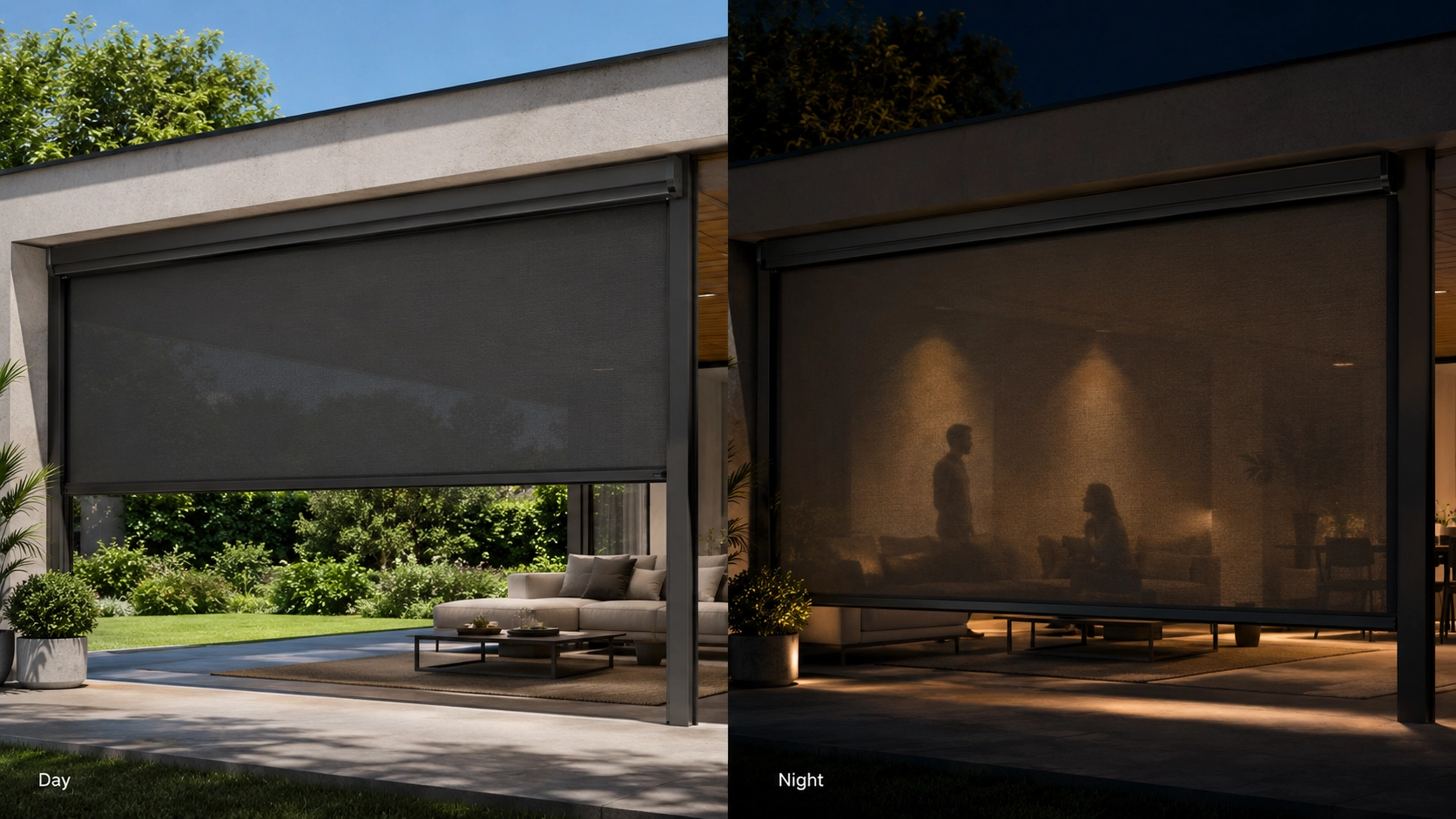
You lower the patio blind in the afternoon. The glare softens, the garden is still visible, and the space finally feels comfortable.
A few hours later, you switch on the lights.
From your seat, the garden outside is now dark. You may assume that the blind is still protecting your privacy. From the street or a neighboring balcony, however, the people behind it may appear as clearly lit silhouettes.
This is where many buyers get caught out.
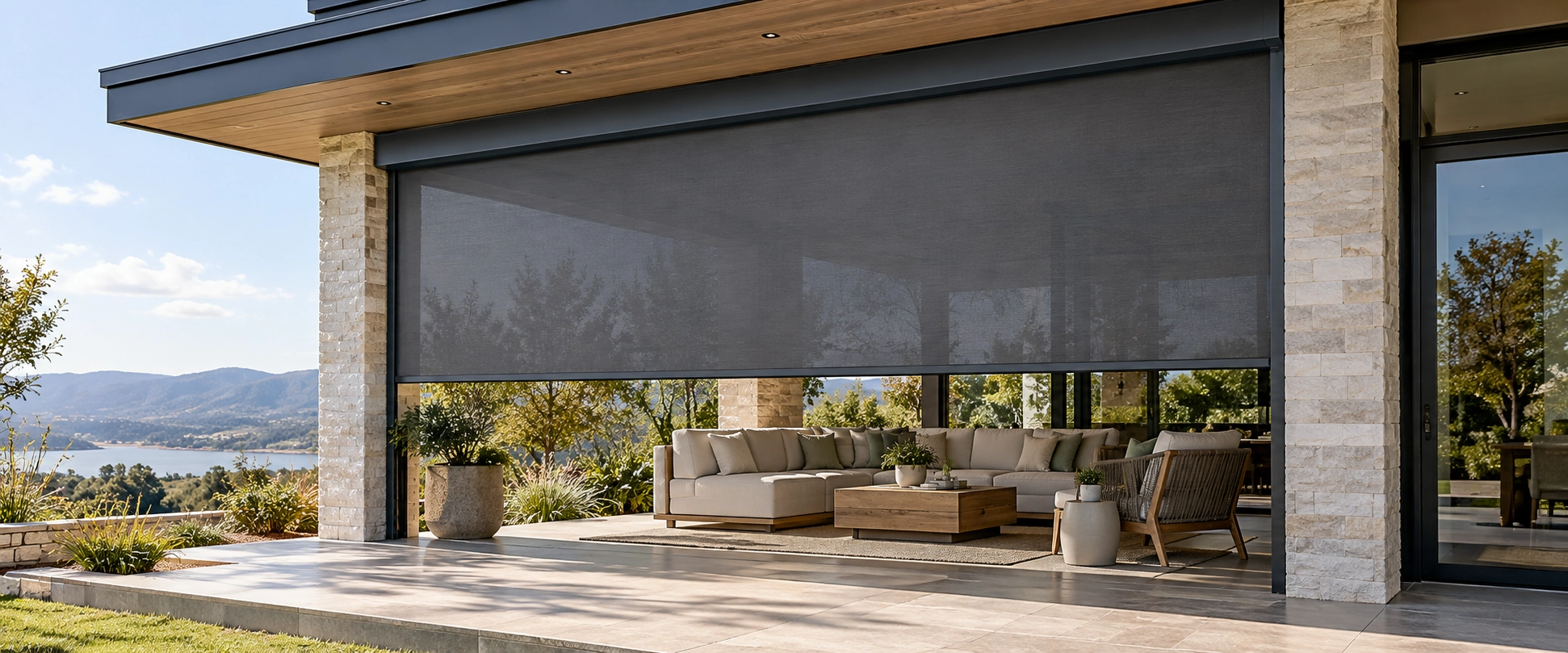
Yes, you can usually still see outside through an outdoor screen blind after it is lowered. But the clarity of the view and the privacy it provides depend on the fabric openness, color, viewing distance and, above all, the lighting on each side.
You do not need to understand every fabric specification before choosing. Start with a simpler question:
- Which would disappoint you more: losing the view, feeling exposed or still struggling with glare?
That answer will normally point you toward the right configuration.
Can You See Through Outdoor Roller Blinds When They Are Down?
Usually, yes—provided that you choose screen fabric rather than an opaque material.
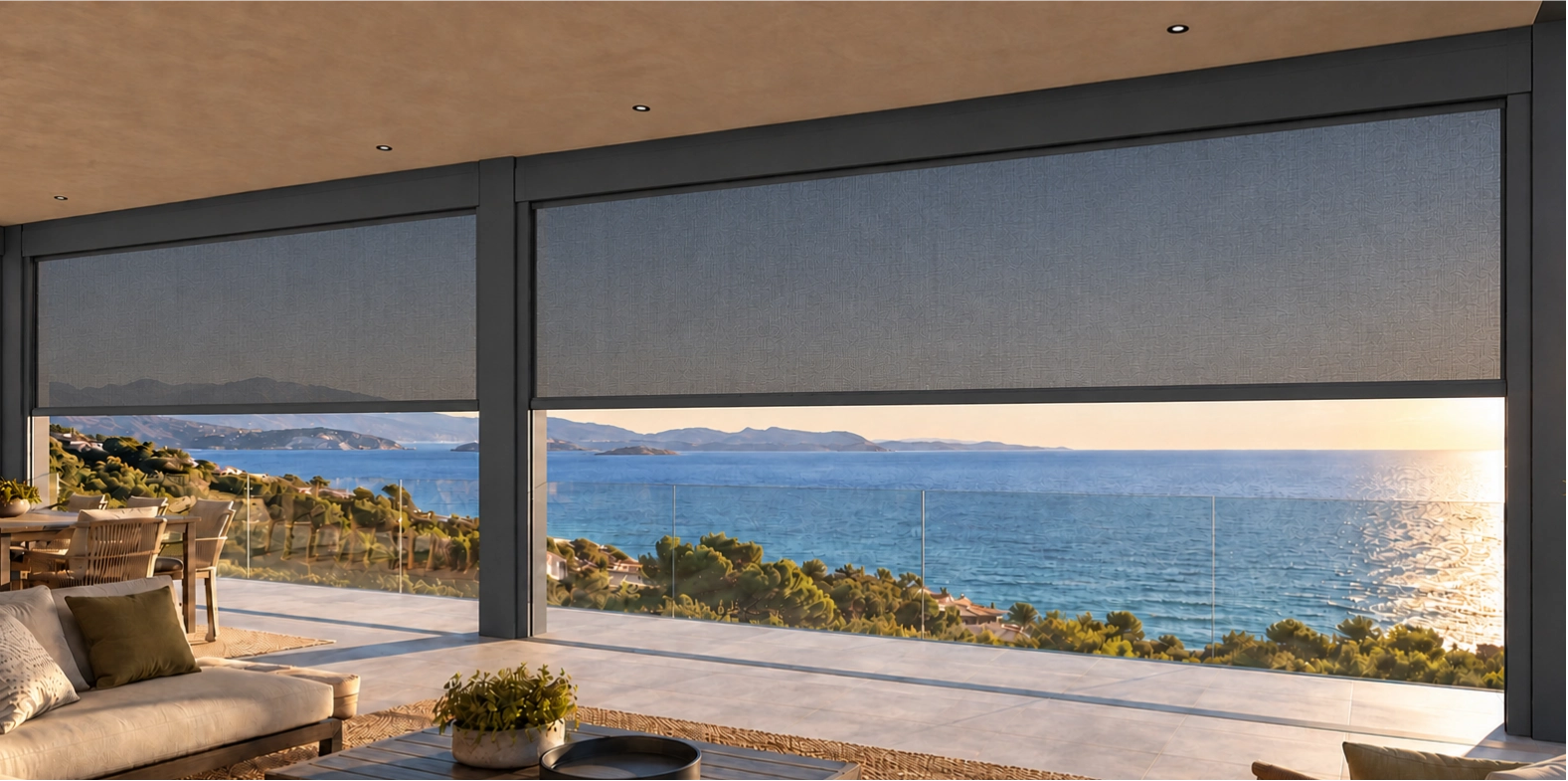
Screen fabrics contain small openings between their yarns. These openings allow part of the garden, pool, street or landscape to remain visible after the blind is lowered.
But openness is only part of the result.
A bright garden behind a dark gray screen may remain relatively clear. A shaded courtyard behind the same fabric may appear flatter and less defined. Viewing distance also matters: when you sit farther behind the blind, the mesh often fades visually into the background.
This is why choosing from a close-up website image is risky. It may show the weave, but it cannot show how the finished patio will feel.
Are outdoor blinds one-way?
They can produce a one-way privacy effect during the day, but the fabric itself is not permanently one-way.
During a bright afternoon, the exterior is normally brighter than the shaded patio. You can see the brighter outdoor scene, while people outside have more difficulty identifying details behind the screen.
At night, that balance changes.
The fabric has not changed. The lighting has.
Based on NewHoo’s experience with ZIP-guided outdoor shading systems, this guide works backward from the way the space is actually used—not from a fabric percentage alone.
Why Outdoor Blinds Privacy Changes at Night
At midday, screen privacy is normally at its strongest.
Imagine sitting behind the blind while the sun is still high. The garden remains visible from your side. From outside, the screen surface is bright and the patio behind it is darker, making faces and furniture harder to distinguish.
By late afternoon, that contrast begins to weaken.
The garden becomes darker, and movement behind the screen becomes easier to notice. You may still feel hidden because the blind is in front of you, yet someone across the courtyard may already see outlines.
Then the lights come on.
The patio becomes the brighter side. From inside, it becomes harder to see into the dark garden. From outside, occupants and furniture may become much clearer.
Solar-screen manufacturers describe their privacy benefit specifically as daytime privacy and note that visibility depends on where the stronger light is located.
If you inspect a screen only at midday, you will almost certainly underestimate how exposed the patio may feel after sunset.
To understand how outdoor blinds privacy at night changes hour by hour:
-
Bright afternoon: you can see out; people outside see less.
-
Late afternoon: movement becomes easier to notice.
-
Dusk: outlines begin to appear.
-
Night with lights off: privacy depends on nearby exterior lighting.
-
Night with lights on: people and furniture may become visible.
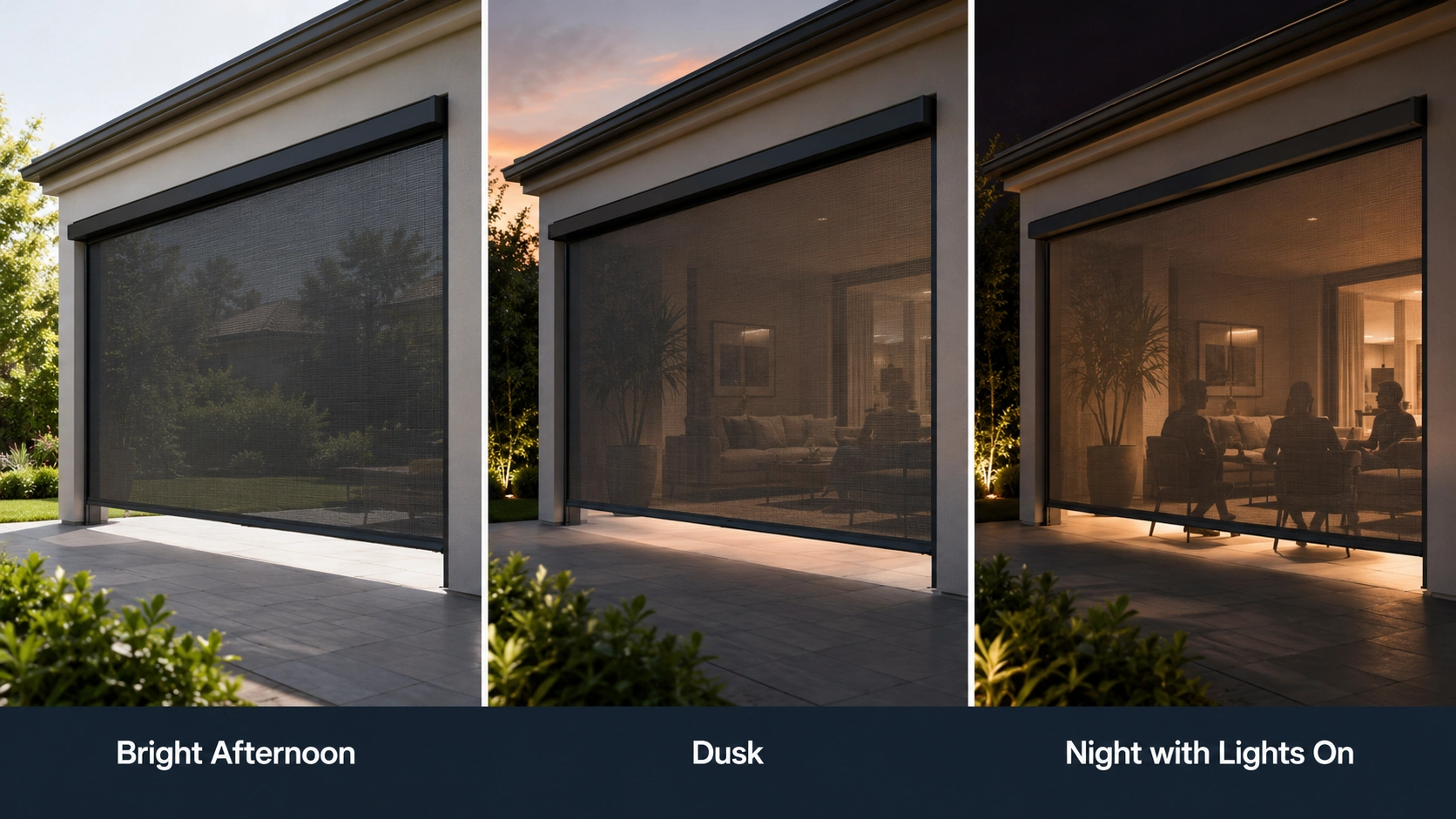 Test privacy under the least favorable lighting condition, not the most flattering one.
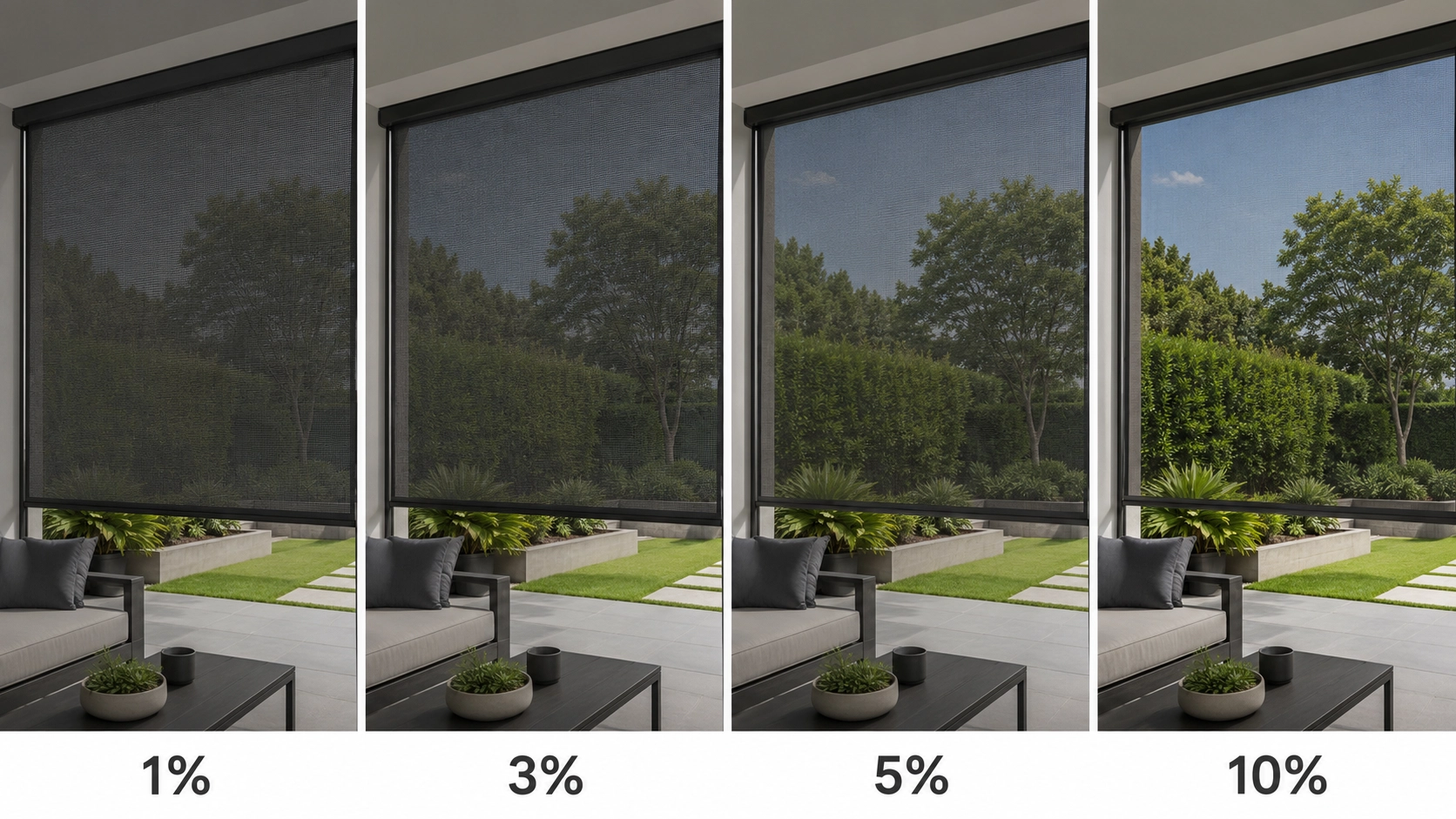
1% vs. 3% vs. 5% vs. 10% Openness
Openness factor is the approximate percentage of open space in the fabric weave.
Lower openness generally provides more visual screening and glare control. Higher openness preserves more of the outside view.
- Buyer warning: “High openness” means more open space, not more protection. A 10% screen gives the clearest view, but also the lowest privacy.
When 1% makes sense
A ground-floor patio facing a street has different priorities from a hilltop terrace.
If nearby people can look directly into the space, or intense west-facing glare makes the patio uncomfortable, 1% may be a suitable starting point.
It hides more daytime detail and controls more glare, but the outside view becomes less defined. It is still an open screen—not blackout fabric—so strong lighting behind it may reveal silhouettes.
Why 3% is often the residential middle ground
For many homes, 3% offers the most practical balance.
It preserves a usable outside view without leaving the patio feeling completely open to neighboring buildings. It also provides more glare control than 5% or 10%.
It suits the homeowner who says:
- “I still want to see the garden, but I do not want the neighbors watching every time I sit outside.”
Where 5% works best
A 5% screen is more appropriate when the garden, pool or landscape is part of the value of the space.
A dark 5% fabric normally keeps the scenery clearer while still softening sunlight and providing moderate daytime screening.
The compromise becomes more noticeable after dark, when illuminated movement behind the screen is easier to see.
When 10% is the right choice
A 10% screen suits an open garden, panoramic terrace or hospitality space with little nearby overlooking.
It preserves the strongest visual connection with the surroundings, but glare control and privacy are both reduced.
| Openness | Outside View | Daytime Privacy | Glare Control | Best Starting Point |
|---|---|---|---|---|
| 1% | Limited | Higher | Stronger | Close neighbors and severe glare |
| 3% | Balanced | Moderate to higher | Moderate to strong | Most residential patios |
| 5% | Clearer | Moderate | Moderate | Gardens, pools and villas |
| 10% | Clearest | Lower | Lower | Panoramic sites with little overlooking |
Dark colors and higher openness are commonly specified when crisp outward visibility is the main objective.
Dark vs. Light Screen Fabric: Which Gives a Better View?
Many buyers expect a white screen to be easier to see through.
In practice, a dark screen normally gives a clearer outward view.
Dark yarn reflects less visible light toward your eyes. The mesh becomes less noticeable, allowing your attention to move toward the garden or landscape beyond it.
Light fabric reflects more daylight. This can make the screen surface more noticeable and cause distant scenery to appear paler or slightly hazy.
What about heat?
Heat control is more complex than choosing between black and white.
A dark inward-facing surface can improve outward visual clarity. On a heavily sun-exposed elevation, a lighter or more reflective outward-facing surface can redirect more incident solar energy before it reaches the protected area.
For projects where both view clarity and solar control matter, NewHoo can match the required openness with:
-
A dark viewing surface
-
A reflective exterior finish
-
A dual-color fabric construction
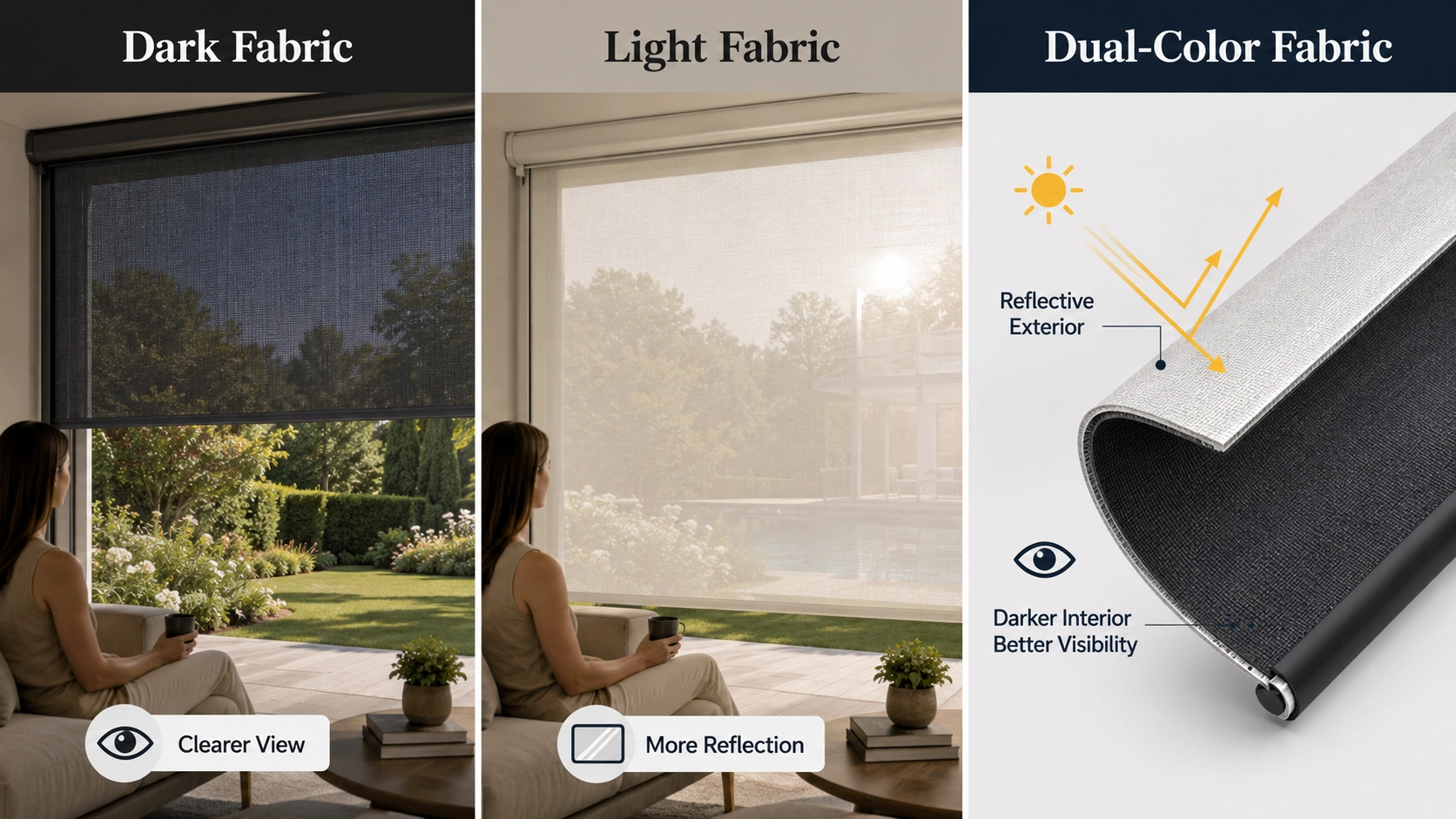
Dual-color and heat-reflective fabric technologies are used specifically to reduce the trade-off between a darker view-oriented appearance and solar performance. Actual results still depend on the selected weave, openness, coating and tested fabric data.
The fabric should follow the real use of the patio—not simply a color chart.
How Much Privacy Do You Actually Need?
When someone says, “I need privacy,” that can mean three different things.
“I just do not want to feel exposed.”
Perhaps neighboring buildings are far away, or pedestrians only pass occasionally.
A 5% screen may be sufficient where the view matters most. A 3% fabric provides more screening where sightlines are closer.
“I do not want people recognizing faces or activity.”
This is common on urban balconies and ground-floor patios.
Start with 1% or 3%, then review the lighting. Keep strong lamps away from directly behind the seating area, and avoid placing chairs in front of a brightly illuminated white wall.
Softer wall lights or indirect lighting usually produce less obvious silhouettes than a strong ceiling light behind the occupants.
These changes can improve privacy, but they cannot make an open screen completely private after dark.
If changing the entire lighting layout feels too restrictive, the real problem is that one fabric is being asked to do two opposite jobs:
-
Remain open enough to preserve the daytime view
-
Remain closed enough to block nighttime visibility
“I need real privacy after dark.”
This is no longer an openness-factor problem.
You need an opaque layer, verified blackout fabric or a double-layer windproof roller shade system.
The daytime layer can use screen fabric for shade and outward visibility. A second dim-out or blackout layer can provide stronger evening privacy.
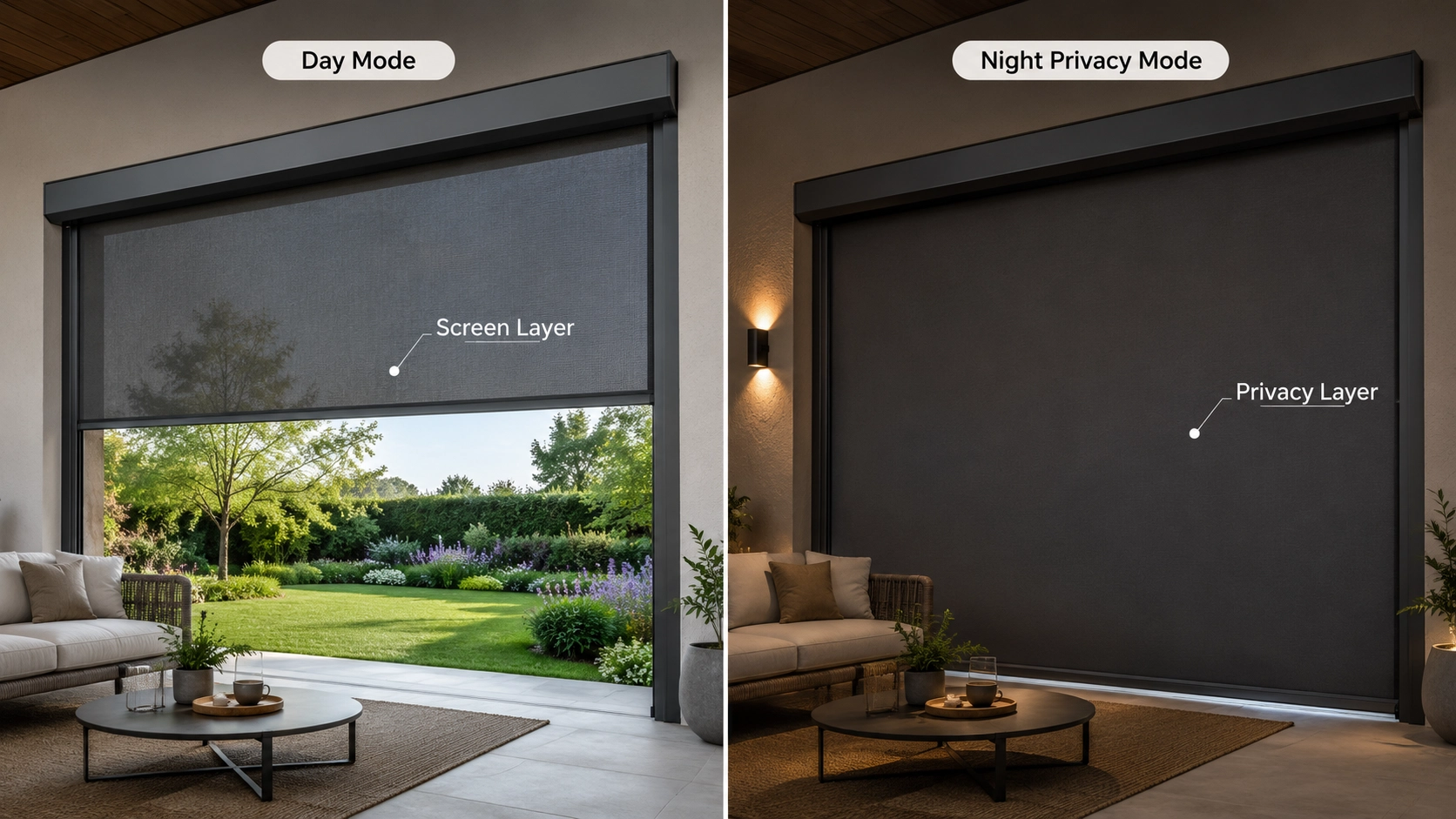
Blackout fabrics are distinct from low-openness screen fabrics: verified blackout materials are designed for complete light blocking and privacy rather than partial view-through.
NewHoo’s double-layer series is designed to let outdoor spaces move between shade, privacy and open-view modes instead of forcing one fabric to cover every requirement.
When suitable insect-screen mesh is combined with well-fitted side tracks, cassette and bottom closure, the screen layer can also help reduce insect entry while retaining airflow. The complete perimeter configuration matters more than the side tracks alone.
Three Patio Problems and the Right Blind Configuration
“I need shade, but I refuse to lose the garden view.”
Begin with a 5% dark gray or charcoal screen.
Consider 10% only when nearby overlooking is minimal. Do not automatically select 1% because it sounds more protective; it may remove too much of the view that gives the patio its value.
“My neighbors are so close that I rarely use the balcony.”
Begin with 3%.
Compare 1% if the viewing distance is very short or the balcony faces a public walkway. Test the fabric from the position where the neighbor would actually look—not while holding the sample directly in front of your face.
If the balcony is frequently used at night, include a second privacy layer from the beginning.
“The patio is unbearable in the afternoon and exposed after dark.”
This is usually a two-layer problem.
Use a 1% or 3% screen for daytime glare control, then add a dim-out or blackout layer for evening privacy.
For tall openings, several blinds or frequent daily changes, motorized outdoor blind operation adds practical value by making it easier to switch between glare-control and privacy modes.
How to Test Screen Fabric Before Ordering
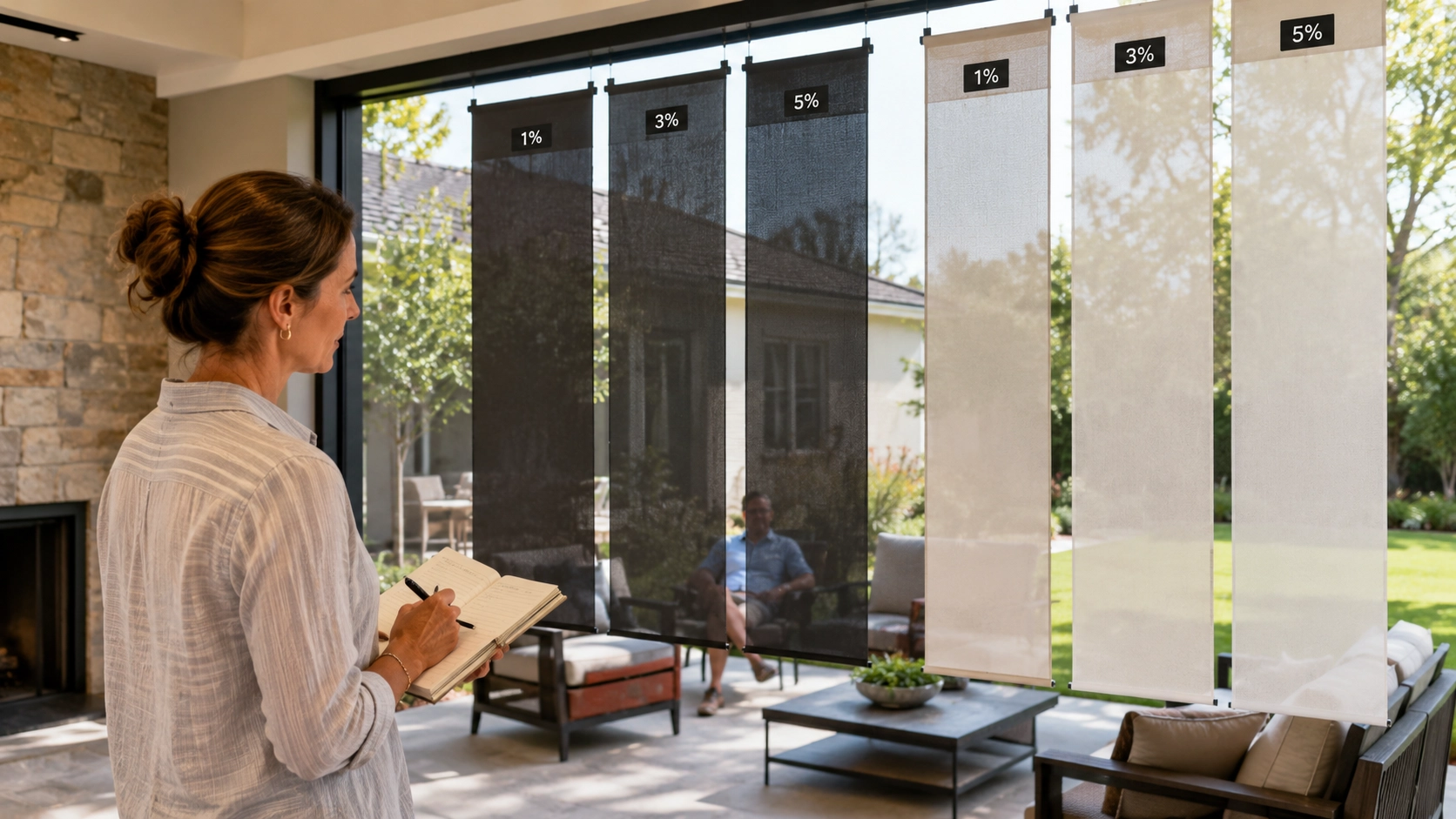
A website photograph cannot show exactly how private a fabric will feel at your property.
Before confirming the fabric:
-
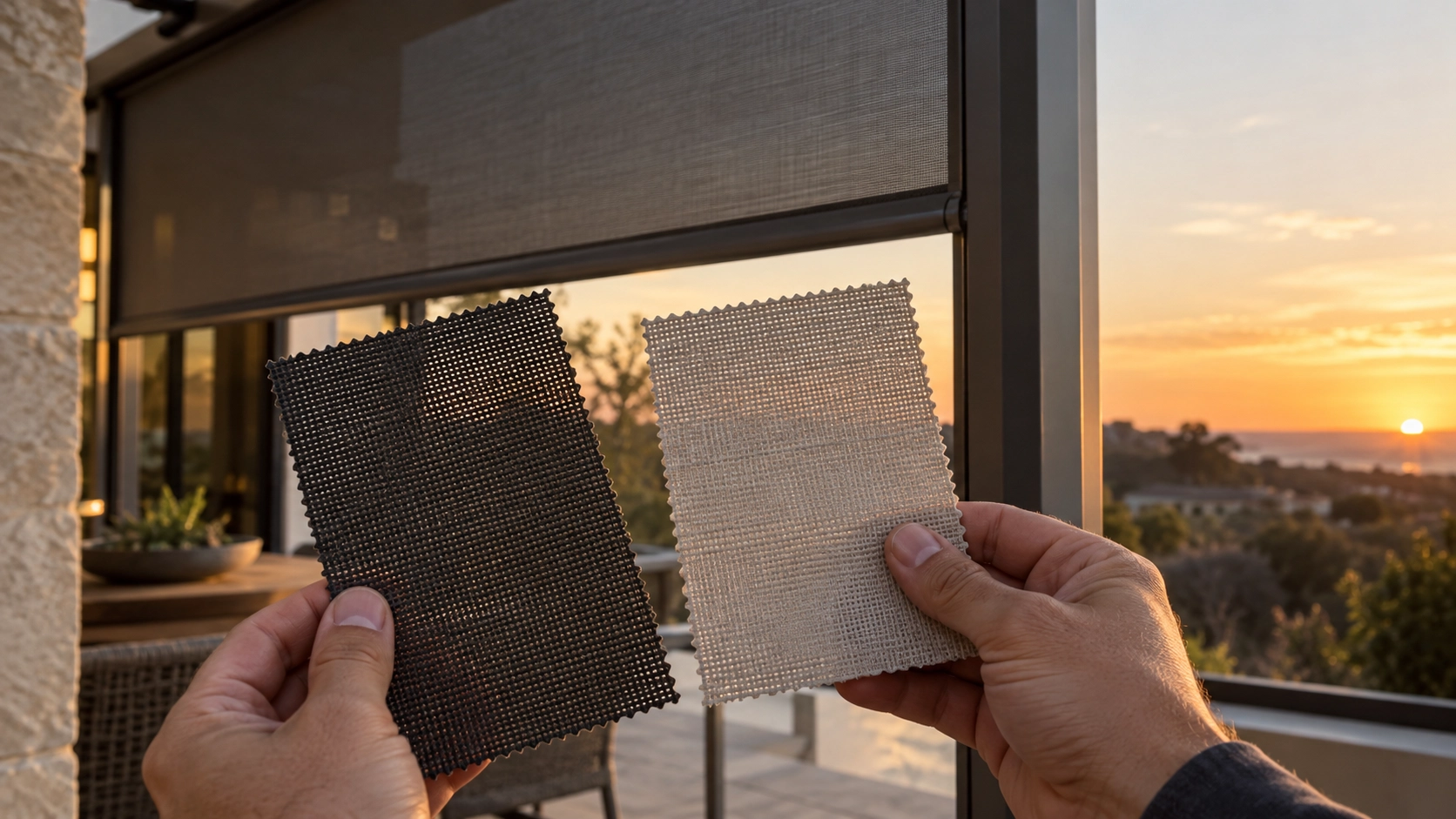
Request samples in the openness levels relevant to the project.
-
Compare dark and light colors at the same openness.
-
Hang the samples vertically.
-
Place a person and furniture behind them.
-
View the samples from the street or neighboring-window distance.
-
Test at midday, dusk and night.
-
Switch on the lights normally used on the patio.
-
Keep the camera position and exposure consistent.
Ask only three questions:
-
Can I still see the view I care about?
-
Can someone see me from the real viewing distance?
-
What changes when the lights come on?
Those answers are more useful than memorizing every technical parameter.
Final Outdoor Blind Selection Guide
Choose 10% when the view is the first priority and overlooking is minimal.
Choose 5% when you want a clearer view with moderate screening.
Choose 3% when view, glare control and daytime privacy need to be balanced.
Choose 1% when strong glare or close daytime overlooking is the main problem.
Choose a double-layer system when daytime visibility and dependable nighttime privacy are both essential.
You do not need to arrive with the perfect fabric already selected.
Start by telling NewHoo what makes the space difficult to use:
- “I want to preserve the garden view.”
- “The neighbors are too close.”
- “The afternoon glare makes the patio unusable.”
- “I need privacy after dark.”
Send us your approximate opening dimensions and several clear site photographs. You can request a project-specific fabric recommendation based on your view, glare and privacy priorities.
For spaces that need a clear daytime view and stronger privacy after dark, explore NewHoo’s double-layer windproof roller shade solutions.
If the project is still at an early planning stage, you can also request physical screen fabric samples to compare 1%, 3% and 5% openness under the actual daytime and nighttime lighting conditions.
The goal is not to make you understand every parameter. It is to make sure the finished patio works the way you expected it to.
Do Cordless Roller Shades Really Stop at Any Position?
Is a Retractable Awning Waterproof or Water-Resistant?
Related Article