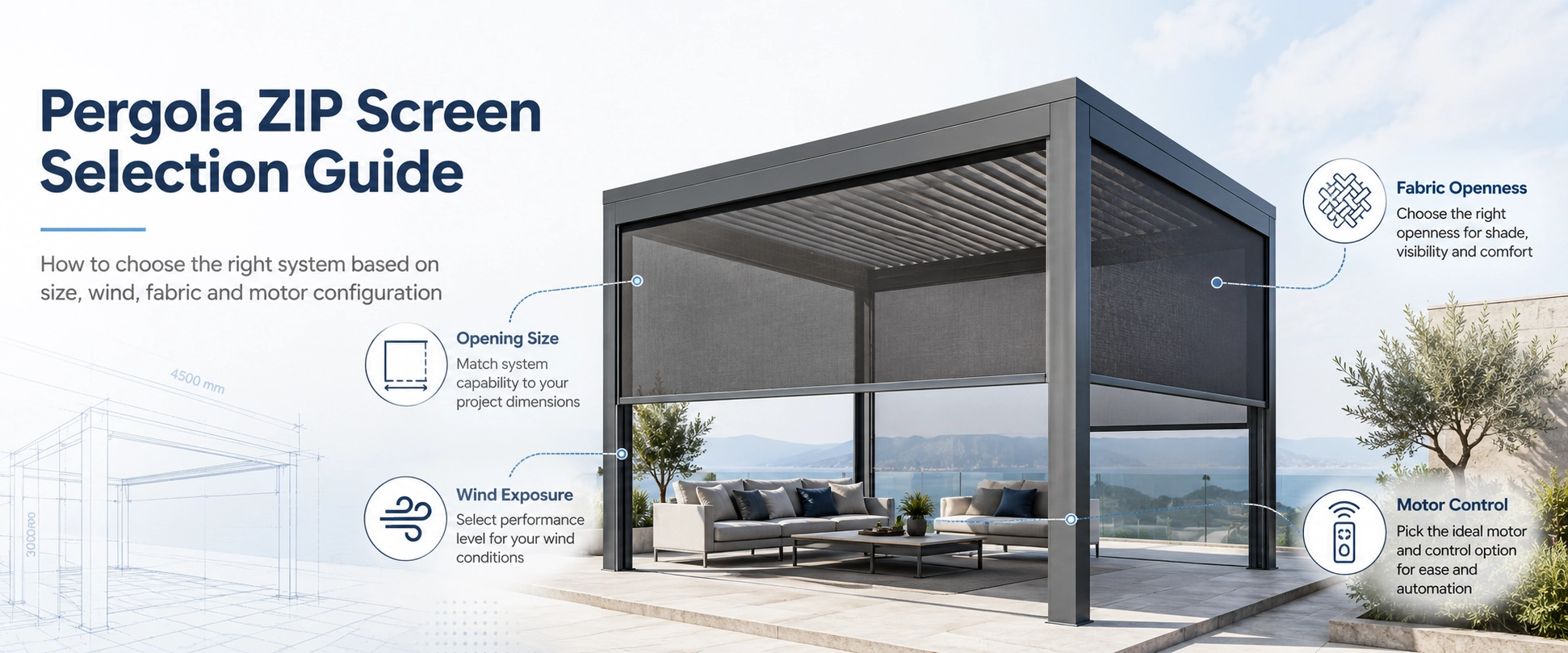
Pergola ZIP Screen Selection Guide: How to Choose the Right System Based on Size, Wind, Fabric and Motor Configuration
-
selecting a screen that is too large for the structure
-
choosing fabric based only on appearance
-
ignoring wind exposure
-
selecting a motor system without considering operation requirements
Opening Size Determines Tube, Motor and System Configuration
The first step in selecting a ZIP Screen is understanding the opening dimensions.
Width and height influence:
- fabric weight
- roller tube load
- motor torque requirement
- guide track stress
- fixing requirements
A common mistake is treating a large screen as simply a small screen with more fabric.
In reality, increasing the size changes the mechanical load of the entire system.
Example 1: Residential Pergola
Opening:
2.5m W × 2.5m H
Typical application:
- backyard pergola
- protected patio
- individual screen operation
A standard ZIP Screen configuration is usually suitable.
The load remains relatively controlled because:
- fabric area is limited
- wind exposure is lower
- operating frequency is moderate
Example 2: Commercial Pergola
Opening:
6m W × 3m H
Typical application:
- restaurant terrace
- hotel outdoor area
- large pergola enclosure
This is not simply a larger version of the residential example.
The system needs additional consideration:
- stronger roller tube
- higher torque motor
- reinforced guide tracks
- improved fixing structure
For wider openings, connected ZIP Screen systems can distribute the load more effectively and provide more stable operation.
Typical Tube Selection Reference
Tube selection depends on:
- screen width
- screen height
- fabric weight
- motor torque
- wind exposure
Typical application range:
| Opening Type | Typical Tube Range |
|---|---|
| Small residential ZIP Screen | 50–63mm |
| Medium outdoor openings | 63–78mm |
| Large ZIP Screen systems | 78–100mm+ |
Tube diameter is one of the first indicators of system capacity.
However, final selection should also consider fabric weight, screen height, motor capability and installation conditions.
Quick Selection Example
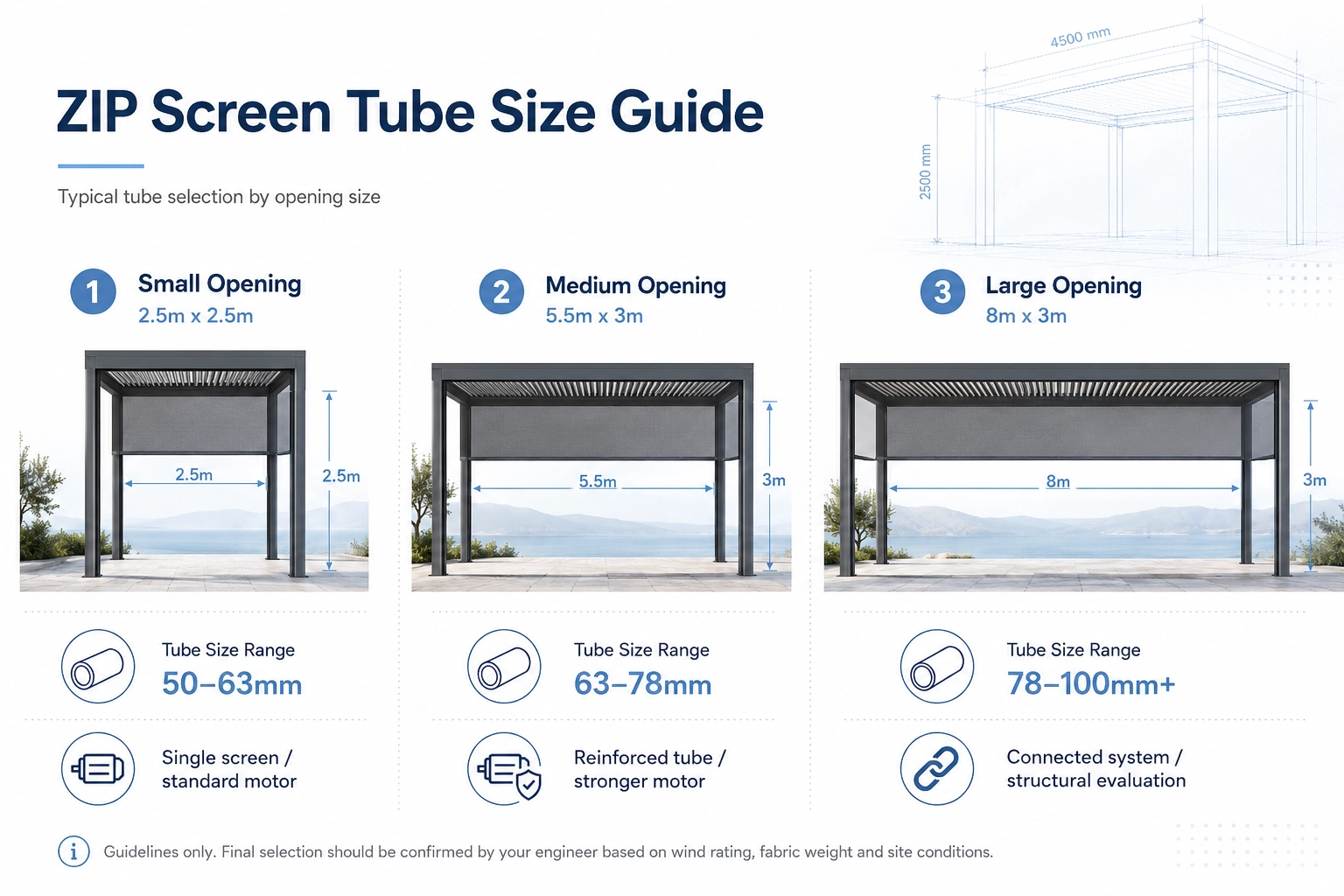
3m × 2.5m opening
Usually:
- single screen
- standard motor
- standard guide system
5.5m × 3m opening
May require:
- reinforced tube
- stronger motor
- upgraded guide structure
8m × 3m opening
Often requires:
- connected ZIP Screen design
- structural evaluation
- customized configuration
Wind Exposure: Match the System With Real Operating Conditions
Wind is one of the most important factors in outdoor shading.
A ZIP Screen installed behind a building and a ZIP Screen installed on a rooftop terrace experience completely different wind loads.
Wind evaluation should consider both:
- Beaufort scale
- actual installation environment
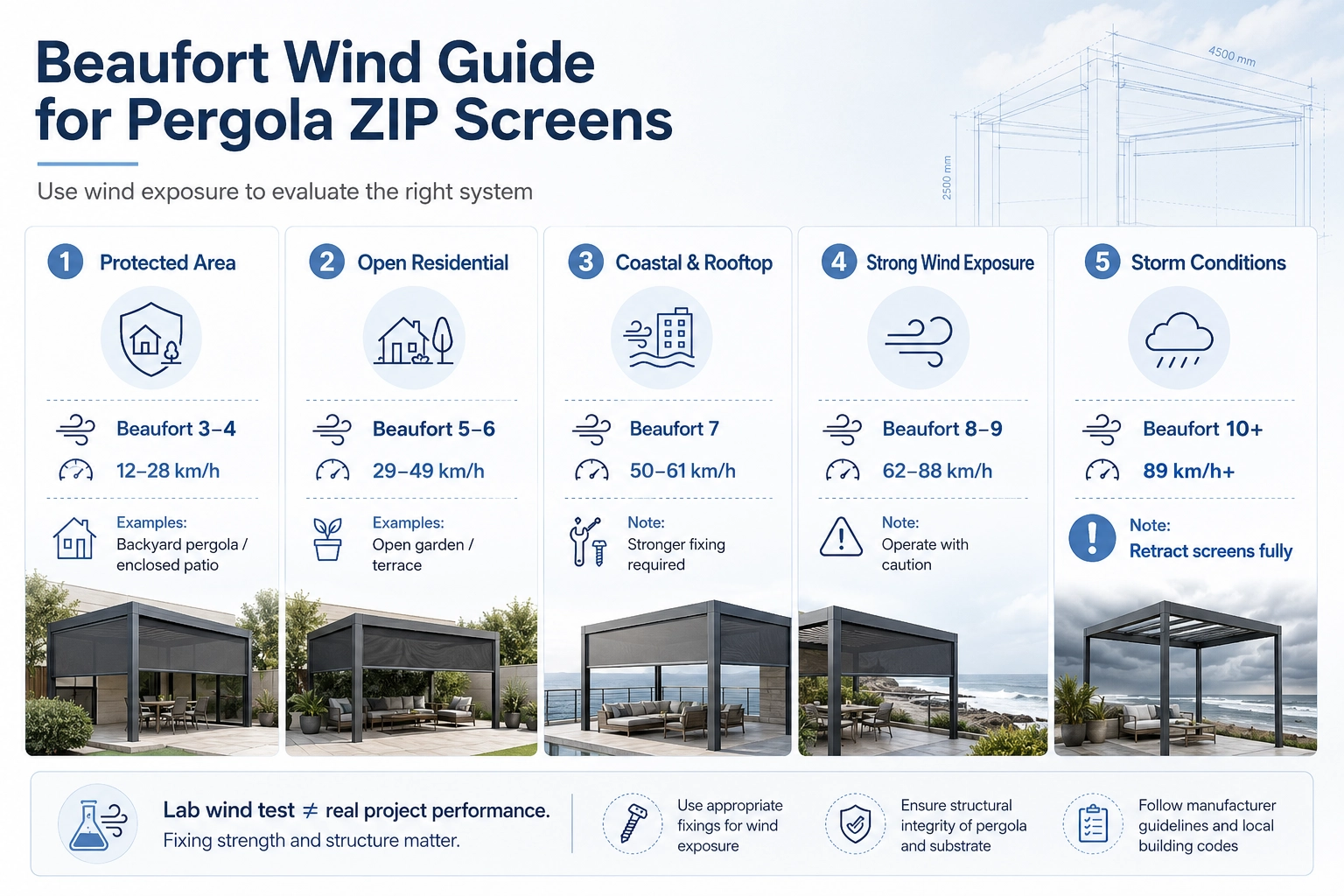
Protected Outdoor Area
Typical:
- backyard pergola
- enclosed patio
- garden surrounded by buildings
Wind reference:
Beaufort 3–4
Approx:
12–28 km/h
Typical requirement:
Standard ZIP Screen configuration.
Open Residential / Terrace Area
Typical:
- open garden
- exposed terrace
- suburban outdoor space
Wind reference:
Beaufort 5–6
Approx:
29–49 km/h
Typical requirement:
- correct screen sizing
- suitable guide structure
- proper fixing method
Coastal and Rooftop Applications
Typical:
- seaside property
- rooftop terrace
- open landscape
Wind reference:
Beaufort 7
Approx:
50–61 km/h
Consider:
- stronger fixing points
- corrosion-resistant components
Strong Wind Exposure
Typical:
- highly exposed coastal areas
- open rooftop projects
Wind reference:
Beaufort 8–9
Approx:
62–88 km/h
At this level:
- operation should be evaluated carefully
- supporting structure becomes critical
- screens should not be left extended during severe wind conditions
Storm Conditions
Beaufort:
10+
Approx:
89 km/h+
Outdoor screens should be fully retracted during severe weather.
ZIP Screen systems improve wind stability by controlling fabric movement, but they are not storm protection systems.
Why Test Data and Real Projects Can Differ
Laboratory wind tests measure system performance under controlled conditions.
Real installations are affected by:
- bracket strength
- pergola frame rigidity
- fixing surface
- installation accuracy
- wind turbulence around buildings
For example:
Two identical ZIP Screens installed on different pergola structures may perform differently.
The weakest point is often not the fabric.
It may be:
- the fixing connection
- the guide track attachment
- the supporting structure
Single ZIP Screen vs Connected System: When Do You Need More?
For smaller openings, a single screen is usually the simplest solution.
However, larger openings create additional mechanical challenges.
Increasing width increases:
- fabric tension
- roller tube load
- motor torque requirement
Single Screen System
Suitable for:
- residential pergolas
- smaller terraces
- standard openings
Advantages:
- simpler installation
- easier maintenance
- lower system complexity
Connected ZIP Screen System
Consider when:
- opening width becomes large
- wind exposure increases
- wider coverage is required
Advantages:
- distributes load
- improves stability
- supports larger applications
A wider opening does not always require a connected system.
Selection depends on:
- width
- height
- fabric type
- wind condition
- structure strength
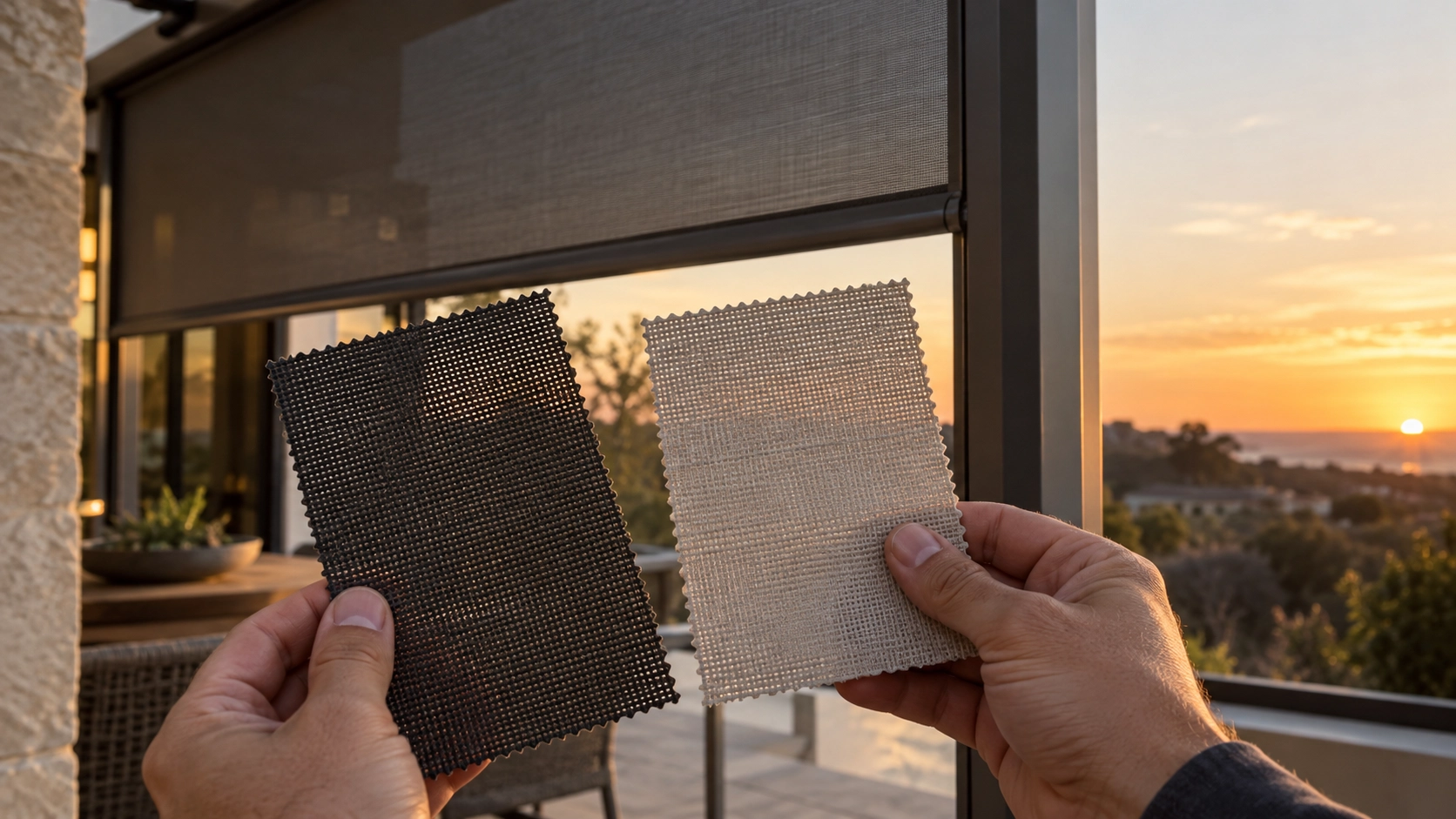
Fabric Selection: Choose Openness Factor Based on Climate and Usage
Fabric selection affects:
- heat control
- visibility
- privacy
- ventilation
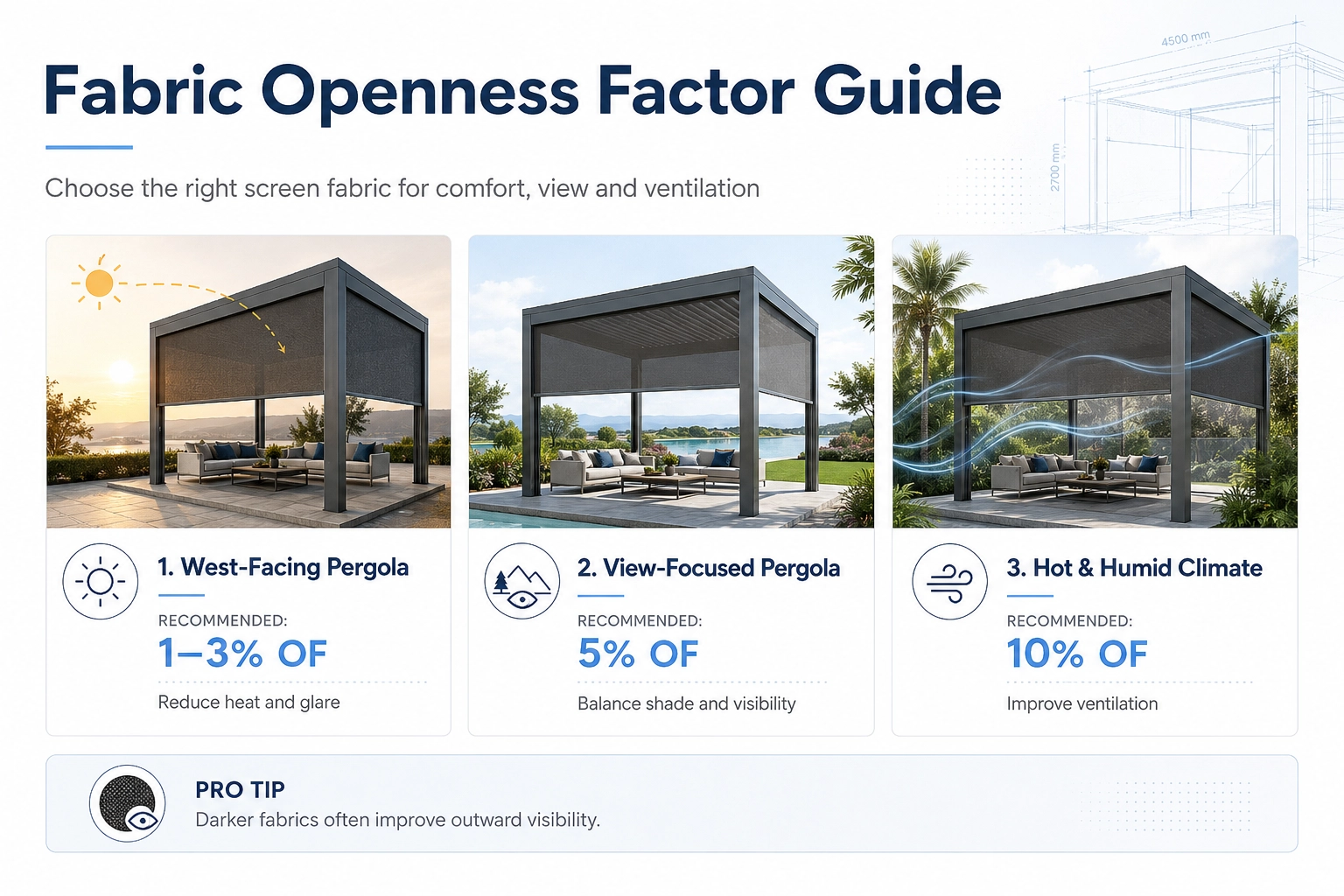
West-Facing Pergola
Problem:
Strong afternoon sunlight.
Recommended:
1–3% openness factor
Best for:
- reducing solar heat
- controlling glare
Landscape View Priority
Example:
- garden pergola
- pool area
Recommended:
5% openness factor
Provides:
- balanced shading
- better visibility
- privacy
Hot and Humid Climate
Recommended:
10% openness factor
Provides:
- improved airflow
- reduced heat accumulation
Fabric Material
Fiberglass-coated fabrics are widely used in outdoor ZIP Screens because they provide:
- dimensional stability
- low stretching
- better shape retention
- outdoor durability
The correct fabric depends on the environment, not only the appearance.
Motor Selection: Choose Control Based on Project Scale
Motor selection affects operation experience and automation.
It does not determine wind resistance.
1–2 Screens
Typical:
Residential pergola
Recommended:
- remote control motor
- individual operation
3–8 Screens
Typical:
Multi-side pergola enclosure
Recommended:
- group control
- synchronized operation
Possible systems:
- Somfy RTS
- io-homecontrol
Commercial Projects
Examples:
- restaurant
- hotel
- smart building
Requirements:
- multiple zones
- automation integration
Possible systems:
- KNX
- Zigbee gateway
- building management integration
Choose the protocol according to:
- number of screens
- automation requirements
- existing smart system
Real Cost Factors: What Actually Changes the Budget?
The final cost difference usually comes from system complexity, not only material quantity.
Larger Tube and Motor System
Cost impact:
High
Because larger systems require:
- stronger components
- higher torque motors
- additional engineering
Connected ZIP Screen System
Compared with the same-size single screen:
Typical increase:
Approximately 30–50% higher system cost
Reasons:
- additional guides
- extra components
- more installation work
Recessed Installation
Compared with surface mounting:
Typical impact:
20–40% higher installation complexity
Reasons:
- construction preparation
- accurate measurements
- additional labor
Solar Motor
Compared with wired motor:
Typical impact:
15–30% higher equipment cost
Main benefit:
- easier retrofit installation
- reduced wiring requirements
Coastal Protection
Cost impact:
Medium–High
Depending on:
- corrosion requirements
- material selection
- surface treatment
Real Installation Problems From Project Sites
Uneven Pergola Columns
A retrofit pergola may have alignment differences.
Example:
Two posts have a 15mm deviation.
If tracks are installed directly:
- fabric movement may become uneven
- bottom bar may not close correctly
- zipper engagement may be affected
Professional installation requires checking alignment before final fixing.
No Electrical Preparation
Many existing pergolas were not designed for motorized shading.
Solar motor systems provide a practical option when electrical wiring is difficult.
Uneven Ground
Outdoor floors often have small height differences.
Possible results:
- bottom gaps
- light leakage
- reduced sealing
Solutions include:
- bottom sealing design
- track adjustment
- correct installation positioning
Technical Information a ZIP Screen Supplier Should Provide
Before production, a professional supplier should provide:
System Drawing
Including:
- installation dimensions
- mounting position
- component layout
Technical Specification
Including:
- recommended size range
- tube information
- motor specification
- fabric options
Installation Guidance
Including:
- fixing requirements
- adjustment methods
- maintenance recommendations
A supplier should help evaluate the project, not only provide a product quotation.
NewHoo specializes in ZIP-guided windproof roller blind systems, supporting customized sizing, fabric selection and technical guidance for residential and commercial outdoor shading projects.
Conclusion: Select the System Before Selecting the Product
A successful pergola ZIP Screen project starts with correct system evaluation.
The final performance of an outdoor shading system is determined by the relationship between:
- opening size and structural capacity
- wind exposure and system configuration
- fabric performance and climate conditions
- motor control and daily operation requirements
- installation conditions and fixing methods
Choosing a ZIP Screen is not only about selecting a larger model or a higher specification. The right solution comes from matching each component with the actual project environment.
For contractors, dealers, and project owners, evaluating these factors before ordering can help reduce installation problems, avoid unnecessary upgrades, and improve long-term system reliability.
Need Help Selecting the Right ZIP Screen System?
Every pergola project has different requirements.
Share your project details with our technical team, including:
- opening width and height
- installation location
- wind exposure conditions
- pergola structure photos
- preferred control method
Our team can help evaluate the suitable ZIP Screen configuration, including system size, fabric selection, motor options, and installation considerations.
Contact NewHoo for a customized ZIP Screen solution for your outdoor shading project.
Can ZIP Screens Be Installed on Uneven or Out-of-Square Openings?
How to Choose Outdoor Blinds: A Practical Guide Based on Real Project Challenges
Related Article