How to Choose Outdoor Blinds: A Practical Guide Based on Real Project Challenges
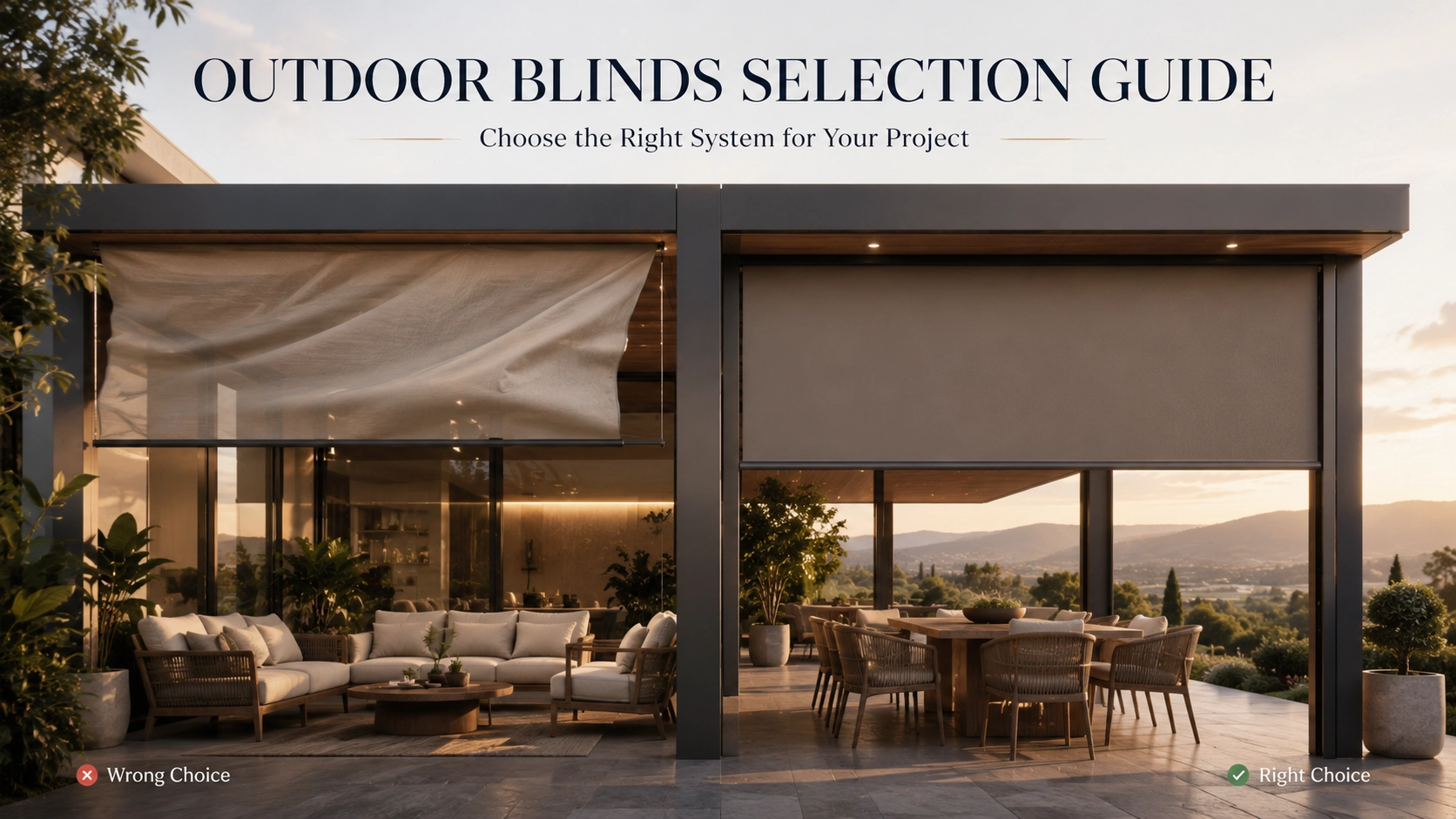
Why Outdoor Blind Selection Mistakes Usually Happen Before Installation
Many outdoor blind problems are not discovered during installation. They appear months later, after the system has been exposed to real weather conditions.
A blind may look suitable in a showroom, but fail when installed on:
- an open terrace with frequent wind;
- a large glass opening requiring a wide span;
- a pergola where appearance and structure must work together;
- an existing building with limited installation conditions.
Common problems include:
- excessive fabric movement;
- uneven rolling on wide openings;
- visible hardware affecting the building design;
- higher maintenance costs after installation.
In most cases, the issue is not simply product quality.
The bigger question is:
Was the blind system selected according to the actual project condition?
Before choosing an outdoor blind, professional installers usually evaluate four factors:
- Wind exposure
- Opening size
- Installation environment
- Architectural requirements
This guide explains the key decisions that help avoid common outdoor blind failures.
1. Wind Exposure: Choosing a System That Keeps Fabric Stable
When Wind Becomes the Main Problem
One common situation in outdoor projects is:
A customer selects a blind based on appearance and price, then installs it on an exposed terrace.
At the beginning, everything looks fine.
After months of outdoor use:
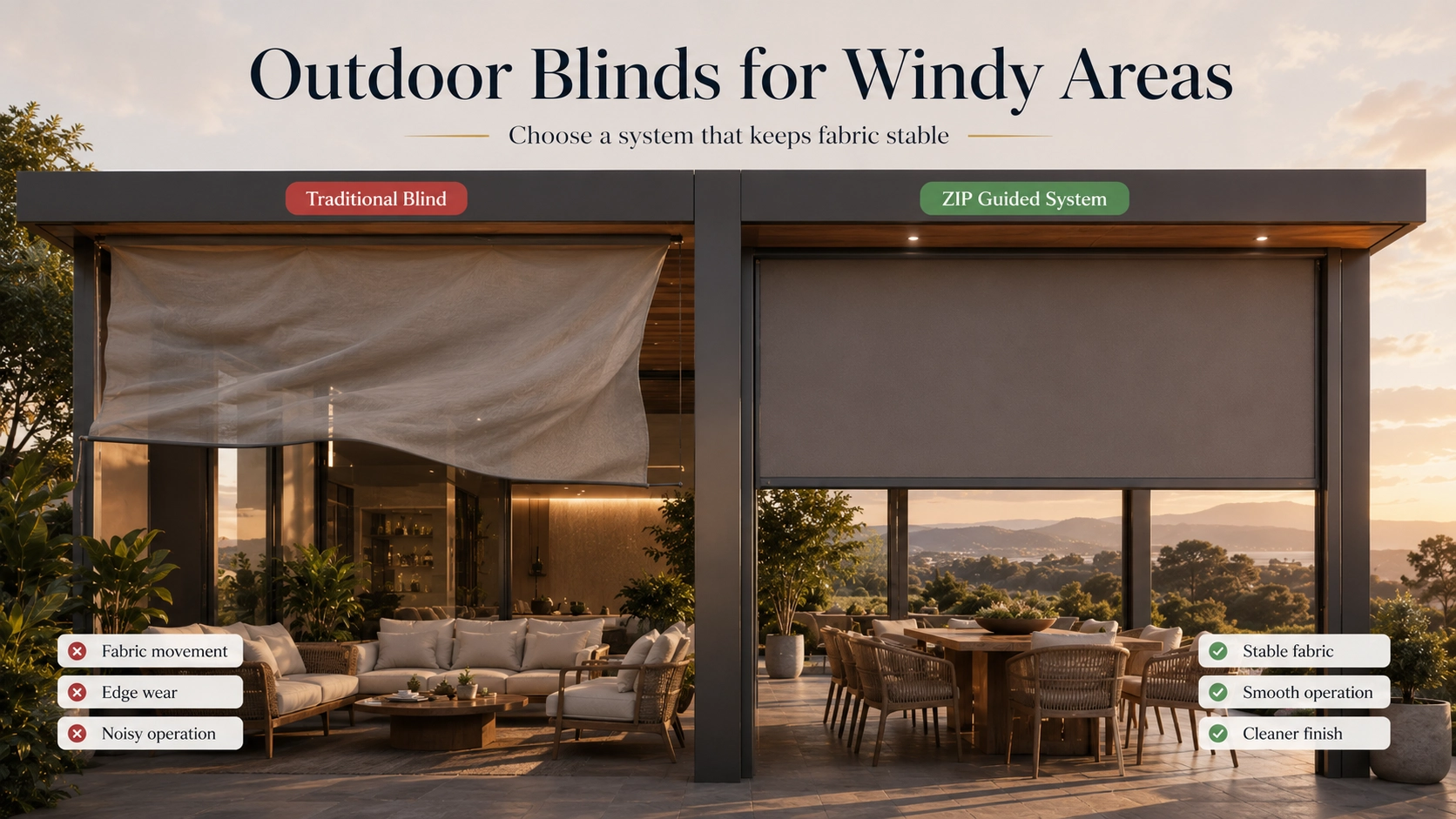
- the fabric moves excessively;
- operation becomes noisy;
- the edges experience repeated stress;
- maintenance becomes more frequent.
Many buyers initially think:
"The fabric quality is not good enough."
However, the problem is often related to how the fabric is controlled during operation.
Why Some Systems Struggle in Wind
When an outdoor blind is exposed to wind, uncontrolled fabric movement can gradually affect:
- fabric tension;
- operating smoothness;
- overall appearance.
This is especially common in:
- open balconies;
- rooftop terraces;
- coastal buildings;
- commercial outdoor areas.
For these applications, the blind needs more than a roller tube and fabric.
It requires a system that keeps the fabric positioned during movement.
ZIP Guided System: Why It Matters
A ZIP guided outdoor blind uses:
- zipper edges integrated into the fabric;
- side guide channels;
- continuous edge control.
The purpose is simple:
to reduce side movement and keep the fabric running smoothly inside the guide system.
This is why ZIP-guided systems are widely used for outdoor areas where wind exposure is a key concern.
NewHoo System Selection
WR100 Classic Windproof Roller Blind
For more protected residential applications, WR100 provides a compact solution.
Typical applications:
- residential balconies;
- sheltered patios;
- smaller outdoor openings.
It is suitable when the main requirement is practical outdoor shading with a compact structure.
WR120 ZIP Guided Outdoor Blind System
For more exposed outdoor areas, WR120 provides stronger fabric guidance.
Typical applications:
- villa terraces;
- open patios;
- outdoor living areas.
The reason to choose WR120 is not only the opening size, but the need for better fabric stability during daily operation.
WR150 Series
For larger outdoor applications, WR150 is considered when the project requires a stronger system configuration.
Typical applications:
- restaurants;
- commercial terraces;
- larger outdoor spaces.
2. Large Openings: Avoiding Smile Line and Uneven Rolling
The Mistake: Maximum Width Is Not Always the Best Solution
A common question from project buyers is:
"What is the maximum width you can make?"
However, maximum manufacturing size does not always equal the best long-term performance.
As the blind becomes wider, the system faces greater challenges:
- longer roller span;
- increased load in the center area;
- reduced fabric tension control.
Understanding the Smile Line Problem
One of the most common issues with oversized blinds is the Smile Line effect.
When the roller tube becomes longer, even small deformation in the center section can become visible after the fabric is installed.
The result:
- the middle area appears lower;
- fabric tension becomes uneven;
- wrinkles become more noticeable;
- the blind appearance declines over time.
This is why a large blind should not simply be treated as a larger version of a small blind.
The system configuration needs to match the opening requirement.
Failure Example: Oversized Single Blind
A commercial project selected one large blind to reduce the number of sections.
After installation:
The appearance was acceptable at first.
Later:
- the center section developed visible sagging;
- the fabric no longer rolled evenly;
- the final appearance did not meet expectations.
The issue was not the size of the opening.
The problem was selecting a system without considering long-term fabric tension.
NewHoo System Selection
WR120 Series
Suitable for medium-size openings where balanced performance is required.
Applications:
- residential patios;
- villa outdoor spaces.
WR150 Series
Suitable for larger terraces where stronger support is required.
Applications:
- commercial outdoor areas;
- larger residential projects.
WR160-190 Heavy Duty System
For extra-wide applications, the priority becomes maintaining stable operation across the entire opening.
Applications:
- large glass facades;
- commercial projects;
- wide outdoor openings.
3. Pergola Projects: Why Installation Integration Matters
A Pergola Is Different From a Normal Wall Installation
A pergola project is not simply about adding a blind to an opening.
The blind needs to work together with:
- pergola posts;
- structural positions;
- fixing points;
- overall appearance.
A standard outdoor blind may operate correctly but still create installation problems:
- visible brackets;
- poor alignment with pergola structures;
- hardware appearing added afterward.
What Should Be Considered for Pergola Applications?
Before selecting a system, installers should consider:
- where the blind will be fixed;
- how the side guides align with the structure;
- whether the installation matches the pergola design.
NewHoo Solution
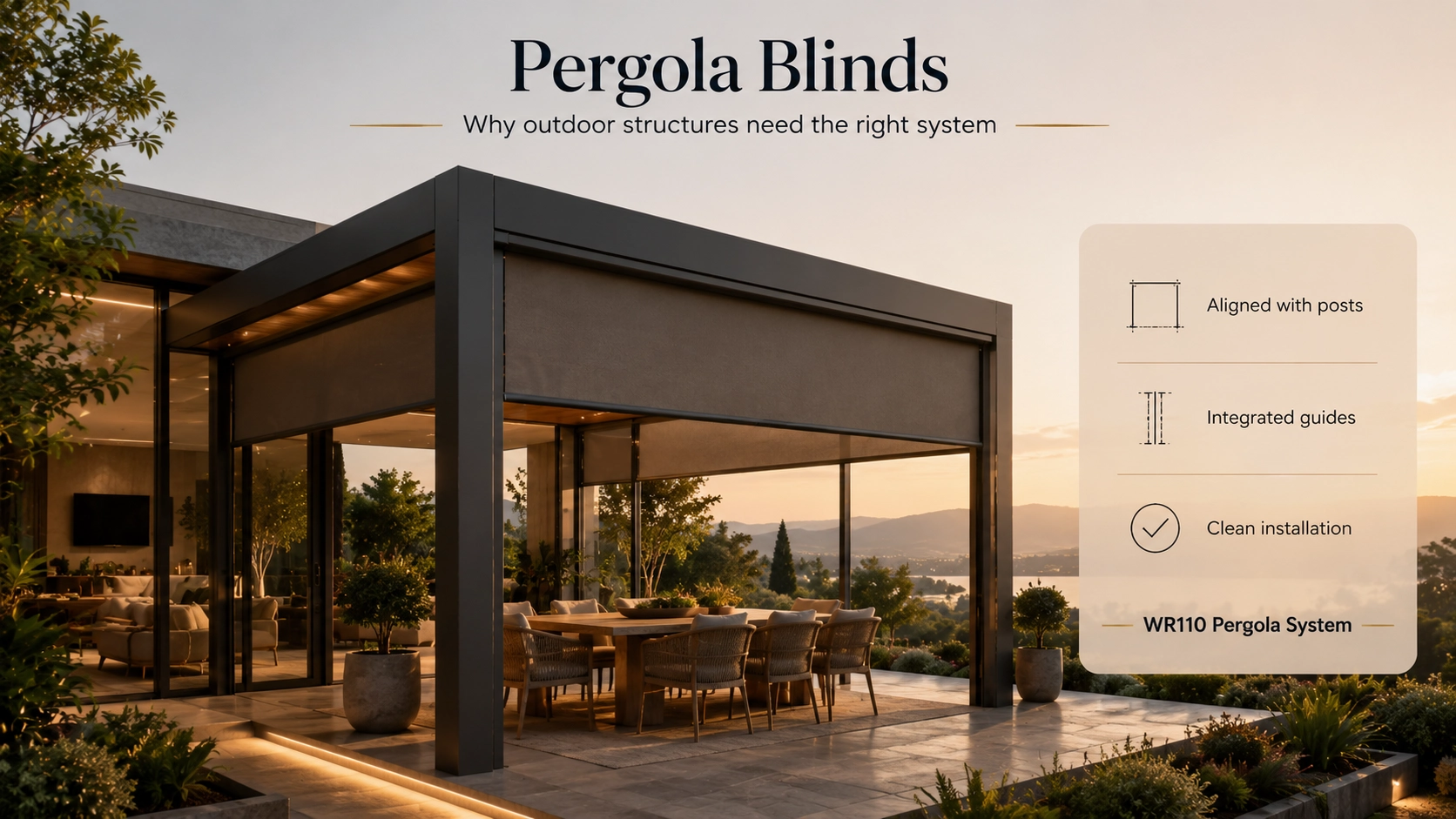
WR110 Pergola Windproof Roller Blind
WR110 is designed for outdoor structures such as:
- pergolas;
- outdoor rooms;
- garden structures.
It is selected when the project requires better integration between the blind system and the pergola structure.
4. New Construction vs Retrofit: Two Different Installation Decisions
The correct blind system also depends on when and where it will be installed.
New Construction Projects
New buildings provide more planning flexibility.
The project can reserve:
- concealed installation space;
- electrical wiring;
- mounting positions.
For modern architectural projects, concealed installation is often preferred.
Concealed Outdoor Blind Solution
Suitable for:
- luxury villas;
- modern residential projects;
- architectural applications.
Advantages:
- reduced visible hardware;
- cleaner appearance;
- easier integration during construction.
Retrofit Projects
Existing buildings create different challenges:
- no reserved wiring;
- uneven installation surfaces;
- limited modification possibilities.
In these projects, the system must adapt to the building condition.
Adjustable Side Track System
Useful for:
- renovation projects;
- uneven walls;
- customized openings.
It helps installers manage real installation differences and improve alignment.
Solar Motor System
For locations without available electrical wiring, solar operation provides a practical option.
Suitable for:
- existing patios;
- pergolas;
- garden structures.
Benefits:
- avoids additional electrical work;
- simplifies installation;
- improves retrofit flexibility.
3-Step Outdoor Blind Selection Checklist
Before requesting a quotation, prepare these details.
Step 1: Measure the Opening
Provide:
✓ Width
✓ Height
✓ Number of openings
Step 2: Evaluate the Environment
Check:
✓ Wind exposure
✓ Open or protected location
✓ Residential or commercial use
Step 3: Confirm Installation Conditions
Determine:
✓ New construction or retrofit
✓ Concealed or visible installation
✓ Power availability
✓ Manual or motorized operation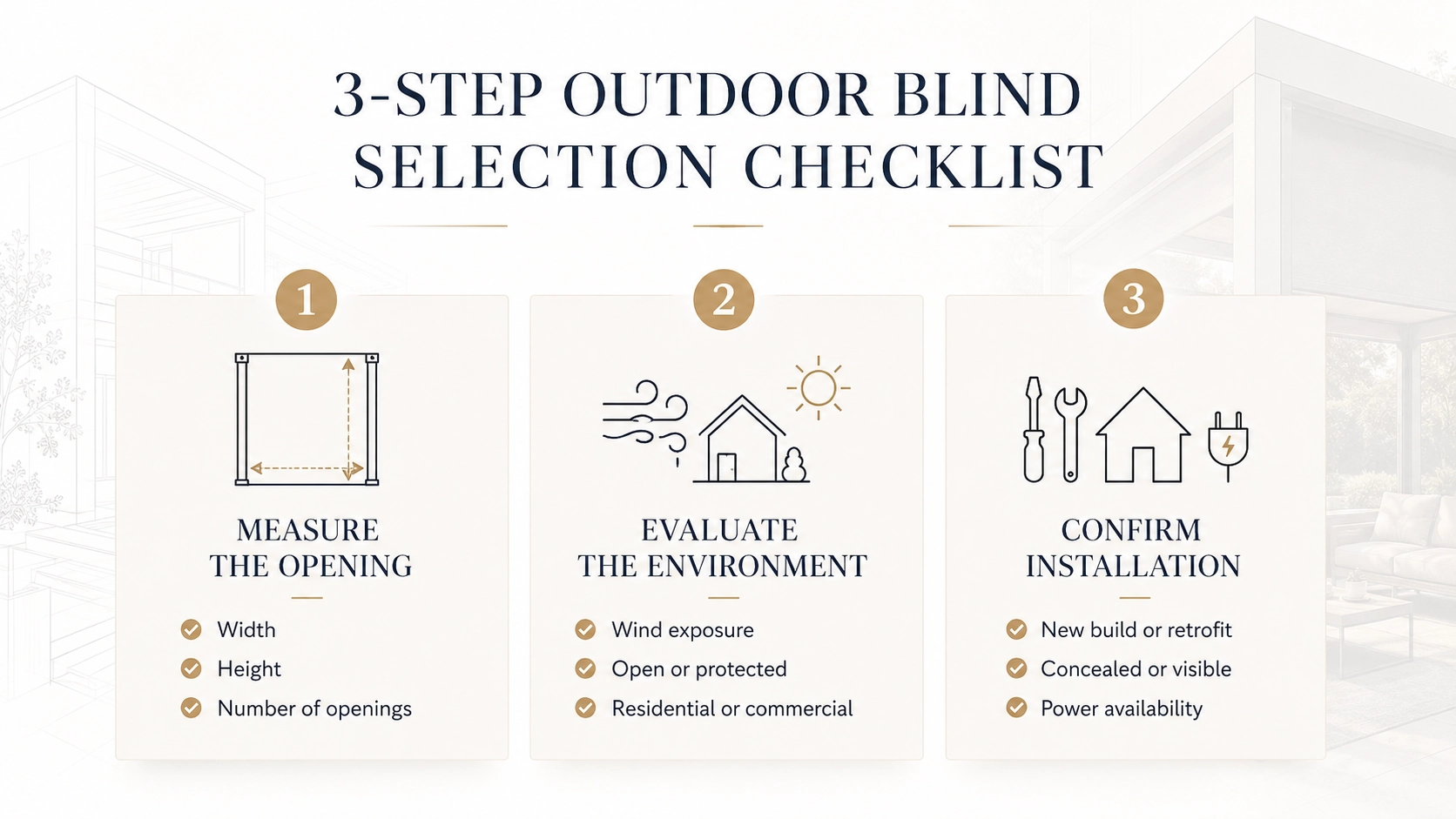
NewHoo Outdoor Blind Selection Guide
| Project Condition | Main Concern | Recommended System |
|---|---|---|
| Protected residential area | Compact outdoor shading | WR100 |
| Wind exposed terrace | Fabric stability | WR120 ZIP System |
| Pergola project | Structure integration | WR110 |
| Large terrace | Larger opening requirement | WR150 |
| Extra-wide opening | Sagging control | WR160-190 |
| Modern architectural design | Hidden installation | Concealed System |
| Retrofit project | Limited wiring | Solar Motor + Adjustable Track |
Before Requesting a Quote
To recommend the right outdoor blind system, prepare:
- Opening dimensions
- Installation photos
- Wind exposure conditions
- New construction or retrofit status
- Power availability
With this information, a supplier can recommend a system based on the real project requirements instead of simply matching a product size.
Conclusion
Choosing outdoor blinds is not about selecting the largest system or the lowest-cost option.
The right choice depends on whether the system matches:
- the installation environment;
- the opening size;
- the structure requirements;
- the future maintenance expectations.
Before selecting fabric colors or appearance, evaluate the project conditions first.
A properly selected system can reduce installation problems, avoid premature maintenance, and provide reliable outdoor shading performance.
NewHoo helps residential, commercial, and architectural projects select outdoor blind solutions based on real application requirements.
Pergola ZIP Screen Selection Guide: How to Choose the Right System Based on Size, Wind, Fabric and Motor Configuration
How Do Windproof Roller Blinds Resist Wind—and Why Do ZIP Tracks Jam?
Related Article